
[论文解读] Knowledge-guided Machine Learning: Current Trends and Future Prospects
对 KGML 的综述,概述如何在 ML 中整合科学知识和数据,以提高泛化性、一致性和可解释性,采用三维分类并探讨方法与用例。
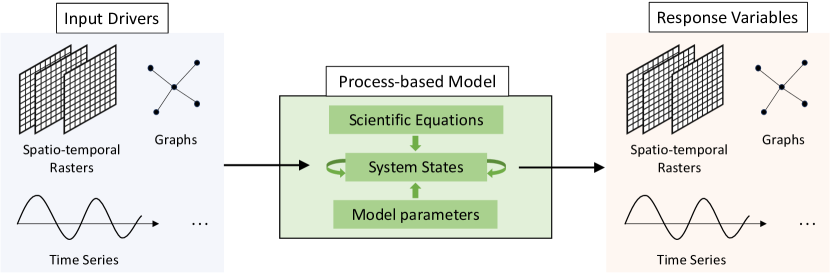
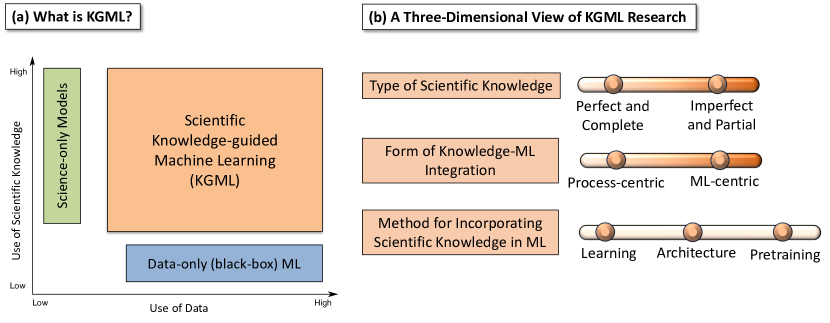
This paper presents an overview of scientific modeling and discusses the complementary strengths and weaknesses of ML methods for scientific modeling in comparison to process-based models. It also provides an introduction to the current state of research in the emerging field of scientific knowledge-guided machine learning (KGML) that aims to use both scientific knowledge and data in ML frameworks to achieve better generalizability, scientific consistency, and explainability of results. We discuss different facets of KGML research in terms of the type of scientific knowledge used, the form of knowledge-ML integration explored, and the method for incorporating scientific knowledge in ML. We also discuss some of the common categories of use cases in environmental sciences where KGML methods are being developed, using illustrative examples in each category.
研究动机与目标
- 介绍科学建模领域和 KGML。
- 比较基于过程的模型与 ML 方法并讨论它们的互补性。
- 提出一个三维的 KGML 框架(知识类型、整合形式、融入方法)。
- 描述环境科学中的主要 KGML 方法和用例。
- 强调未来方向与机会,包括环境科学中的基础模型。
提出的方法
- 描述基于过程的模型与 ML 模型在科学建模中的优缺点。
- 提出一个三维 KGML 分类:知识类型、整合形式和融入方法。
- 总结三种主要的 KGML 整合方法:知识引导学习、体系架构和预训练/初始化。
- 提供示例并参考关键 KGML 工作(如 PGNN、PINNs、PGRNN、PGA-LSTM)。
- 讨论在前向建模、反向建模、生成建模和尺度下放中的用例。
- 强调机会,如基础模型以及未来研究方向。
实验结果
研究问题
- RQ1KGML 中使用的科学知识类型有哪些,部分知识与完整知识如何影响建模?
- RQ2存在哪些知识-ML 集成形式,它们有何不同(以 ML 为中心 vs 以过程为中心)?
- RQ3用于将科学知识融入 ML 模型的方法有哪些(学习、架构、预训练)?
- RQ4环境科学中的主要 KGML 用例有哪些,未来研究的机会有哪些?
- RQ5KGML 如何促进环境科学中的基础模型?
主要发现
- 与黑箱 ML 相比,KGML 将科学知识与数据结合,以提高泛化性和科学一致性。
- KGML 可以在三个维度上进行分类:知识类型、知识-ML 整合形式和融入方法。
- 存在三种主要的融入方法:知识引导学习(损失函数)、知识引导的架构,以及知识引导的预训练/初始化。
- KGML 方法的示例包括 PINNs、PGNNs、PGRNN、PGA-LSTM 和子网格参数化,展示了以 ML 为中心和以过程为中心的方法。
- KGML 的用例覆盖环境科学中的前向建模、反演建模、生成建模和尺度下放。
- 该领域正向着环境科学中的基础模型发展,为广泛、可迁移的知识带来机会。
阅读本论文
在 Nubint 阅读器中打开原文,边读边就任意段落提问。
在 Nubint 中阅读本论文本解读由 AI 根据论文原文生成,引用前请核对原文。