
[论文解读] Koopman Operators in Robot Learning
本文综述了机器人领域的Koopman算子理论,提供了带可执行代码的实用教程,并讨论了在多种机器人平台上使用EDMD及相关方法的数据驱动建模、状态估计与控制。
Koopman operator theory offers a rigorous treatment of dynamics and has been emerging as an alternative modeling and learning-based control method across various robotics sub-domains. Due to its ability to represent nonlinear dynamics as a linear (but higher-dimensional) operator, Koopman theory offers a fresh lens through which to understand and tackle the modeling and control of complex robotic systems. Moreover, it enables incremental updates and is computationally inexpensive, thus making it particularly appealing for real-time applications and online active learning. This review delves deeply into the foundations of Koopman operator theory and systematically builds a bridge from theoretical principles to practical robotic applications. We begin by explaining the mathematical underpinnings of the Koopman framework and discussing approximation approaches for incorporating inputs into Koopman-based modeling. Foundational considerations, such as data collection strategies as well as the design of lifting functions for effective system embedding, are also discussed. We then explore how Koopman-based models serve as a unifying tool for a range of robotics tasks, including model-based control, real-time state estimation, and motion planning. The review proceeds to a survey of cutting-edge research that demonstrates the versatility and growing impact of Koopman methods across diverse robotics sub-domains: from aerial and legged platforms to manipulators, soft-bodied systems, and multi-agent networks. A presentation of more advanced theoretical topics, necessary to push forward the overall framework, is included. Finally, we reflect on some key open challenges that remain and articulate future research directions that will shape the next phase of Koopman-inspired robotics. To support practical adoption, we provide a hands-on tutorial with executable code at https://shorturl.at/ouE59.
研究动机与目标
- 在较少数据下推动在新环境中运行的机器人进行运行时学习。
- 将Koopman算子理论呈现为一个数据高效、可解释、线性表示的非线性机器人动力学框架。
- 综述并综合使用Koopman算子在机器人领域的最新算法和应用进展。
- 提供实用的教程和可执行代码,帮助从业者实现基于Koopman的建模与控制。
提出的方法
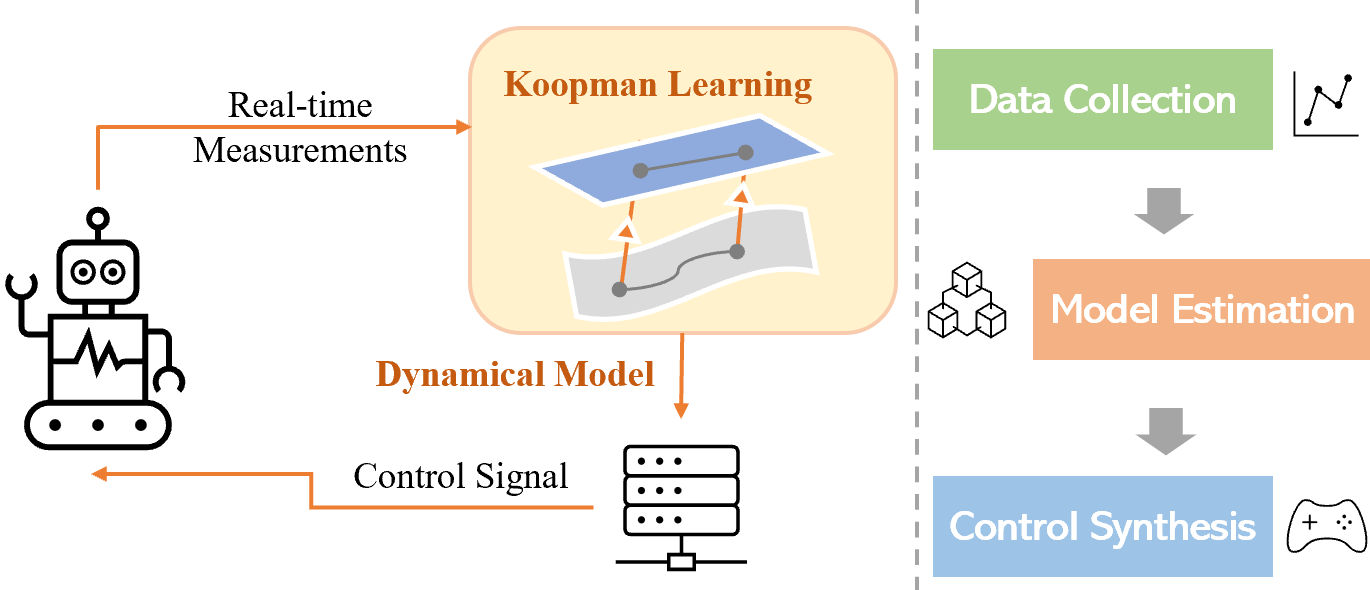
- 解释Koopman算子概念以及将状态提升到非线性动力学变为线性的一步。
- 引入有限维不变量子空间及EDMD方法以从数据近似Koopman算子。
- 讨论在Koopman基建模中处理输入和控制的方法,以及如何扩展状态或使用双线性形式。
- 概述为Koopman基控制器进行数据收集、提升函数选择、算子估计和稳定性考虑。
- 描述如何在Koopman模型之上构建线性控制器(如LQR)或非线性MPC。
实验结果
研究问题
- RQ1Koopman算子理论如何实现非线性机器人系统的运行时、数据高效学习?
- RQ2在机器人领域,哪些数据驱动方法(如EDMD)可以从有限数据近似Koopman算子?
- RQ3在机器人应用中应如何选择提升字典以在精度和维度之间取得平衡?
- RQ4如何将输入和控制信号纳入Koopman基建模与控制框架?
- RQ5在Koopman基机器人系统中,数据收集、模型训练与控制器设计的实际工作流是什么?
主要发现
- Koopman算子提供了非线性机器人动力学的线性表示,使得线性控制工具(如LQR)成为可能。
- 数据高效的学习是可能的,因为EDMD及相关方法能从稀疏数据近似算子,支持在线更新。
- 该方法具有可解释性,并通过算子理论属性和特征结构分析潜在提供稳定性保证。
- 基于EDMD的预测器在所选字典内近似Koopman作用,且在某些条件下随着字典大小增加具有收敛性。
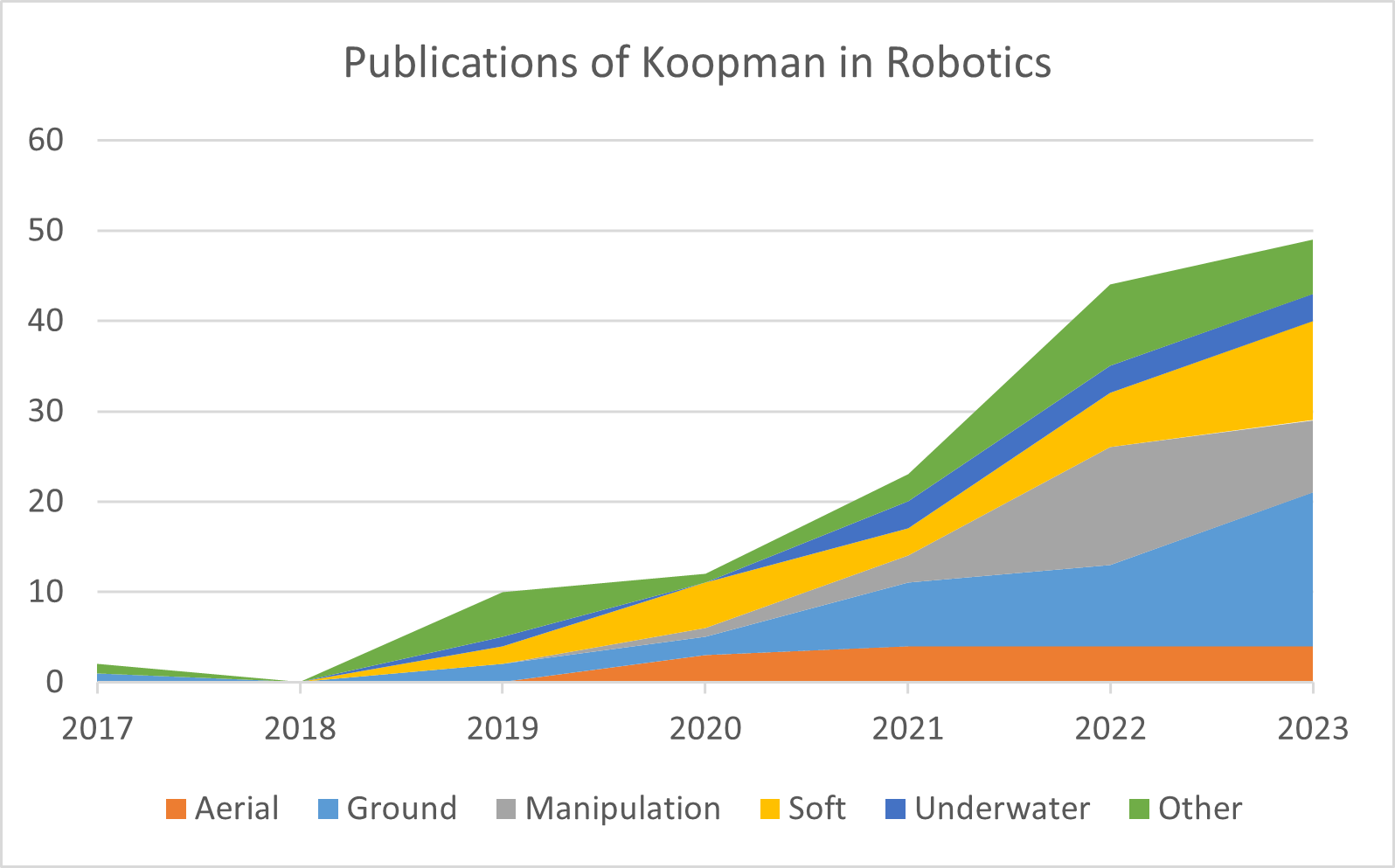
- 该综述覆盖广泛的机器人平台(航空、步行、轮式、水下、软体、机械手),并讨论实用教程、代码与实现指南。
- 该框架通过整合数据采集、模型学习与控制合成步骤,支持运行时学习和实时控制。
阅读本论文
在 Nubint 阅读器中打开原文,边读边就任意段落提问。
在 Nubint 中阅读本论文本解读由 AI 根据论文原文生成,引用前请核对原文。