
[论文解读] Krylov Complexity in Lifshitz-type Scalar Field Theories
本文研究了在有限温度下具有整数动力学指数 $z$ 的自由 Lifshitz 标量场论中的 Lanczos 系数与 Krylov 复杂度。尽管具有非相对论性标度,Lanczos 系数在晚期时间仍表现出普遍的线性增长,导致 K-复杂度呈指数增长,其斜率为 $2/\pi\beta$,且与 $z$ 无关;而质量与紫外截断则会改变行为,K-复杂度与 K-熵在有限尺寸效应下表现出不同的标度特性。
We investigate various aspects of the Lanczos coefficients in a family of free Lifshitz scalar theories, characterized by their integer dynamical exponent, at finite temperature. In this non-relativistic setup, we examine the effects of mass, finite ultraviolet cutoff, and finite lattice spacing on the behavior of the Lanczos coefficients. We also investigate the effect of the dynamical exponent on the asymptotic behavior of the Lanczos coefficients, which show a universal scaling behavior. We carefully examine how these results can affect different measures in Krylov space, including Krylov complexity and entropy. Remarkably, we find that our results are similar to those previously observed in the literature for relativistic theories.
研究动机与目标
- 理解具有整数动力学指数 $z$ 的非相对论性 Lifshitz 型标量场论中 Lanczos 系数的行为。
- 研究质量、有限紫外截断与晶格间距如何影响这些理论中的 Krylov 复杂度与熵。
- 检验在非相对论性设置下普遍算符增长假说的普适性。
- 将结果与相对论性模型进行比较,评估 K-复杂度与 K-熵在不同临界指数与质量区域是否表现出相似的标度行为。
提出的方法
- 应用 Lanczos 算法,通过哈密顿量与局部算符的嵌套对易子构建 Krylov 基。
- 在 Lifshitz 标量理论的连续与离散版本中,数值计算 Lanczos 系数 $b_n$。
- 通过热密度矩阵引入有限温度效应,并从 Krylov 基中算符的时间演化计算 Krylov 复杂度 $K_{\mathcal{O}}(t)$。
- 从算符在 Krylov 基中展开系数的概率分布计算 K-熵 $S_{\mathcal{O}}(t)$。
- 引入硬紫外截断与有限晶格间距以正则化连续场论,并研究其对 Lanczos 系数饱和与复杂度增长的影响。
- 在不同 $z$、质量 $m$ 与温度 $\beta^{-1}$ 下进行数值模拟,以提取标度行为与渐近趋势。
实验结果
研究问题
- RQ1在有限温度下,具有整数动力学指数 $z$ 的自由 Lifshitz 标量场论中,Lanczos 系数如何演化?
- RQ2在非相对论性、标度不变的场论中,普遍算符增长假说——即 $b_n$ 的线性增长——是否成立?
- RQ3质量与有限紫外截断如何改变 Krylov 复杂度与 K-熵的渐近行为?
- RQ4在有限尺寸效应下,Lifshitz 理论中 K-复杂度与 K-熵之间存在何种关系?
- RQ5Krylov 复杂度的观测行为在不同 $z$ 值下是否具有普适性,还是临界指数显著改变动力学?
主要发现
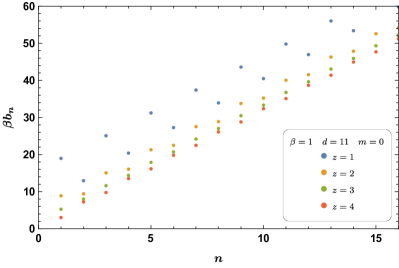
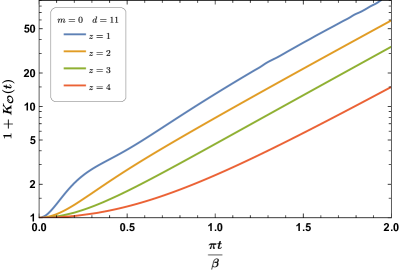
- 在无质量连续情况下,Lanczos 系数 $b_n$ 随 $n$ 线性增长,其斜率与 $z$ 无关,K-复杂度表现出指数增长,晚期时间的指数为 $\lambda = 2\pi/\beta$,且与 $z$ 无关。
- K-方差在晚期时间趋于常数,且随 $z$ 增大而减小,表明高 $z$ 理论中量子噪声降低。
- 对于有质量理论,$b_n$ 的斜率受 $\pi/\beta$(无质量极限)限制,并随质量单调减小,而奇偶振荡随 $z$ 增大而增强,且与 $m^z$ 成正比。
- 引入硬紫外截断后,Lanczos 系数初始线性增长,随后饱和,导致 K-复杂度在晚期时间由指数增长转为线性增长。
- K-熵在饱和阶段表现出近似对数增长,与线性复杂度增长一致,数值上满足 $1 + K_{\mathcal{O}}(t) \sim e^{a S_{\mathcal{O}}(t)}$ 且 $a < 1$,但该关系并非普适。
- K-复杂度与 K-熵的行为在无质量和有质量情况下定性相似,二者均随 $z$ 或 $m$ 增大而减小,反映出量子涨落长度的减小。
阅读本论文
在 Nubint 阅读器中打开原文,边读边就任意段落提问。
在 Nubint 中阅读本论文本解读由 AI 根据论文原文生成,引用前请核对原文。