
[论文解读] KS-GNNExplainer: Global Model Interpretation Through Instance Explanations On Histopathology images
KS-GNNExplainer 是一种新颖的模型级图神经网络解释器,专为组织病理学图像设计,通过引入成对子图相似性与基于柯尔莫哥洛夫-斯米尔诺夫(KS)检验的目标函数,增强了如 GNNExplainer 等实例级解释器的全局模式提取能力。该方法在多个样本中有效识别出一致且具有临床意义的子结构(如淋巴血管侵犯),显著提升了癌症诊断中的忠实度与可解释性。
Instance-level graph neural network explainers have proven beneficial for explaining such networks on histopathology images. However, there has been few methods that provide model explanations, which are common patterns among samples within the same class. We envision that graph-based histopathological image analysis can benefit significantly from such explanations. On the other hand, current model-level explainers are based on graph generation methods that are not applicable in this domain because of no corresponding image for their generated graphs in real world. Therefore, such explanations are communicable to the experts. To follow this vision, we developed KS-GNNExplainer, the first instance-level graph neural network explainer that leverages current instance-level approaches in an effective manner to provide more informative and reliable explainable outputs, which are crucial for applied AI in the health domain. Our experiments on various datasets, and based on both quantitative and qualitative measures, demonstrate that the proposed explainer is capable of being a global pattern extractor, which is a fundamental limitation of current instance-level approaches in this domain.
研究动机与目标
- 解决基于图神经网络(GNN)的组织病理学图像分析中缺乏能够跨多个样本提取一致、类别级模式的全局模型级解释器的问题。
- 通过实现模型级解释,克服实例级解释器无法识别相似样本间共享子结构的局限性。
- 提出一个基于柯尔莫哥洛夫-斯米尔诺夫(KS)检验的基准框架,客观评估解释器有效性,依据节点重要性移除进行评估。
- 将实例级可解释性(通过 GNNExplainer 实现)与通过子图相似性及 KS 分数优化实现的全局模式发现相结合,构建统一的目标函数。
提出的方法
- 提出一个基准框架,通过迭代移除解释分数中最重要的和最不重要的节点,随后对标签变化的累积分布应用 KS 检验,以评估解释器性能。
- 提出一种新型模型级解释目标函数,包含三个组成部分:(1) 对原始 GNN 预测的保真度,(2) 同一类样本中子图嵌入的成对余弦相似度,(3) 跨样本的 KS 检验统计量之和。
- 通过正则化损失函数最小化样本间 KS 分数的方差,确保模式检测的一致性与可靠性,其中引入超参数 λ₁、λ₂ 和 λ₃。
- 使用 HACT-Net 从基于核分割(通过 Hover-Net 获得)的细胞图中生成固定大小的图嵌入,支持基于 GNN 的分类与解释。
- 以 GNNExplainer 框架为基础,扩展其能力以在一批同类别样本中生成最大化 KS 分数与子图相似度的子图。
- 采用多阶段优化流程,识别出在局部忠实性与跨相似组织病理学病例的全局一致性方面均表现优异的子图。
实验结果
研究问题
- RQ1能否通过利用实例级解释方法,有效设计出适用于组织病理学中 GNN 的模型级解释器?
- RQ2如何在多个样本上客观衡量基于图的解释的忠实度与一致性?
- RQ3引入子图相似性与基于 KS 检验的评估在多大程度上提升了 GNN 解释的可靠性与临床相关性?
- RQ4与现有解释器相比,所提出的损失函数在检测生物上具有意义的模式(如淋巴血管侵犯)方面是否具有优势?
主要发现
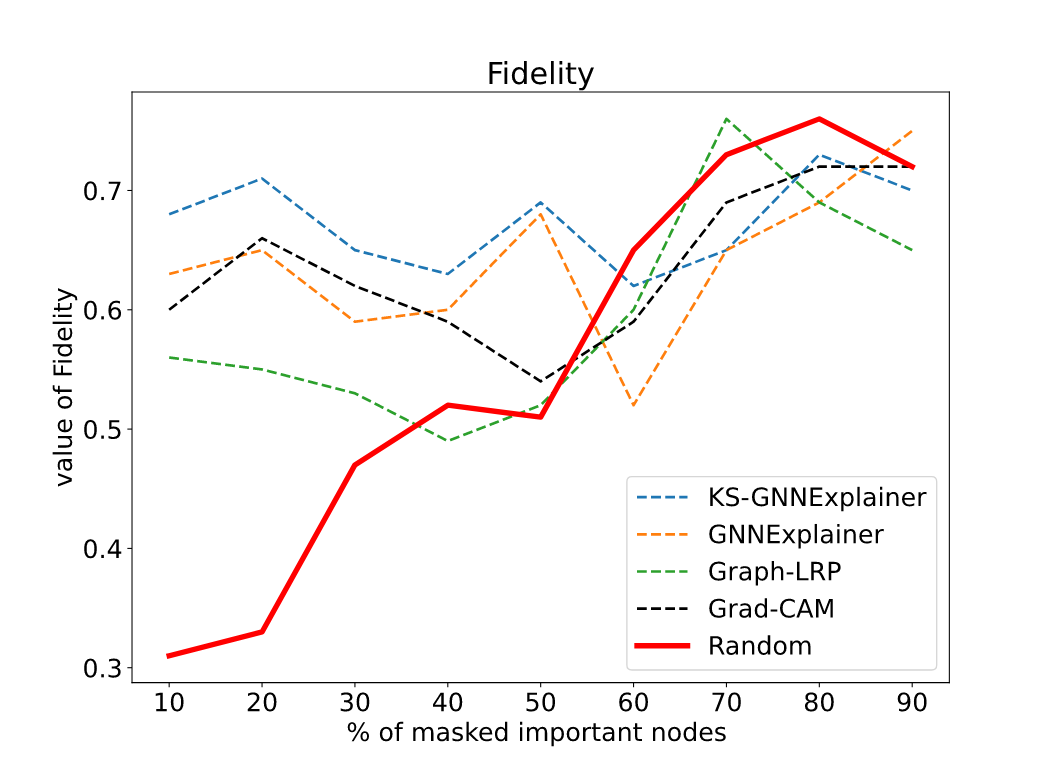
- 在 BreCaHAD 数据集上,KS-GNNExplainer 在肿瘤与非肿瘤核分类任务中取得了 0.697 的宏平均 F1 分数,优于 GNNExplainer(0.687)、GraphLRP(0.489)和 Grad-CAM(0.549)。
- 在 BRACS 数据集上,KS-GNNExplainer 的 Fidelity 得分为 0.63,显著高于无 KS 项的消融版本(0.28),证明了 KS 检验在性能中的关键作用。
- 消融研究显示,移除 KS 检验组件后,BRACS 上 Fidelity 下降 0.35,BACH 上下降 0.36,证实其对提升解释可靠性的重要性。
- 引入成对子图相似性(项 P)使 BACH 上 Fidelity 提升 0.19,BRACS 上提升 0.23,表明一致的子图结构可增强模型可解释性。
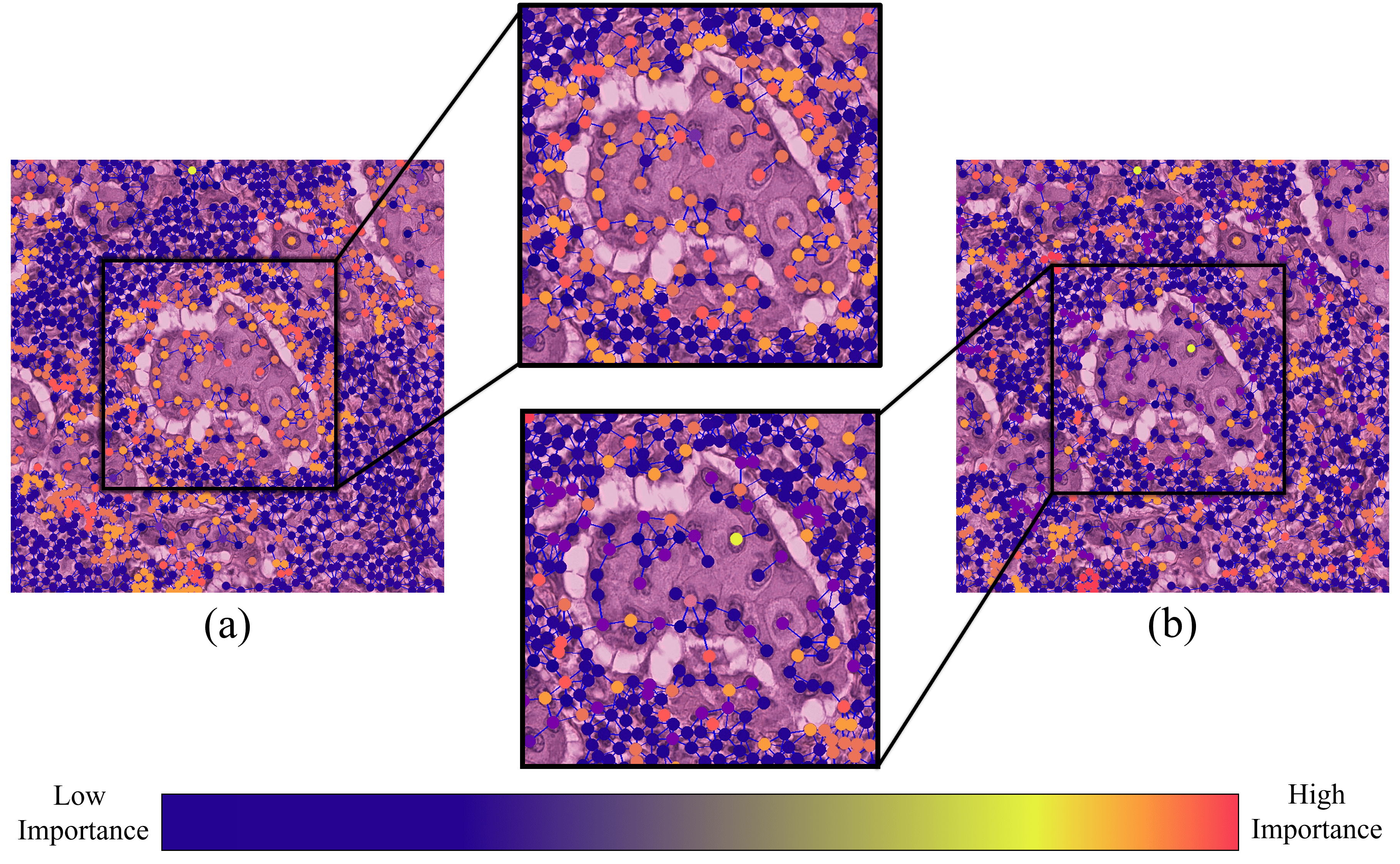
- 定性结果表明,KS-GNNExplainer 更有效地突出导管原位癌(DCIS)病例中的淋巴血管侵犯区域,且病理学家确认其更优地整合了关键诊断特征。
- 在包含 KS 求和与方差项时,Fidelity 提升了 0.16–0.18,表明样本间均匀且高 KS 分数是实现稳健全局解释的关键。
阅读本论文
在 Nubint 阅读器中打开原文,边读边就任意段落提问。
在 Nubint 中阅读本论文本解读由 AI 根据论文原文生成,引用前请核对原文。