
[论文解读] Label-Retrieval-Augmented Diffusion Models for Learning from Noisy Labels
这篇论文将从嘈杂标签学习重新表述为一个随机条件标签生成问题,并引入 LRA-diffusion,它利用带邻居标签检索和预训练编码器(如 CLIP、SimCLR)的扩散模型,在嘈杂标签基准上实现了最先进的性能。
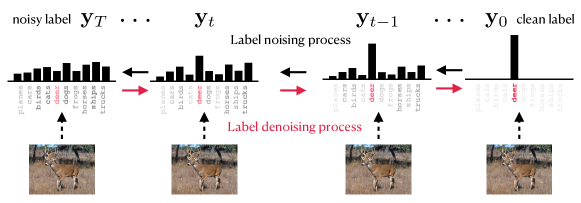
Learning from noisy labels is an important and long-standing problem in machine learning for real applications. One of the main research lines focuses on learning a label corrector to purify potential noisy labels. However, these methods typically rely on strict assumptions and are limited to certain types of label noise. In this paper, we reformulate the label-noise problem from a generative-model perspective, $ extit{i.e.}$, labels are generated by gradually refining an initial random guess. This new perspective immediately enables existing powerful diffusion models to seamlessly learn the stochastic generative process. Once the generative uncertainty is modeled, we can perform classification inference using maximum likelihood estimation of labels. To mitigate the impact of noisy labels, we propose the $ extbf{L}$abel-$ extbf{R}$etrieval-$ extbf{A}$ugmented (LRA) diffusion model, which leverages neighbor consistency to effectively construct pseudo-clean labels for diffusion training. Our model is flexible and general, allowing easy incorporation of different types of conditional information, $ extit{e.g.}$, use of pre-trained models, to further boost model performance. Extensive experiments are conducted for evaluation. Our model achieves new state-of-the-art (SOTA) results on all the standard real-world benchmark datasets. Remarkably, by incorporating conditional information from the powerful CLIP model, our method can boost the current SOTA accuracy by 10-20 absolute points in many cases.
研究动机与目标
- 通过生成过程的视角,而非传统的判别/维护方法,来驱动嘈杂标签学习。
- 开发一种基于扩散的框架,在噪声存在下建模条件标签生成。
- 通过标签检索的邻居一致性来为扩散训练创建伪干净目标。
- 结合强大预训练编码器(如 CLIP、SimCLR)来对扩散过程进行条件化并提升性能。
- 在真实世界的嘈杂标签基准上展示最先进的结果,并通过加速推理评估效率。
提出的方法
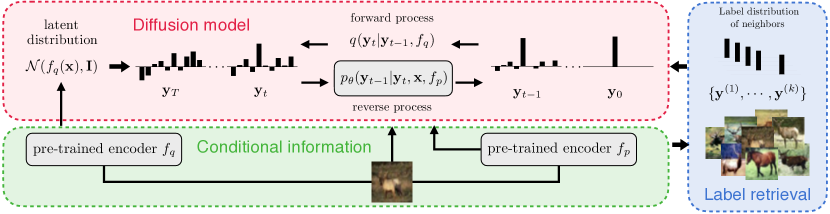
- 采用扩散模型骨干(CARD)来学习给定图像的标签的条件分布。
- 引入标签检索增强:在学习到的特征空间中对 k 个最近邻的标签进行检索,形成用于训练的伪干净目标。
- 使用两个编码器:f_q(y_T 的均值估计,可能为 0)和 f_p(高维特征提取器)来对扩散过程进行条件化。
- 以 ELBO 目标进行训练,采用简单的损失使预测噪声在扩散步骤中与真实噪声匹配。
- 通过广义的 DDIM 采样加速推理,在减少步数的同时保持边际分布。
- 通过不强制 f_q = f_p 来实现灵活的条件化,并实现将 CLIP 等大型预训练模型作为 f_p 的集成。
实验结果
研究问题
- RQ1扩散模型如何用于建模在噪声下标签生成的随机过程?
- RQ2在学习特征空间中检索邻居标签是否能提高扩散基分类器对嘈杂标签的鲁棒性?
- RQ3预训练编码器(如 CLIP、SimCLR)通过条件化能否提升基于扩散的嘈杂标签学习?
- RQ4在扩散式标签推断中,DDIM 加速技术带来的效率提升是多少,以及对准确性的影响?
- RQ5与最先进方法相比,LRA-diffusion 在合成与真实世界的嘈杂标签基准上的表现如何?
主要发现
- LRA-diffusion 在标准真实世界嘈杂标签基准上实现最先进的性能。
- 结合 CLIP 条件特征可显著提升准确性,相较于先前方法有显著改进。
- 标签检索增强使扩散模型能够从邻域标签中学习,提高对标签噪声的鲁棒性。
- 通过广义 DDIM 的加速推理在减少计算量的同时保持性能(如使用更少的步数)。
- 在合成噪声基准(CIFAR-10/100)上,配合 CLIP 的 LRA-diffusion 在 PMD 和混合噪声设置下显著优于基线。
- 真实世界数据集上显示对 WebVision、ILSVRC2012 和 Food-101N 的方法性能有显著提升。
阅读本论文
在 Nubint 阅读器中打开原文,边读边就任意段落提问。
在 Nubint 中阅读本论文本解读由 AI 根据论文原文生成,引用前请核对原文。