
[论文解读] LaMAGIC: Language-Model-based Topology Generation for Analog Integrated Circuits
LaMAGIC 使用监督微调的语言模型,在单次通过从规范生成模拟电路拓扑,达到在 0.01 容差下最高可达 0.96 的成功率,并对更复杂的 6 元件电路显示鲁棒转移。
In the realm of electronic and electrical engineering, automation of analog circuit is increasingly vital given the complexity and customized requirements of modern applications. However, existing methods only develop search-based algorithms that require many simulation iterations to design a custom circuit topology, which is usually a time-consuming process. To this end, we introduce LaMAGIC, a pioneering language model-based topology generation model that leverages supervised finetuning for automated analog circuit design. LaMAGIC can efficiently generate an optimized circuit design from the custom specification in a single pass. Our approach involves a meticulous development and analysis of various input and output formulations for circuit. These formulations can ensure canonical representations of circuits and align with the autoregressive nature of LMs to effectively addressing the challenges of representing analog circuits as graphs. The experimental results show that LaMAGIC achieves a success rate of up to 96\% under a strict tolerance of 0.01. We also examine the scalability and adaptability of LaMAGIC, specifically testing its performance on more complex circuits. Our findings reveal the enhanced effectiveness of our adjacency matrix-based circuit formulation with floating-point input, suggesting its suitability for handling intricate circuit designs. This research not only demonstrates the potential of language models in graph generation, but also builds a foundational framework for future explorations in automated analog circuit design.
研究动机与目标
- 应对复杂规格和日益增长的定制需求所带来的自动化模拟电路设计需求
- 开发基于语言模型的方法,以一次性将电路拓扑生成为图
- 研究输入/输出表述以产生规范化、适用于自回归的电路表示
- 评估对更复杂的(6 元件)电路的可扩展性以及学习到的设计的迁移性
提出的方法
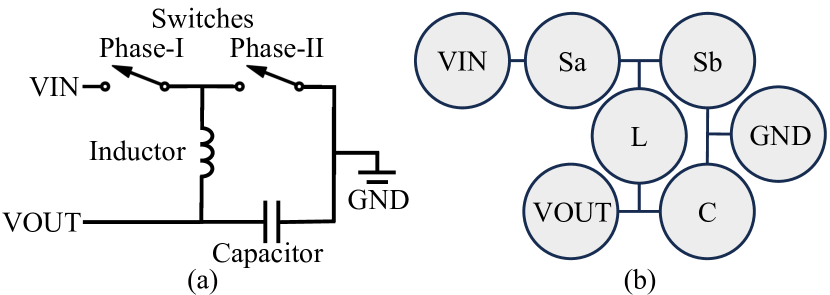
- 将电路设计表述为图生成,使用编码器-解码器变换器产生的序列(Flan-T5-base,248M 参数)
- 比较多种输入/输出表述:Naïve Formulation(NF)、Canonical Form(CF)、Canonical Form with New Duty Cycle Encoding(CFDC)、基于邻接矩阵的文本输入(PM)、以及带浮点输入的基于邻接的(FM)
- 将电路表示为边缘生成与拓扑生成任务,使用自回归损失和 T5 风格的掩码语言建模进行图生成
- 通过对随机顶点顺序排列进行数据增强,以提高排列不变性和泛化能力
- 在合成的 NGSPICE 验证的含 3–6 个元件、占空比变化的数据集上微调模型;用容差 t 下的成功率和目标规格与仿真性能之间的均方误差(MSE)进行评估
实验结果
研究问题
- RQ1语言模型是否可以微调以直接从规格生成有效的模拟电路拓扑?
- RQ2哪些输入/输出表述最有利于对电路的自回归图生成?
- RQ3该方法对于更复杂的(6 元件)电路的扩展性以及从较小拓扑的迁移学习表现如何?
- RQ4数据增强和顶点顺序置换对生成性能有何影响?
主要发现
- 最佳表述形式优于简单基线,在容差为 0.01 时达到最高 0.96 的成功率
- 基于邻接的表述并采用浮点输入(FM)在处理复杂的 6 元件电路时显示出强大性能并具备有益的可迁移性
- PM(基于文本的邻接)和 CF/CFDC 在边缘与拓扑生成方面表现优越,FM 在更宽容差下的拓扑任务表现出色
- 仅编码器的语言模型在电路生成上无法收敛,强调需要自回归图生成建模
- 通过随机顶点顺序排列进行数据增强可提升生成性能,数值输入表述尤为有效
- 6 元件迁移实验中,FM 和 PM 的对 MSE 的鲁棒性高于 CF/CFDC,表明对规模具有鲁棒性
阅读本论文
在 Nubint 阅读器中打开原文,边读边就任意段落提问。
在 Nubint 中阅读本论文本解读由 AI 根据论文原文生成,引用前请核对原文。