
[论文解读] Language models are weak learners
本论文表明基于提示的大语言模型可以充当弱学习者,并在嵌入带数据描述的提示的提升框架中,超过零-shot/少样本甚至某些微调基线在表格数据上的表现。
A central notion in practical and theoretical machine learning is that of a $ extit{weak learner}$, classifiers that achieve better-than-random performance (on any given distribution over data), even by a small margin. Such weak learners form the practical basis for canonical machine learning methods such as boosting. In this work, we illustrate that prompt-based large language models can operate effectively as said weak learners. Specifically, we illustrate the use of a large language model (LLM) as a weak learner in a boosting algorithm applied to tabular data. We show that by providing (properly sampled according to the distribution of interest) text descriptions of tabular data samples, LLMs can produce a summary of the samples that serves as a template for classification and achieves the aim of acting as a weak learner on this task. We incorporate these models into a boosting approach, which in some settings can leverage the knowledge within the LLM to outperform traditional tree-based boosting. The model outperforms both few-shot learning and occasionally even more involved fine-tuning procedures, particularly for tasks involving small numbers of data points. The results illustrate the potential for prompt-based LLMs to function not just as few-shot learners themselves, but as components of larger machine learning pipelines.
研究动机与目标
- 探索基于提示的LLMs在表格数据的提升框架中是否能充当弱学习者。
- 开发将表格数据转换为适合LLM提示的文本描述的流程。
- 研究摘要/概括作为在不对LLM进行微调的情况下创建有效弱学习者的机制。
提出的方法
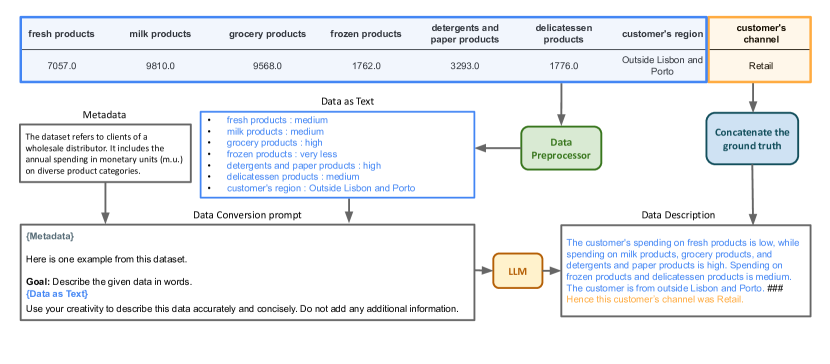
- 通过零-shot提示将表格记录转换为自然语言数据描述。
- 使用LLMs从采样的数据描述生成摘要(弱学习者)。
- 应用基于聚类的抽样,在LLM上下文限制内选择具有代表性的子集。
- 将摘要整合到AdaBoost框架中,形成弱学习者的集成。
- 将Summary和Summary Boosting与零-shot、少-shot以及常规表格方法进行比较。
实验结果
研究问题
- RQ1LLMs是否能通过基于提示的摘要在表格数据的提升框架中充当弱学习者?
- RQ2对数据描述的摘要是否比简单的少-shot提示产生更好的弱学习者?
- RQ3提出的Summary Boosting方法与传统表格方法及提示基线相比如何?
主要发现
- 零-shot在不同数据集上的表现不稳定,通常较差。
- 大多数数据集上少-shot优于零-shot,只有少数数据集例外。
- 摘要在所有数据集上均优于少-shot和零-shot。
- Summary Boosting通常超过Summary和其他提示基线。
- 在极小的数据集上,Summary Boosting可超越某些微调或非提示基线。
- 在含有大量连续属性的数据集上性能下降,除非对LLMs进行微调或使用更新的模型。

阅读本论文
在 Nubint 阅读器中打开原文,边读边就任意段落提问。
在 Nubint 中阅读本论文本解读由 AI 根据论文原文生成,引用前请核对原文。