
[论文解读] Language Models Learn Rare Phenomena from Less Rare Phenomena: The Case of the Missing AANNs
该论文表明,大型语言模型学习英语中罕见的语法结构(如‘Article+Adjective+Numeral+Noun’,即AANN结构)并非通过记忆,而是通过从更常见、相关的结构(如‘a few days’)中进行泛化。通过系统的语料操控和受控训练,作者发现,只要存在相关结构且其槽位填充项具有高度可变性,即使训练数据中完全不包含目标结构,模型仍能保留并泛化AANN结构。
Language models learn rare syntactic phenomena, but the extent to which this is attributable to generalization vs. memorization is a major open question. To that end, we iteratively trained transformer language models on systematically manipulated corpora which were human-scale in size, and then evaluated their learning of a rare grammatical phenomenon: the English Article+Adjective+Numeral+Noun (AANN) construction (``a beautiful five days''). We compared how well this construction was learned on the default corpus relative to a counterfactual corpus in which AANN sentences were removed. We found that AANNs were still learned better than systematically perturbed variants of the construction. Using additional counterfactual corpora, we suggest that this learning occurs through generalization from related constructions (e.g., ``a few days''). An additional experiment showed that this learning is enhanced when there is more variability in the input. Taken together, our results provide an existence proof that LMs can learn rare grammatical phenomena by generalization from less rare phenomena. Data and code: https://github.com/kanishkamisra/aannalysis.
研究动机与目标
- 探究语言模型是否通过泛化而非记忆来学习罕见语法现象(如AANN结构)。
- 检验训练数据中若完全缺乏AANN示例,是否会影响学习,以及相关结构能否作为学习触发因素替代。
- 考察AANN结构中开放槽位(形容词、数词、名词)填充项的可变性如何影响模型的泛化能力。
- 确定模型在接触多样化、非冗余的实例后,是否能泛化到全新的AANN组合。
- 提供实证证据,表明LM可通过从更常见、结构相似的构造中进行归纳学习,掌握罕见句法模式。
提出的方法
- 在人工规模的语料(BabyLM,约1亿词)上训练基于Transformer的模型,通过系统性地操控语料版本,以隔离特定构造的影响。
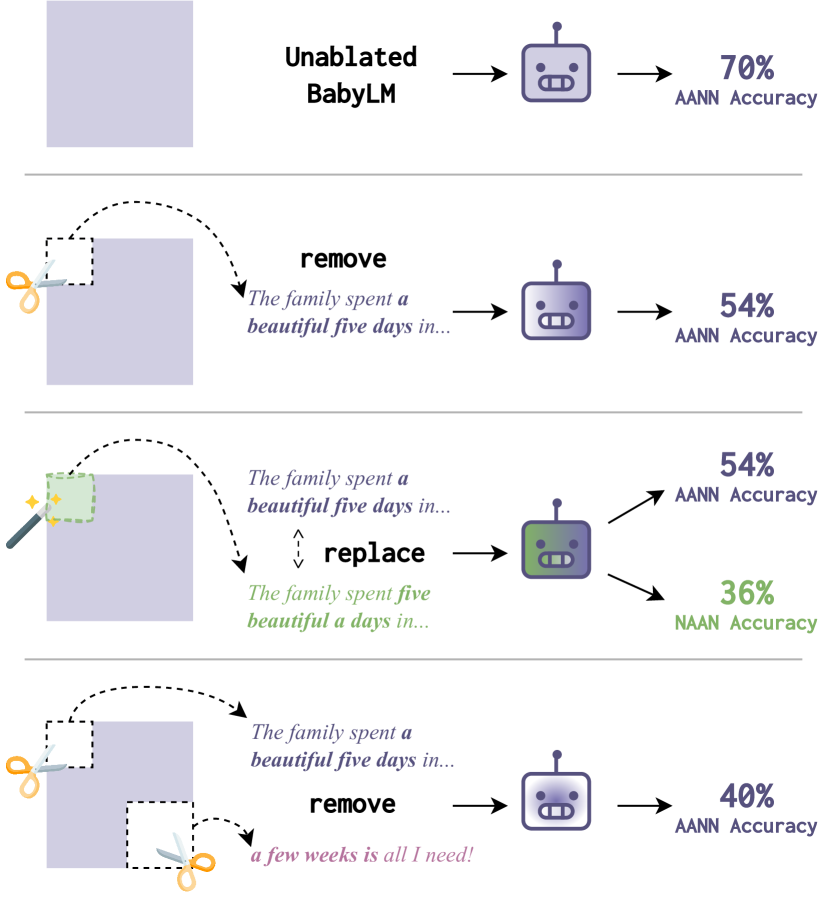
- 构建反事实语料:一种是移除所有AANN结构,一种是将AANN结构替换为损坏变体(如‘beautiful a five days’),一种是同时移除AANN结构及相关构造(如‘a few weeks is’)。
- 使用句子重复性似然度(SLOR)作为度量,评估模型对未见AANN类构造的似然性。
- 将AANN实例划分为两组:一组具有高槽位可变性(多样化形容词、数词、名词),另一组具有低可变性(重复填充项),分别对模型进行训练。
- 采用表征编辑和消融技术,隔离特定构造类型对模型行为的影响。
- 比较不同条件下模型的表现,以评估其泛化能力及对输入多样性的敏感度。
实验结果
研究问题
- RQ1当训练数据中完全不包含AANN结构时,语言模型能否学习该结构?
- RQ2更常见、相关的结构(如‘a few days’)在多大程度上能支持AANN结构的学习?
- RQ3AANN结构中开放槽位填充项的可变性如何影响模型对新组合的泛化能力?
- RQ4即使目标结构未直接出现,模型对未见AANN结构的泛化能力是否依赖于训练实例的多样性?
- RQ5模型在AANN结构上的表现,更应由记忆还是由从相关结构中归纳泛化来解释?
主要发现
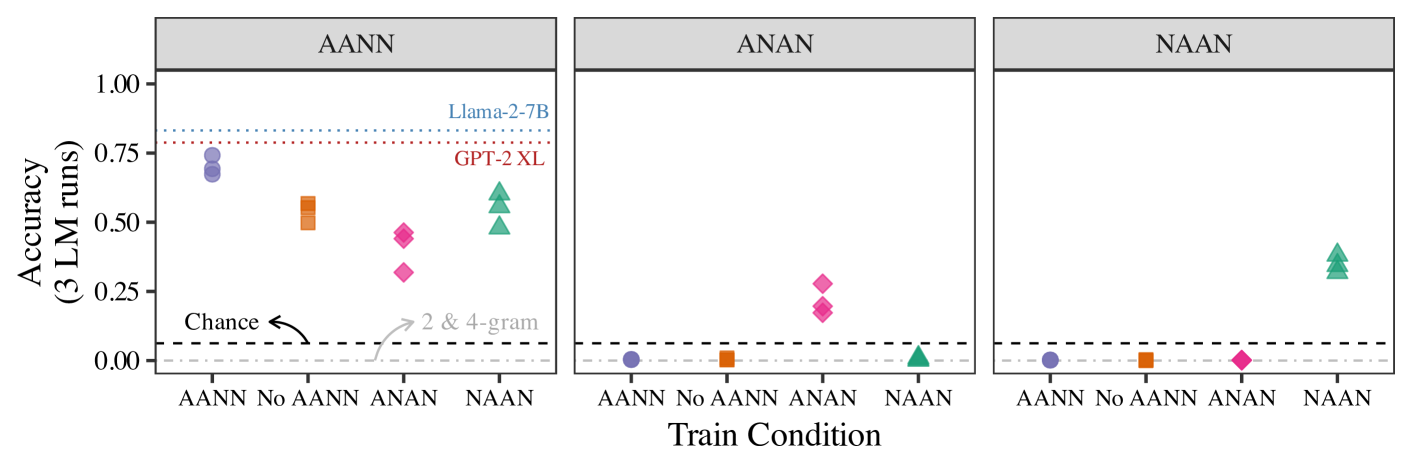
- 在未接触任何AANN示例的模型,对未见AANN结构仍获得较高的SLOR分数,表明其学习机制为泛化而非记忆。
- 在缺乏AANN结构但包含相关构造(如‘a few days’)的语料上训练的模型,其AANN结构学习效果与在含AANN结构的语料上训练的模型相当。
- 接触高槽位可变性AANN结构(多样化形容词、数词、名词)的模型,其SLOR分数与在完整AANN语料上训练的模型相当或更高。
- 仅在低可变性AANN实例上训练的模型,其表现与未接触任何AANN结构的模型无异,表明其对有限模式存在过拟合。
- 即使AANN结构完全缺失,相关构造(如‘a few weeks is’)的存在仍显著提升了AANN结构的学习效果。
- 槽位可变性作为模型泛化的强提示信号,高可变性输入能显著提升生成新颖AANN结构的能力。
阅读本论文
在 Nubint 阅读器中打开原文,边读边就任意段落提问。
在 Nubint 中阅读本论文本解读由 AI 根据论文原文生成,引用前请核对原文。