
[论文解读] Language models scale reliably with over-training and on downstream tasks
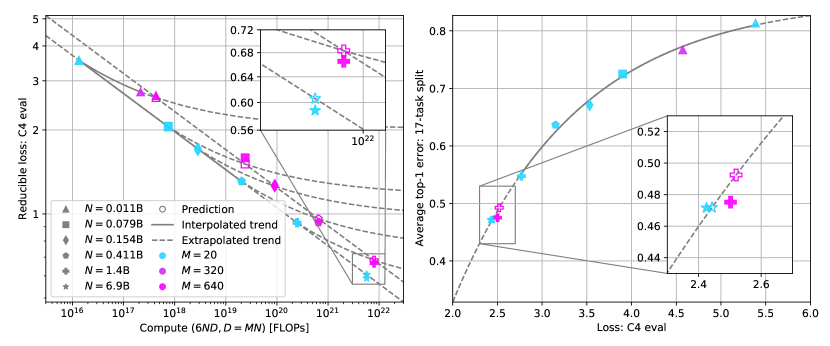
本文在过训练状态下建立了语言模型的可靠缩放定律,并通过幂律将语言建模困惑度与下游任务性能关联起来。基于在三个数据集上训练的104个模型,该研究可分别以仅需直接训练所需计算量的1/300和1/20的计算量,预测大规模模型的验证损失和平均下游Top-1错误率。
Scaling laws are useful guides for derisking expensive training runs, as they predict performance of large models using cheaper, small-scale experiments. However, there remain gaps between current scaling studies and how language models are ultimately trained and evaluated. For instance, scaling is usually studied in the compute-optimal training regime (i.e., "Chinchilla optimal" regime). In contrast, models are often over-trained to reduce inference costs. Moreover, scaling laws mostly predict loss on next-token prediction, but models are usually compared on downstream task performance. To address both shortcomings, we create a testbed of 104 models with 0.011B to 6.9B parameters trained with various numbers of tokens on three data distributions. First, we fit scaling laws that extrapolate in both the amount of over-training and the number of model parameters. This enables us to predict the validation loss of a 1.4B parameter, 900B token run (i.e., 32$ imes$ over-trained) and a 6.9B parameter, 138B token run (i.e., a compute-optimal run)$\unicode{x2014}$each from experiments that take 300$ imes$ less compute. Second, we relate the perplexity of a language model to its downstream task performance by proposing a power law. We use this law to predict top-1 error averaged over downstream tasks for the two aforementioned models, using experiments that take 20$ imes$ less compute. Our experiments are available at https://github.com/mlfoundations/scaling.
研究动机与目标
- 弥合计算最优缩放定律与真实世界大规模语言模型过训练实践之间的差距。
- 探究当模型训练超出计算最优区域时,缩放定律是否仍具有可预测性。
- 建立语言建模困惑度与下游任务性能之间的定量关联,以实现在早期阶段预测模型效能。
- 提供一个可扩展的实验测试平台,用于验证缩放定律在模型规模和训练计算量之间的外推性能。
- 通过准确的低计算量外推,减少对昂贵全规模训练运行的依赖,实现高效模型开发。
提出的方法
- 在三个数据分布(RedPajama、C4 和 RefinedWeb)上训练104个语言模型,参数量从0.011B到6.9B不等。
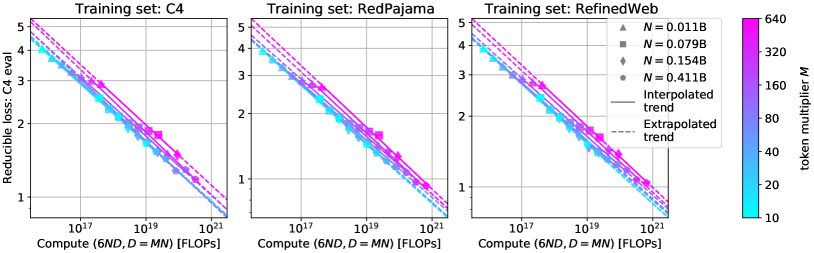
- 使用幂律形式 L′ = λ·C^(-α_C) 拟合模型验证损失与训练计算量(C)及参数-词元比(M = D/N)之间的缩放定律。
- 将基于小模型训练的缩放定律外推,以预测在300倍更多计算量(例如,1.4B参数、9000亿词元)下训练的大模型性能。
- 建立模型困惑度与17项任务平均下游Top-1错误率之间的幂律关系,从而实现仅通过低计算量实验即可预测错误率。
- 利用自助法置信区间和计算量-错误率权衡分析,验证缩放定律预测的可靠性与效率。
- 在 https://github.com/mlfoundations/scaling 上发布所有实验结果与代码,以支持可复现性与进一步研究。
实验结果
研究问题
- RQ1在过训练状态下,是否能够可靠地将基于小模型训练的缩放定律外推至使用显著更多计算量训练的大模型,特别是当训练量远超训练缩放定律所用计算量时?
- RQ2缩放指数 α_C 如何随参数-词元比 M 变化?其在不同数据分布和模型规模下是否保持稳定?
- RQ3模型在下一项词元预测任务上的困惑度,在多大程度上能预测其在多样化基准测试中的平均下游Top-1错误率?
- RQ4在拟合缩放定律时投入的计算量与最终损失预测和下游错误预测的准确性之间存在何种权衡?
- RQ5在计算最优的小模型上训练的缩放定律,能否准确预测大规模过训练模型的性能?
主要发现
- 在计算最优区域训练的小模型所拟合的缩放定律,可仅使用2.4×10^19 FLOPs的计算量,准确预测在9000亿词元上训练的1.4B参数模型的验证损失——该模型实际训练需300倍于训练缩放定律所用的计算量。
- 缩放指数 α_C 在不同参数-词元比 M 下保持近似恒定,表明在过训练状态下缩放行为具有稳定的泛化能力。
- 困惑度与平均下游Top-1错误率之间存在幂律关系,使得仅使用2.7×10^20 FLOPs(即直接训练所需计算量的1/20)在6.9B参数模型上训练1380亿词元后,即可在17项任务上实现误差预测误差小于1个百分点。
- 预测下游错误所需计算量高于预测损失,以达到相同的相对误差水平,表明错误预测比损失预测更敏感且效率更低。
- 在三个数据集上构建的104个模型的实验测试平台表明,即使在显著过训练条件下,缩放定律依然保持稳健且可预测。
- 结果证实,在过训练和下游性能预测中均可实现可靠外推,从而支持高效模型开发工作流。
阅读本论文
在 Nubint 阅读器中打开原文,边读边就任意段落提问。
在 Nubint 中阅读本论文本解读由 AI 根据论文原文生成,引用前请核对原文。