
[论文解读] Large-capacity and Flexible Video Steganography via Invertible Neural Network
该论文提出 LF-VSN,一种基于可逆神经网络(INNs)的大容量、灵活的视频隐写框架,可使用单一模型在单个载体视频中可逆地隐藏并恢复多达七段秘密视频。该方法通过密钥可控的恢复机制与可扩展的嵌入策略,实现了高安全性和高性能,其伪视频质量超过 35 dB,且对隐写分析工具具有强抗御能力。
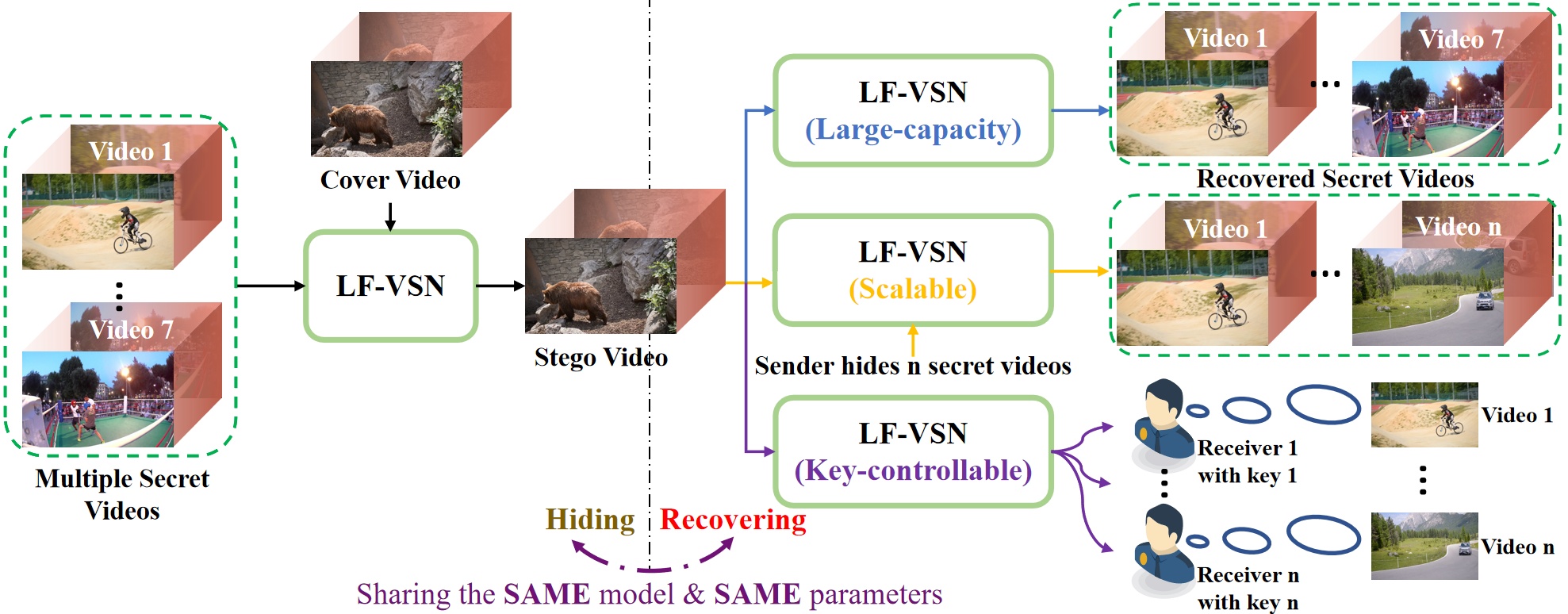
Video steganography is the art of unobtrusively concealing secret data in a cover video and then recovering the secret data through a decoding protocol at the receiver end. Although several attempts have been made, most of them are limited to low-capacity and fixed steganography. To rectify these weaknesses, we propose a Large-capacity and Flexible Video Steganography Network (LF-VSN) in this paper. For large-capacity, we present a reversible pipeline to perform multiple videos hiding and recovering through a single invertible neural network (INN). Our method can hide/recover 7 secret videos in/from 1 cover video with promising performance. For flexibility, we propose a key-controllable scheme, enabling different receivers to recover particular secret videos from the same cover video through specific keys. Moreover, we further improve the flexibility by proposing a scalable strategy in multiple videos hiding, which can hide variable numbers of secret videos in a cover video with a single model and a single training session. Extensive experiments demonstrate that with the significant improvement of the video steganography performance, our proposed LF-VSN has high security, large hiding capacity, and flexibility. The source code is available at https://github.com/MC-E/LF-VSN.
研究动机与目标
- 为解决现有视频隐写方法存在的隐藏容量低和管道僵化等局限性。
- 实现使用统一模型在单个载体视频中可逆地隐藏并恢复多段秘密视频。
- 引入密钥可控性,使不同接收方可使用唯一密钥恢复特定秘密视频。
- 设计可扩展的嵌入策略,使单个训练好的模型支持可变数量的秘密视频。
- 在隐写容量与抗隐写分析安全性方面达到最先进水平。
提出的方法
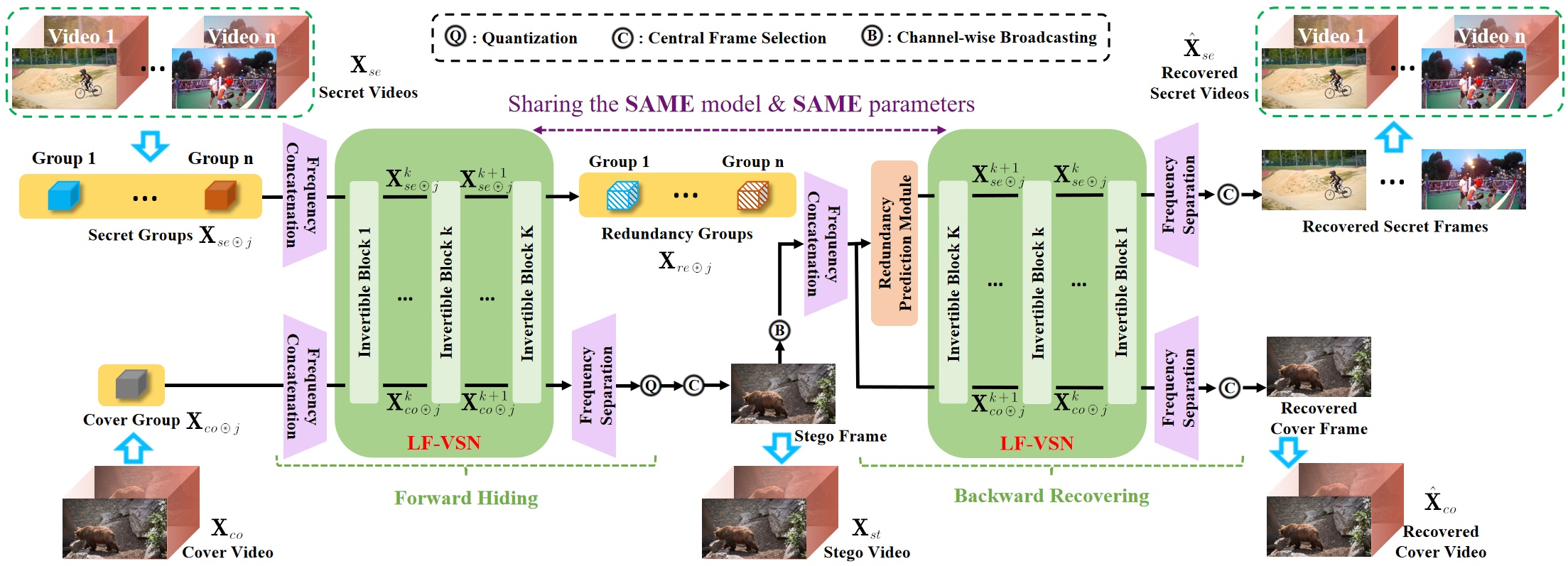
- 该框架采用可逆神经网络(INN)对多段秘密视频进行可逆编码与解码,嵌入至单个载体视频中。
- 采用窗口大小为 3 的滑动窗口机制,以利用视频帧之间的时序相关性。
- 通过离散小波变换(DWT)在频域进行特征拼接,融合输入视频组的特征,以提升信息融合效果。
- 冗余预测模块(RPM)取代后向传播中的随机采样,实现密钥可控性并提升性能。
- 模型在多个视频隐写任务间共享权重,以降低复杂度,同时保持高容量。
- 可扩展设计使同一模型可在单次训练后支持可变数量的秘密视频嵌入(最多 7 个)。
实验结果
研究问题
- RQ1单个可逆神经网络模型能否实现对载体视频中多段秘密视频的可逆隐藏与恢复?
- RQ2如何将密钥可控性集成至视频隐写系统中,以实现授权接收方的选择性恢复?
- RQ3单个模型能否在不重新训练的情况下支持可变数量的秘密视频,从而提升灵活性?
- RQ4与固定配置设计相比,可扩展嵌入设计在视频质量与安全性方面的性能权衡如何?
- RQ5所提方法对最先进的隐写分析工具(如 StegExpose)的抗性如何?
主要发现
- 所提出的 LF-VSN 实现了超过 35 dB 的伪视频质量,当隐藏 7 段秘密视频时,峰值信噪比(PSNR)达到 42.40 dB。
- 该方法保持了高安全性,隐写分析检测准确率接近 50%(理想值),表明对 StegExpose 具有强抗检测能力。
- 密钥可控方案使不同接收方可使用唯一密钥恢复特定秘密视频,显著提升数据安全性。
- 可扩展设计使单个模型可嵌入最多 7 段秘密视频,且性能退化极小,优于固定配置模型。
- 消融实验表明,通过 DWT 的频域拼接可使 PSNR 提升 1.7–1.91 dB;RPM 同时提升了性能与密钥可控性。
- 该模型在隐藏容量、灵活性与安全性方面达到最先进水平,且参数量显著低于先前基于 3D-CNN 的方法。
阅读本论文
在 Nubint 阅读器中打开原文,边读边就任意段落提问。
在 Nubint 中阅读本论文本解读由 AI 根据论文原文生成,引用前请核对原文。