
[论文解读] Large Language Models as General Pattern Machines
预训练的大语言模型可以自回归地从 PCFG 和 ARC 提示中完成复杂的标记序列,展示通过上下文学习实现零样本模式操作,并在包括轨迹外推和简单闭环控制的机器人任务中得到演示。
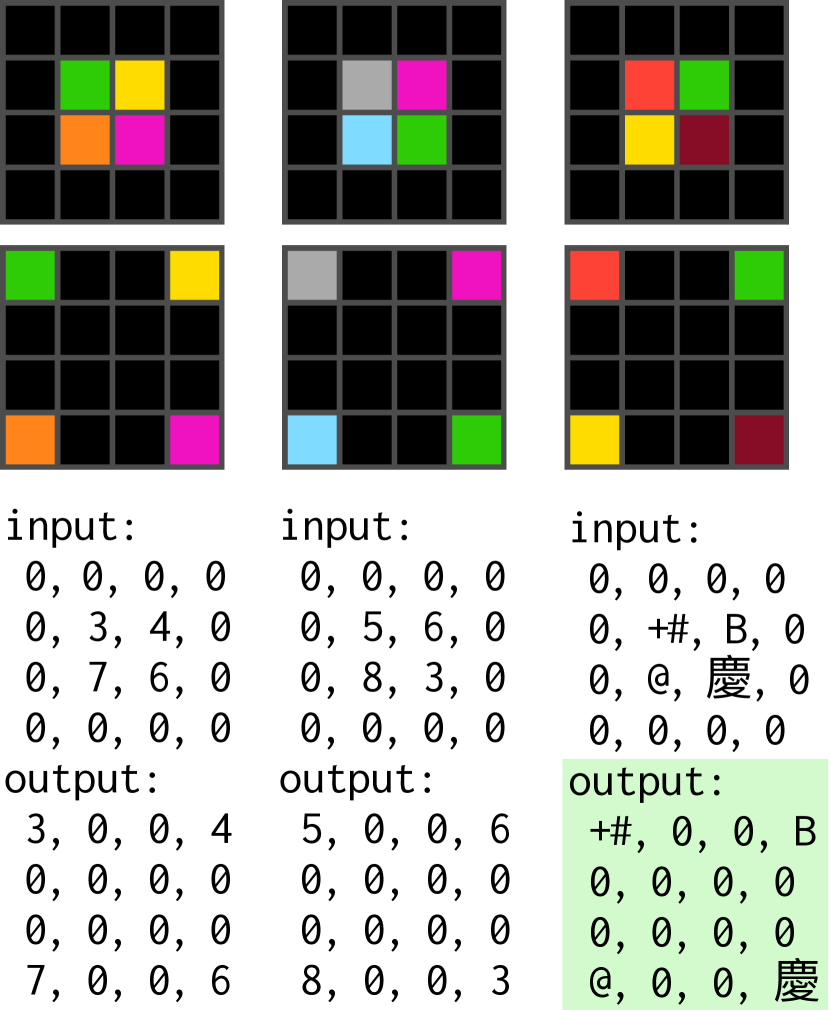
We observe that pre-trained large language models (LLMs) are capable of autoregressively completing complex token sequences -- from arbitrary ones procedurally generated by probabilistic context-free grammars (PCFG), to more rich spatial patterns found in the Abstraction and Reasoning Corpus (ARC), a general AI benchmark, prompted in the style of ASCII art. Surprisingly, pattern completion proficiency can be partially retained even when the sequences are expressed using tokens randomly sampled from the vocabulary. These results suggest that without any additional training, LLMs can serve as general sequence modelers, driven by in-context learning. In this work, we investigate how these zero-shot capabilities may be applied to problems in robotics -- from extrapolating sequences of numbers that represent states over time to complete simple motions, to least-to-most prompting of reward-conditioned trajectories that can discover and represent closed-loop policies (e.g., a stabilizing controller for CartPole). While difficult to deploy today for real systems due to latency, context size limitations, and compute costs, the approach of using LLMs to drive low-level control may provide an exciting glimpse into how the patterns among words could be transferred to actions.
研究动机与目标
- 激发研究将 LLMs 作为超越语言任务的通用模式操控者。
- 评估在非语言序列(ARC、PCFG)上的零样本模式学习能力。
- 探索在机器人领域展示这些能力的示例,包括序列外推和基本控制器。
- 描述在不进行微调的情况下,LLMs 在引导低级机器人决策中的局限性和潜在作用。
提出的方法
- 使用上下文学习,提示中编码输入-输出序列示例(ARC 的 ASCII 艺术风格)。
- 使用分词网格和随机字母表评估 ARC 表现,以测试模式的记号不变性。
- 引入基于 PCFG 的可配置模式转换,打造一个独立于 ARC 的可扩展基准。
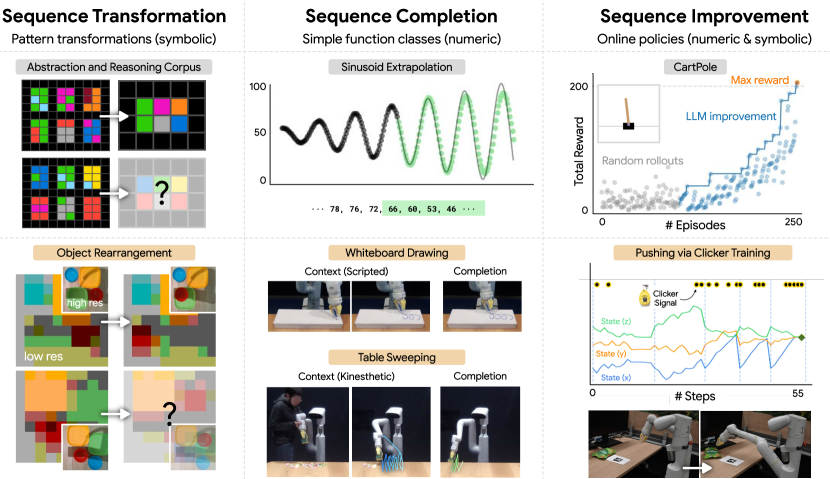
- 在任务中演示序列转换、完成与改进,包括动觉演示和简单的机器人轨迹。
- 尝试在线、奖励条件化的轨迹以及人类在环提示,以发现简单控制器(如 CartPole)。
- 讨论部署基于 LLM 的控制的实际考量与局限性(延迟、上下文大小、计算成本)。
实验结果
研究问题
- RQ1预训练的 LLMs 是否能够在零样本设定下对非语言符号执行抽象序列变换?
- RQ2当模式以随机符号表表达时,LLMs 是否表现出鲁棒的模式完成和记号不变性?
- RQ3上下文中 LLM 提示是否能扩展到简单的机器人任务,如轨迹外推和基本闭环控制器的发现?
- RQ4将 LLMs 用于基于序列的控制与策略改进的实际局限性与权衡有哪些?
- RQ5基于 PCFG 与 ARC 的基准在揭示与机器人相关的一般模式能力方面有何比较?
主要发现
- 以 ASCII-art 风格提示的 LLMs 可以解决最多 85 个 ARC 问题(800 个中),超过部分未训练的基于 DSL 的方法。
- 记号映射不变性:在随机字母表下,LLMs 能解决相当一部分 ARC 风格任务(例如在一个设置中随机字母表下为 58±1)。
- 基于 PCFG 的模式完成随模型规模而提升;更大的模型在各 PCFG 变体中获得更高的准确性(例如 PaLM 和 text-davinci-003 胜过较小的模型)。
- 序列完成实验在更多上下文和更大模型下揭示接近完美的正弦及相关函数的外推。
- 序列改进实验表明 LLMs 能外推轨迹以实现更高的奖励,包括学习简单的 CartPole 控制器和在线的人类引导轨迹优化。
- 展示的应用包括外推动觉演示(运动)、白板上的简单运动模式,以及机器人中的奖励驱动轨迹改进。
阅读本论文
在 Nubint 阅读器中打开原文,边读边就任意段落提问。
在 Nubint 中阅读本论文本解读由 AI 根据论文原文生成,引用前请核对原文。