
[论文解读] Large Language Models as Urban Residents: An LLM Agent Framework for Personal Mobility Generation
本文提出 LLMob,一种通过结合语义模式提取、自洽性评估和动机驱动的、基于检索增强的生成来生成个人出行轨迹的 LLM 代理框架,并在真实的东京数据上得到验证。
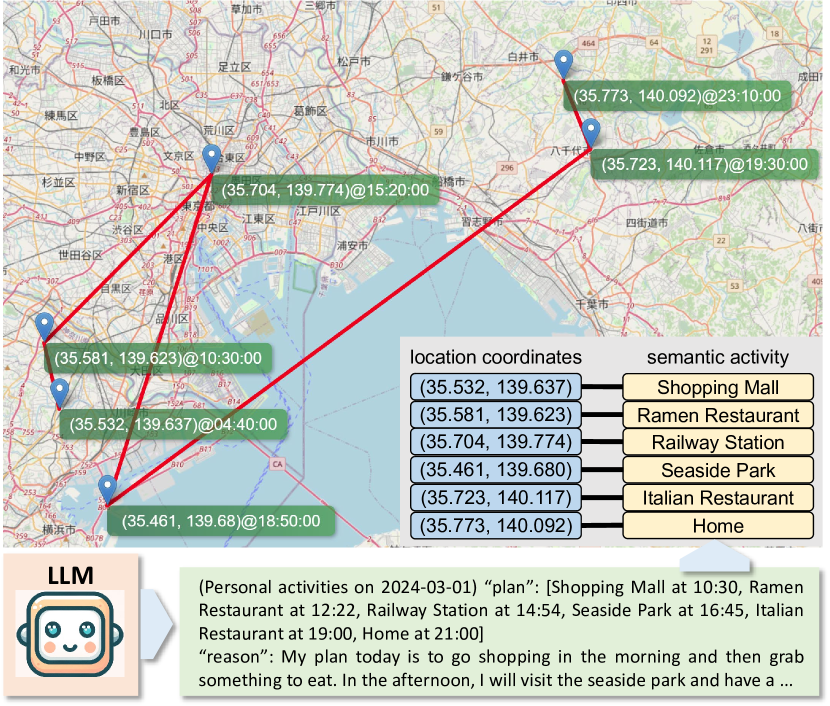
This paper introduces a novel approach using Large Language Models (LLMs) integrated into an agent framework for flexible and effective personal mobility generation. LLMs overcome the limitations of previous models by effectively processing semantic data and offering versatility in modeling various tasks. Our approach addresses three research questions: aligning LLMs with real-world urban mobility data, developing reliable activity generation strategies, and exploring LLM applications in urban mobility. The key technical contribution is a novel LLM agent framework that accounts for individual activity patterns and motivations, including a self-consistency approach to align LLMs with real-world activity data and a retrieval-augmented strategy for interpretable activity generation. We evaluate our LLM agent framework and compare it with state-of-the-art personal mobility generation approaches, demonstrating the effectiveness of our approach and its potential applications in urban mobility. Overall, this study marks the pioneering work of designing an LLM agent framework for activity generation based on real-world human activity data, offering a promising tool for urban mobility analysis.
研究动机与目标
- 将 LLM 与语义丰富的个人出行数据对齐以实现生成。
- 开发可靠、可解释的策略来生成活动轨迹。
- 将习惯性模式与动态动机结合以模拟城市出行。
- 用真实世界数据验证框架并与传统模型进行比较。
提出的方法
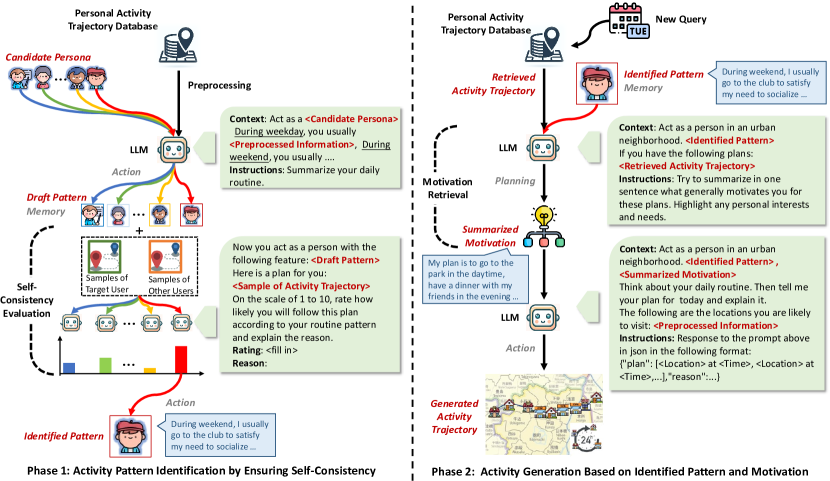
- 二阶段管线:(i) 使用 LLM 与人物画像提示来从历史数据中识别自洽的活动模式;(ii) 基于检索增强提示的动机驱动活动生成。
- 自洽性评分将候选模式与目标及其他用户进行比较,以选取最佳模式。
- 两种动机检索策略:基于演化和基于学习的策略,包括一个对比学习模型 f_theta 用于估计日期相似性。
- 将模式与汇总的动机整合以生成日常活动轨迹。
- 以 GPT-3.5-Turbo-0613 作为生成与分析的 LLM 核心。
实验结果
研究问题
- RQ1RQ1:如何将 LLM 与关于日常个体活动的语义丰富数据对齐?
- RQ2RQ2:使用 LLM 进行可靠且有意义的活动生成的有效策略是什么?
- RQ3RQ3:LLM 在提升城市出行方面的潜在应用有哪些?
主要发现
- LLMob 相较基线如马尔可夫、LSTM 和 DeepMove 在时序模式生成(ST-ACT、ST-LOC)方面具有优越性。
- 框架保持了具有竞争力的空间模式,并在异常的疫情样本情景下显示出鲁棒性。
- 基于动机的生成使 LLM 代理能够生成现实的日常轨迹并对外部因素(如疫情提示)做出适应。
- 检索增强策略提升了生成的活动轨迹的可解释性与可靠性。
- 自洽性评估有助于将 LLM 输出与现实世界的日常活动数据对齐。
阅读本论文
在 Nubint 阅读器中打开原文,边读边就任意段落提问。
在 Nubint 中阅读本论文本解读由 AI 根据论文原文生成,引用前请核对原文。