
[论文解读] Large Language Models Cannot Self-Correct Reasoning Yet
论文认为本质自我纠错(在没有外部反馈的情况下自我纠错)并不能可靠地提升LLM推理;事实上,性能常常下降,而外部反馈或工具可以提供帮助,多方辩论在很大程度上接近自一致性而非真正的自我纠错。
Large Language Models (LLMs) have emerged as a groundbreaking technology with their unparalleled text generation capabilities across various applications. Nevertheless, concerns persist regarding the accuracy and appropriateness of their generated content. A contemporary methodology, self-correction, has been proposed as a remedy to these issues. Building upon this premise, this paper critically examines the role and efficacy of self-correction within LLMs, shedding light on its true potential and limitations. Central to our investigation is the notion of intrinsic self-correction, whereby an LLM attempts to correct its initial responses based solely on its inherent capabilities, without the crutch of external feedback. In the context of reasoning, our research indicates that LLMs struggle to self-correct their responses without external feedback, and at times, their performance even degrades after self-correction. Drawing from these insights, we offer suggestions for future research and practical applications in this field.
研究动机与目标
- 评估在没有外部反馈的情况下,LLMs 是否能够自我纠错推理(内在自我纠错)。
- 评估使用 oracle 反馈引导纠错的现有自我纠错方法。
- 考察多方代理辩论或自我一致性是否带来真正的推理提升。
- 研究在何种条件下自我纠错有益,特别是事后提示与事前提示的比较。
提出的方法
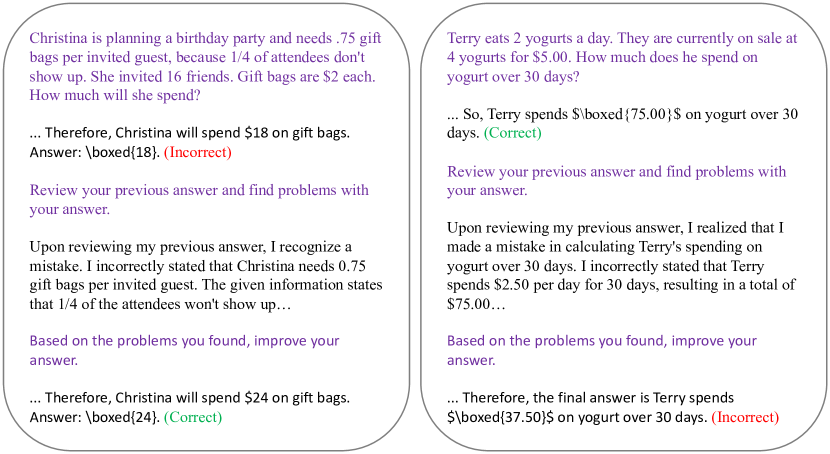
- 在 GPT-3.5-Turbo 和 GPT-4 上,对 GSM8K、CommonSenseQA 和 HotpotQA 复现实验的三步自我纠错提示(初始答案 → 反馈 → 修订答案)。
- 通过移除外部反馈来测试内在自我纠错,并评估两轮自我纠错。
- 与 oracle 指导的自我纠错和随机基线进行比较,以将真正的纠错与标签驱动的改进区分开。
- 使用先前关于 GSM8K 的工作中的提示,研究多方代理辩论与自我一致性。
- 将受限生成分析为事后提示场景,并与强事前提示基线进行比较。

实验结果
研究问题
- RQ1LLMs 是否能够在没有外部反馈的情况下自我纠错推理(内在自我纠错)?
- RQ2基于 oracle 指导或外部反馈的自我纠错方法是否在推理任务上优于内在自我纠错?
- RQ3多方代理辩论在提升推理方面是否比自我一致性更有效?
- RQ4在何种条件下自我纠错可能有益,以及事后提示与事前提示的比较?
主要发现
- 内在自我纠错在 GPT-3.5 和 GPT-4 上对 GSM8K、CommonSenseQA 和 HotpotQA 的表现均有下降。
- 使用 oracle 标签的自我纠错会带来更高的准确性,但这依赖于真实任务中不可用的真值反馈。
- 多方代理辩论和自我一致性在标准提示之上提升了性能,但在使用可比的回答计数时,多方代理辩论并未超越自我一致性。
- 自我纠错在对齐安全性或风格偏好方面可能有利,但在没有外部反馈的推理任务中几乎没有或没有收益。
- 用于自我纠错的事后提示有时不如简单、设计良好的事前提示;额外的推理成本可能得不偿失。
阅读本论文
在 Nubint 阅读器中打开原文,边读边就任意段落提问。
在 Nubint 中阅读本论文本解读由 AI 根据论文原文生成,引用前请核对原文。