
[论文解读] Large Multimodal Agents: A Survey
本综述分析基于大语言模型驱动的多模态代理(LMAs),提出四类型分类法,评估协作框架,并提供标准化的评估框架与未来方向。
Large language models (LLMs) have achieved superior performance in powering text-based AI agents, endowing them with decision-making and reasoning abilities akin to humans. Concurrently, there is an emerging research trend focused on extending these LLM-powered AI agents into the multimodal domain. This extension enables AI agents to interpret and respond to diverse multimodal user queries, thereby handling more intricate and nuanced tasks. In this paper, we conduct a systematic review of LLM-driven multimodal agents, which we refer to as large multimodal agents ( LMAs for short). First, we introduce the essential components involved in developing LMAs and categorize the current body of research into four distinct types. Subsequently, we review the collaborative frameworks integrating multiple LMAs , enhancing collective efficacy. One of the critical challenges in this field is the diverse evaluation methods used across existing studies, hindering effective comparison among different LMAs . Therefore, we compile these evaluation methodologies and establish a comprehensive framework to bridge the gaps. This framework aims to standardize evaluations, facilitating more meaningful comparisons. Concluding our review, we highlight the extensive applications of LMAs and propose possible future research directions. Our discussion aims to provide valuable insights and guidelines for future research in this rapidly evolving field. An up-to-date resource list is available at https://github.com/jun0wanan/awesome-large-multimodal-agents.
研究动机与目标
- 介绍 LMAs 的核心组成部分(感知、规划、行动、记忆)。
- 提出 LMAs 的四类型分类,并讨论设计权衡。
- 回顾多代理协作框架以提升性能。
- 概述评估方法并提出 LMAs 的标准化框架。
- 总结应用并提出未来研究方向。
提出的方法
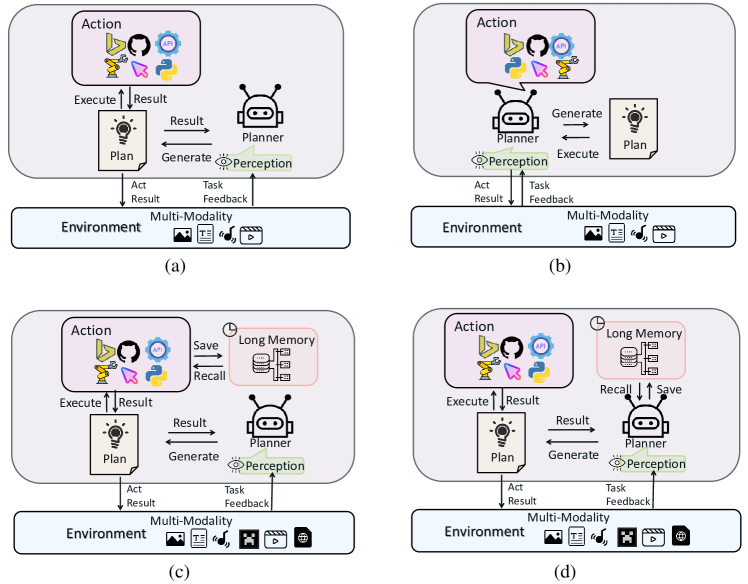
- 基于规划与记忆将现有研究分为四类 LMA(类型 I–IV)。
- 描述感知、规划、行动和记忆组件及其实现方式(引用表格和图示)。
- 讨论面向多 LMAs 的协作框架与具备记忆的体系结构。
- 总结评估方法,包括主观与客观指标、基准测试及挑战。
- 通过公开仓库提供最新的 LMAs 资源清单。
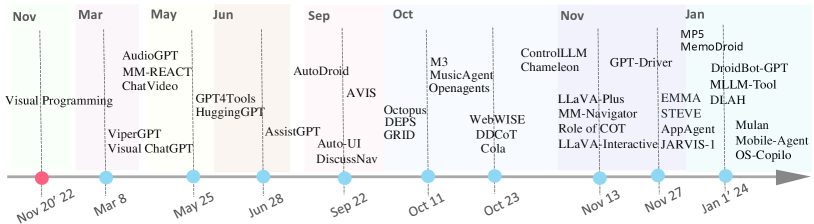
实验结果
研究问题
- RQ1LMAs 的基本组成成分及其交互是如何的?
- RQ2基于规划类型和记忆,LMAs 如何归入一个全面的分类(类型 I–IV)?
- RQ3哪些协作框架能够实现高效的多代理 LMA 系统?
- RQ4应如何评估 LMA 以实现公平比较与进展跟踪?
- RQ5LMAs 的关键现实世界应用及未来方向是什么?
主要发现
- 基于规划特征与记忆集成,LMAs 被分为四类型(类型 I–IV)。
- 记忆机制(短期/长期)显著影响 LMA 的能力与泛化性。
- 需要一个统一的评估框架与基准来标准化不同 LMAs 的比较。
- 协作多代理框架可以提升任务性能并分配工作负载。
- 本综述强调广泛的应用(GUI 自动化、机器人、游戏 AI、自动驾驶、视频理解等),并提供一个用于最新 LMA 的 GitHub 资源。
阅读本论文
在 Nubint 阅读器中打开原文,边读边就任意段落提问。
在 Nubint 中阅读本论文本解读由 AI 根据论文原文生成,引用前请核对原文。