
[论文解读] Large-scale Reinforcement Learning for Diffusion Models
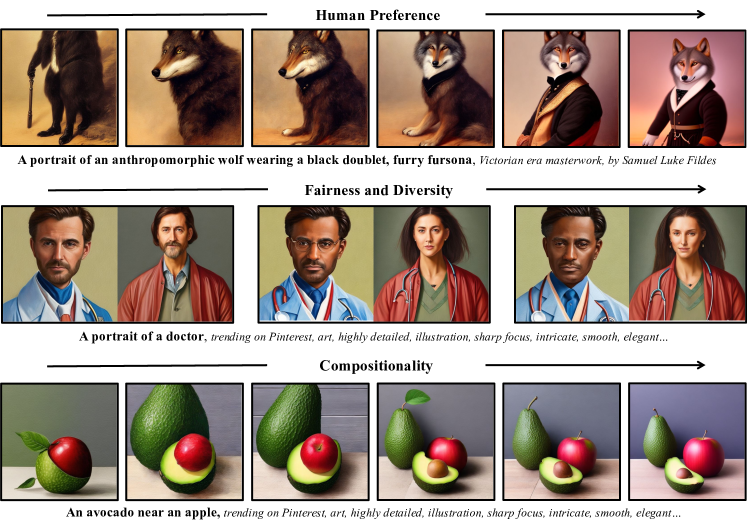
本文提出了一种大规模强化学习(RL)框架,通过在数百万个提示词上使用多样化奖励函数(如人类偏好、组合性、公平性)对扩散模型进行微调。通过利用基于分布的奖励和多目标优化的可扩展RL训练方法,该方法使Stable Diffusion模型在80.3%的情况下生成人类更偏好的图像,同时在无需推理时干预或合成数据的情况下,提升了组合性准确度和多样性。
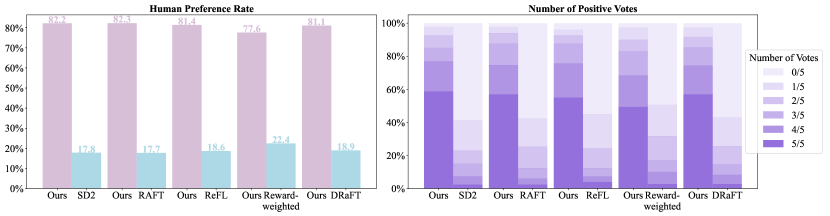
Text-to-image diffusion models are a class of deep generative models that have demonstrated an impressive capacity for high-quality image generation. However, these models are susceptible to implicit biases that arise from web-scale text-image training pairs and may inaccurately model aspects of images we care about. This can result in suboptimal samples, model bias, and images that do not align with human ethics and preferences. In this paper, we present an effective scalable algorithm to improve diffusion models using Reinforcement Learning (RL) across a diverse set of reward functions, such as human preference, compositionality, and fairness over millions of images. We illustrate how our approach substantially outperforms existing methods for aligning diffusion models with human preferences. We further illustrate how this substantially improves pretrained Stable Diffusion (SD) models, generating samples that are preferred by humans 80.3% of the time over those from the base SD model while simultaneously improving both the composition and diversity of generated samples.
研究动机与目标
- 为解决文本到图像扩散模型的局限性,如组合保真度差、美学不匹配以及社会偏见,这些局限性源于在未经筛选的网络规模数据上进行的预训练。
- 克服先前基于RL的微调方法在可扩展性和泛化能力方面的限制,这些方法受限于少量提示词或狭窄领域。
- 开发一种通用且可扩展的RL框架,实现使用任意奖励函数的多目标优化,而无需辅助输入或推理时的修改。
- 以一种增强质量与伦理对齐的方式微调预训练的扩散模型,同时保持多样性与可控性。
提出的方法
- 该方法将RL微调建模为策略优化问题,在扩散模型的采样过程中最大化生成图像的期望奖励。
- 采用基于分布的奖励函数,通过惩罚模式崩溃并促进输出空间的覆盖,以鼓励生成样本的多样性。
- 通过奖励函数的加权组合实现多目标RL,包括人类偏好、组合性准确度和公平性度量,实现对多个目标的同步优化。
- 采用离策略RL算法,结合经验回放和目标网络,以在数百万个提示词和多样化奖励信号下稳定训练。
- 通过使用来自预训练奖励模型的奖励信号,避免对完整生成过程进行梯度反向传播,从而支持不可微分的奖励函数。
- 该方法端到端地应用于微调扩散模型的参数,使用大规模文本提示词数据集及相应的奖励信号。
实验结果
研究问题
- RQ1大规模强化学习能否在大规模上有效提升文本到图像扩散模型在多个目标(包括人类偏好、组合性与公平性)上的表现?
- RQ2与标准RL微调方法相比,所提出的基于分布的奖励函数在提升样本多样性方面有何优势?
- RQ3在无需额外推理时引导或合成数据的情况下,多目标RL训练能在多大程度上提升基础扩散模型?
- RQ4在多样化提示词上的人类偏好评估中,RL微调模型的性能与基线方法相比如何?
- RQ5所提出的方法能否在数百万个提示词上实现泛化,并同时在质量与伦理对齐方面保持改进?
主要发现
- RL微调模型在人类偏好评估中平均得分达到80.3%,显著优于基础的Stable Diffusion v2模型。
- 该方法通过使模型更好地对齐提示词中描述的复杂多对象关系,提升了组合性准确度。
- 基于分布的奖励函数有效提高了样本多样性,减少了模式崩溃,并改善了输出分布的覆盖度。
- 该模型在无需合成数据增强的情况下,在多个偏见基准测试中表现出更好的公平性并减少了刻板印象。
- 该方法在数百万个提示词上具有泛化能力,并在所有评估目标(偏好、组合性、公平性)上保持了一致的性能提升。
- 该方法在人类偏好评估中实现了最先进性能,同时避免了基于梯度的奖励优化带来的内存与计算开销。
阅读本论文
在 Nubint 阅读器中打开原文,边读边就任意段落提问。
在 Nubint 中阅读本论文本解读由 AI 根据论文原文生成,引用前请核对原文。