
[论文解读] Large-Scale Unsupervised Object Discovery
本文提出 LOD(大规模对象发现),一种新颖的无监督对象发现方法,将无监督对象发现(UOD)建模为基于图的特征值和 PageRank 技术对区域提议进行排序的问题。该方法在单对象和多对象发现任务上均达到最先进性能,在 170 万张图像数据集上相比之前方法提升超过 37%,并实现了首个完全无监督的流水线,使用自监督特征。
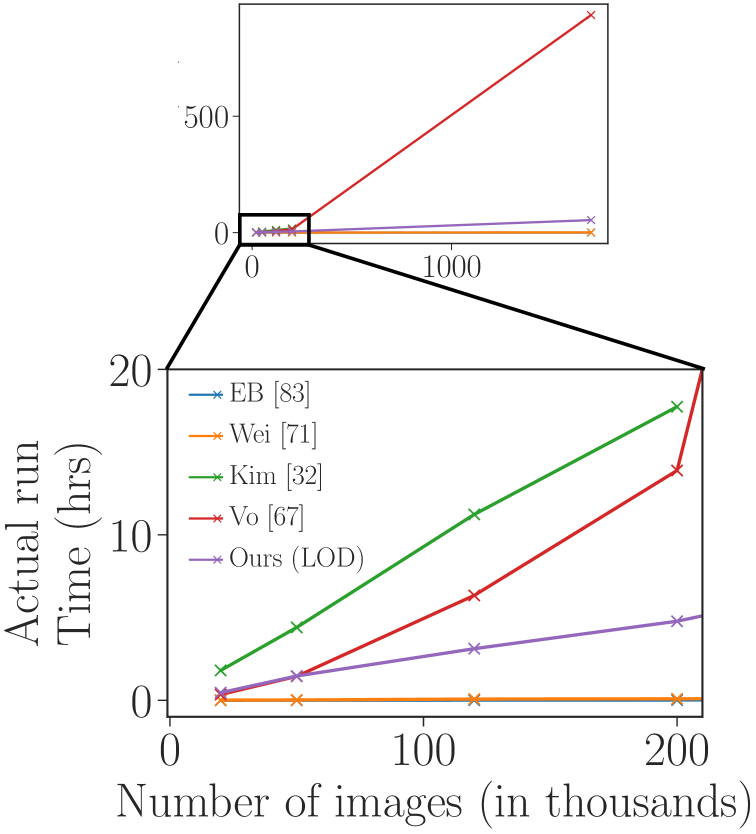
Existing approaches to unsupervised object discovery (UOD) do not scale up to large datasets without approximations that compromise their performance. We propose a novel formulation of UOD as a ranking problem, amenable to the arsenal of distributed methods available for eigenvalue problems and link analysis. Through the use of self-supervised features, we also demonstrate the first effective fully unsupervised pipeline for UOD. Extensive experiments on COCO and OpenImages show that, in the single-object discovery setting where a single prominent object is sought in each image, the proposed LOD (Large-scale Object Discovery) approach is on par with, or better than the state of the art for medium-scale datasets (up to 120K images), and over 37% better than the only other algorithms capable of scaling up to 1.7M images. In the multi-object discovery setting where multiple objects are sought in each image, the proposed LOD is over 14% better in average precision (AP) than all other methods for datasets ranging from 20K to 1.7M images. Using self-supervised features, we also show that the proposed method obtains state-of-the-art UOD performance on OpenImages. Our code is publicly available at https://github.com/huyvvo/LOD.
研究动机与目标
- 解决现有无监督对象发现(UOD)方法在大规模数据集上的可扩展性限制。
- 克服先前 UOD 方法中组合优化和串行处理带来的计算瓶颈。
- 通过整合自监督特征,实现完全无监督的 UOD,无需依赖预训练检测模型。
- 在包括 OpenImages(170 万张图像)在内的多种数据集规模下,实现单对象和多对象发现的高性能表现。
- 通过在稀有类别上保持性能,证明方法对长尾对象分布的鲁棒性。
提出的方法
- 将 UOD 重新建模为图排序问题,其中节点为区域提议,边的权重由区域相似度和目标度分数决定。
- 利用归一化图拉普拉斯矩阵的主特征向量识别连接紧密、类似对象的区域,实现高效计算。
- 应用个性化 PageRank,利用主特征向量作为个性化向量,以改进定位效果,进一步优化对象发现。
- 将基于特征的排序与 PageRank 结合,形成名为 LOD 的混合算法,专为分布式和可扩展执行而设计。
- 集成自监督特征(如 MoCo 或 SimCLR),以消除对有监督区域提议或特征的依赖。
- 在排名靠前的提议上增加后处理聚类步骤,以发现无标注的对象类别。

实验结果
研究问题
- RQ1无监督对象发现能否被有效重构成可扩展的图排序问题,从而克服现有方法中的计算瓶颈?
- RQ2在单对象和多对象发现设置下,基于图的排序方法与组合优化方法相比性能如何?
- RQ3自监督特征能否实现完全无监督的 UOD 流水线,且在区域提议或特征中完全无监督?
- RQ4在大规模数据集的长尾分布下,所提方法是否仍能保持对稀有对象类别的强性能?
- RQ5基于排序的方法在从 2 万张到 170 万张图像的不同规模数据集上,其泛化能力如何?
主要发现
- 在 COCO 数据集(12 万张图像)上,LOD 在单对象发现任务中达到最先进性能,AP@[50:95] 为 1.98,优于该规模下的所有先前方法。
- 在 OpenImages 数据集(170 万张图像)上,LOD 将多对象发现的 AP@[50:95] 提升超过 37%,相比唯一能扩展到该规模的其他方法。
- 使用自监督特征,LOD 在 OpenImages 170 万张图像上实现 AP@[50:95] 为 1.86,首次实现完全无监督的 UOD 流水线并达到最先进结果。
- LOD 在性能与对象类别频率之间的相关性极低(−0.09),表明其对稀有类别的强大泛化能力。
- 在 VOC_all 上,LOD 使用排名靠前的提议实现 68.6 的纯度,超过使用完整图像特征获得的 61.8 纯度,表明定位质量显著提升。
- 得益于其基于分布式、特征值和 PageRank 的设计,该方法可高效扩展至 170 万张图像——是之前最先进方法的 87 倍。
阅读本论文
在 Nubint 阅读器中打开原文,边读边就任意段落提问。
在 Nubint 中阅读本论文本解读由 AI 根据论文原文生成,引用前请核对原文。