
[论文解读] Laser-power consumption of soliton formation in a bidirectional Kerr resonator
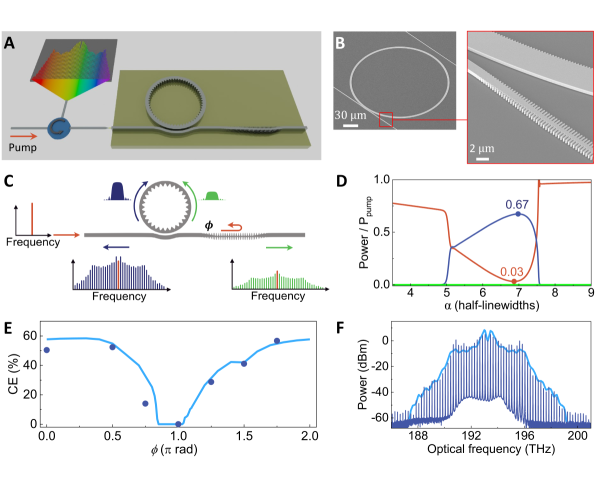
本文展示了一种带反射器的纳米光子双向 Kerr 谐振腔,在孤子微梳的激光功率转换效率方面接近单位,输入 40 mW 时达到 65% 转换效率和 97% 泵消耗。它将相干回散射与片上反射结合起来,以控制能量流并在正常色散 PhCR 中形成稳定的孤子。
Laser sources power extreme data transmission as well as computing acceleration, access to ultrahigh-speed signaling, and sensing for chemicals, distance, and pattern recognition. The ever-growing scale of these applications drives innovation in multi-wavelength lasers for massively parallel processing. We report a nanophotonic Kerr-resonator circuit that consumes the power of an input laser and generates a soliton frequency comb at approaching unit efficiency. By coupling forward and backward propagation, we realize a bidirectional Kerr resonator that supports universal phase matching but also opens excess loss by double-sided emission. Therefore, we induce reflection of the resonator's forward, external-coupling port to favor backward propagation, resulting in efficient, one-sided soliton formation. Coherent backscattering with nanophotonics provides the control to put arbitrary phase-matching and efficient laser-power consumption on equal footing in Kerr resonators. In the overcoupled-resonator regime, we measure 65% conversion efficiency of a 40 mW input pump laser, and the nonlinear circuit consumes 97% of the pump, generating the maximum possible comb power. Our work opens up high-efficiency soliton formation in integrated photonics, exploring how energy flows in nonlinear circuits and enabling laser sources for advanced transmission, computing, quantum sensing, and artificial-intelligence applications.
研究动机与目标
- Motivate high-density, energy-efficient soliton microcomb sources for integrated photonics.
- Show that coherent backscattering enables universal phase matching and enables control of energy flow in Kerr resonators.
- Demonstrate near-unit pump utilization by using a reflector to route forward pump power into backward-propagating solitons.
- Quantify how reflector phase and coupling (R and phi) affect conversion efficiency and threshold.
- Demonstrate compatibility with ITU-T grids and a chip-scale DFB laser for practical deployment.
提出的方法
- Model the forward and backward fields in a bidirectional Kerr resonator using the Lugiato-Lefever equation (LLE) with forward-backward coupling and a pump reflector.
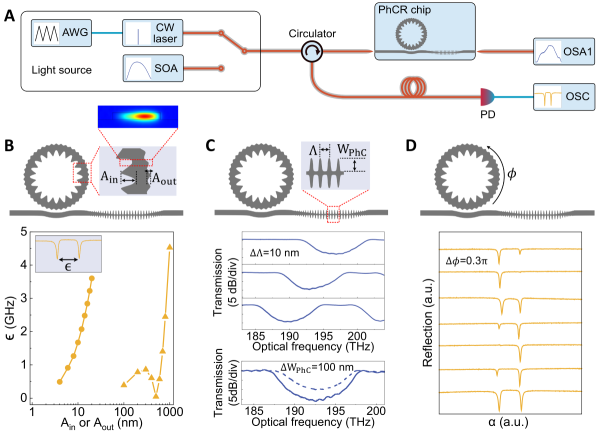
- Introduce a PhCR with split-mode coherence and a reflector on the coupling waveguide to control interference and energy flow.
- Define conversion efficiency CE = P_comb/P_pump and simulate power flow (P_f, P_b, P_comb^f, P_comb^b) as a function of detuning alpha and coupling K.
- Experimentally fabricate Ta2O5 PhCR devices with azimuthal width modulation and a reflector, and vary the reflection phase phi by rotating the PhCR.
- Characterize the split-mode parameters (epsilon), reflection bandwidth, and reflector reflectivity R to optimize CE and pump consumption.
- Compare measurements to LLE simulations to validate energy-flow control and soliton formation dynamics.
实验结果
研究问题
- RQ1Can coherent backscattering in a bidirectional Kerr resonator enable universal phase matching for soliton microcombs in normal dispersion while enabling high energy efficiency?
- RQ2What reflector design (R) and phase (phi) settings maximize pump-to-comb conversion efficiency and minimize unused pump power?
- RQ3How do forward and backward pump components contribute to soliton formation and overall energy consumption?
- RQ4Can the system achieve soliton coherent states with high spectral flatness and compatibility with ITU-T grids and chip-scale DFB lasers?
- RQ5What practical device metrics (threshold, yield, and stability) arise when targeting high CE in chip-scale nanophotonic circuits?
主要发现
- A bidirectional Kerr resonator with a reflector achieves up to 65% conversion efficiency and 97% pump consumption for soliton generation at 40 mW pump power.
- Backward propagation is favored for soliton excitation, and coherent backscattering enables effective phase matching in normal dispersion PhCRs.
- Reflector-assisted control of energy flow reduces unwanted forward pumping and enables near-unit energy usage of the input laser.
- Experiments show 200 GHz soliton trains with 20 comb lines above 0.5 mW and mode-to-mode power variation within 10 dB, aligned to ITU-T grids with <2.6 GHz mismatch across 27 modes.
- Simulation and experiment agree closely on CE dependence on the phase phi, with optimal phi yielding high CE and low unused pump power.
- Threshold power is reduced by ~2.9x with the reflector compared to a PhCR without a reflector under similar coupling, due to bidirectional pump distribution and energy routing.
- Device fabrication yields show CE around 50% with ~40 mW pump for 11 devices on a chip, illustrating variation but overall robustness and compatibility with chip-scale lasers
阅读本论文
在 Nubint 阅读器中打开原文,边读边就任意段落提问。
在 Nubint 中阅读本论文本解读由 AI 根据论文原文生成,引用前请核对原文。