
[论文解读] Late Breaking Results: Fortifying Neural Networks: Safeguarding Against Adversarial Attacks with Stochastic Computing
论文提出在推理阶段使用随机计算,尤其在前几层卷积层,以提高神经网络对对抗性攻击的鲁棒性,在 LeNet-5(MNIST) 与 ResNet-20(CIFAR-10) 上对 L2/Carlini-Wagner 攻击进行展示。
In neural network (NN) security, safeguarding model integrity and resilience against adversarial attacks has become paramount. This study investigates the application of stochastic computing (SC) as a novel mechanism to fortify NN models. The primary objective is to assess the efficacy of SC to mitigate the deleterious impact of attacks on NN results. Through a series of rigorous experiments and evaluations, we explore the resilience of NNs employing SC when subjected to adversarial attacks. Our findings reveal that SC introduces a robust layer of defense, significantly reducing the susceptibility of networks to attack-induced alterations in their outcomes. This research contributes novel insights into the development of more secure and reliable NN systems, essential for applications in sensitive domains where data integrity is of utmost concern.
研究动机与目标
- 评估随机计算(SC)是否能提升神经网络对对抗攻击的鲁棒性。
- 识别在 SC 中哪些层和比特流配置对鲁棒性贡献最大。
- 评估基于 SC 的防御在简单的(LeNet-5/MNIST)和复杂的(ResNet-20/CIFAR-10)架构上的表现。
提出的方法
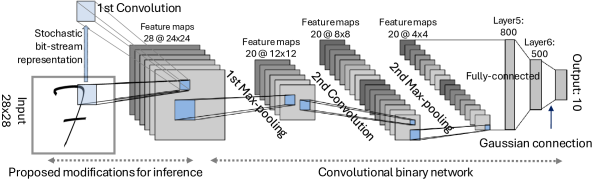
- 在目标卷积层中用基于 SC 的比特流乘法器替代乘法,使用按位 AND 运算。
- 将输入和权重编码为通过准随机 Sobol 序列生成的随机比特流。
- 将 SC 应用聚焦在第一层卷积层上,以降低复杂度同时保持准确性。
- 仅在推理阶段进行修改;训练阶段保持不变。
- 评估对 MNIST 和 CIFAR-10 数据集的白盒 L2(Carlini-Wagner)对抗攻击的防御效果。
实验结果
研究问题
- RQ1在不重新训练的情况下,在早期层中引入 SC 是否能提高对抗扰动的鲁棒性?
- RQ2哪些层和比特流长度在攻击下优化鲁棒性与准确率之间的权衡?
- RQ3基于 SC 的推理是否能在 CIFAR-10 的 ResNet-20 等复杂网络上对抗 L2 攻击?
- RQ4与现有防御方法相比,基于 SC 的防御在攻击下的误分类方面表现如何?
主要发现
- 第一卷积层的 SC 显著提升鲁棒性,而单独在第二层应用 SC 对于小比特流而言收益较少。
- 在 MNIST 的 LeNet-5 在攻击前保持接近原始准确率(≈99%),在攻击后经 SC 防御,某些配置下准确率提高至最高 79%。
- 在 CIFAR-10 的 ResNet-20 显示出鲁棒性提升,且随着比特流长度增加(例如 N=256),达到常规准确度水平;在某些配置下,攻击后的准确率可达 85%。
- 在攻击下,受保护的模型误分类率显著降低(例如 10% 的误分类)相比现有的最先进基准。
- 该方法避免重新训练,能够适应简单与复杂的网络,提供一种面向安全 AI 系统的实用防御。
- 研究表明,在推理阶段,随机处理能够在对抗性干扰存在的情况下维持或恢复准确性。
阅读本论文
在 Nubint 阅读器中打开原文,边读边就任意段落提问。
在 Nubint 中阅读本论文本解读由 AI 根据论文原文生成,引用前请核对原文。