
[论文解读] Latent Stochastic Differential Equations for Modeling Quasar Variability and Inferring Black Hole Properties
本文提出了一种潜在随机微分方程(SDE)模型,用于在不规则采样和长时间间隙的情况下,联合重建多波段类星体光变曲线并推断黑洞质量、倾角和温度斜率等物理属性。该模型在模拟的LSST数据上进行训练,其重建精度优于多输出高斯过程回归,在处理观测挑战时表现出更强的鲁棒性,能够从随机变异性中实现物理参数的可靠推断。
Quasars are bright and unobscured active galactic nuclei (AGN) thought to be powered by the accretion of matter around supermassive black holes at the centers of galaxies. The temporal variability of a quasar's brightness contains valuable information about its physical properties. The UV/optical variability is thought to be a stochastic process, often represented as a damped random walk described by a stochastic differential equation (SDE). Upcoming wide-field telescopes such as the Rubin Observatory Legacy Survey of Space and Time (LSST) are expected to observe tens of millions of AGN in multiple filters over a ten year period, so there is a need for efficient and automated modeling techniques that can handle the large volume of data. Latent SDEs are machine learning models well suited for modeling quasar variability, as they can explicitly capture the underlying stochastic dynamics. In this work, we adapt latent SDEs to jointly reconstruct multivariate quasar light curves and infer their physical properties such as the black hole mass, inclination angle, and temperature slope. Our model is trained on realistic simulations of LSST ten year quasar light curves, and we demonstrate its ability to reconstruct quasar light curves even in the presence of long seasonal gaps and irregular sampling across different bands, outperforming a multioutput Gaussian process regression baseline. Our method has the potential to provide a deeper understanding of the physical properties of quasars and is applicable to a wide range of other multivariate time series with missing data and irregular sampling.
研究动机与目标
- 开发一种可扩展、可微分的多变量类星体光变曲线模型,适用于不规则采样和长时间间隙。
- 联合重建观测到的光变曲线,并推断内在物理参数,如黑洞质量、倾角和温度斜率。
- 实现从大规模巡天(如LSST)中对类星体参数群体分布的分层推断。
- 在应对观测挑战(如不规则采样、数据缺失)时,改进现有高斯过程回归基线在光变曲线重建和结构函数恢复方面的性能。
- 证明潜在SDE在存在缺失数据的随机天体物理时间序列中实现物理推断的可行性。
提出的方法
- 该模型采用潜在SDE框架,将类星体亮度变异性背后的随机动力学表示为连续时间扩散过程。
- 将多波段光变曲线作为共享潜在过程的观测,通过波段特定的转移函数建模波长相关的时移。
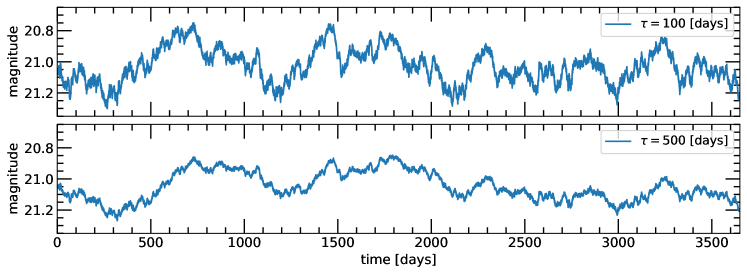
- 在具有十年基线、不规则观测周期和季节性间隙的现实LSST模拟光变曲线上进行端到端训练。
- 使用神经网络参数化SDE的漂移和扩散函数,实现对复杂变异性灵活、数据驱动的建模。
- 通过变分推断与随机梯度采样进行推断,支持不确定性量化和后验估计。
- 该框架支持光变曲线的联合重建与物理参数推断,包括对群体分布的分层建模。
实验结果
研究问题
- RQ1潜在SDE模型能否在不规则采样和长时间间隙下准确重建多波段类星体光变曲线?
- RQ2潜在SDE在多大程度上能从随机变异性中推断出黑洞质量、倾角和温度斜率等物理参数?
- RQ3潜在SDE在光变曲线重建和结构函数恢复方面与多输出高斯过程回归相比表现如何?
- RQ4该模型能否实现对类星体参数群体分布的稳健分层推断?
- RQ5观测效应(如观测周期和间隙)对物理参数可恢复性有何影响?
主要发现
- 在不规则采样和长时间季节性间隙下,潜在SDE模型在重建类星体光变曲线方面优于多输出高斯过程回归。
- 该模型成功恢复了模拟类星体光变曲线的真实结构函数,平均预测值与真实值高度吻合。
- 对黑洞质量、倾角和温度斜率等物理参数的推断中,中位预测值接近真实值,且在95%的测试案例中,1σ不确定性区间覆盖了真实值。
- 该模型支持分层推断,可估计温度斜率等参数的群体分布,从而对吸积盘和风模型提供约束。
- 潜在SDE框架对观测挑战(如缺失数据和不规则采样)表现出鲁棒性,适用于LSST规模的巡天。
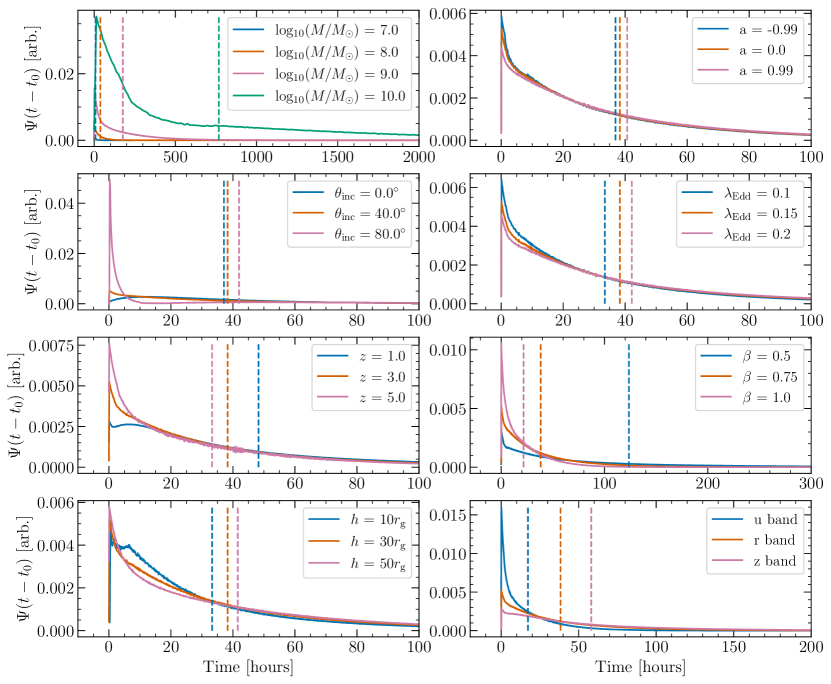
- 仅当时间延迟或变异性宽度相对于时间分箱足够大时,参数恢复才可行;时间效应小于12小时的参数可能无法恢复。
阅读本论文
在 Nubint 阅读器中打开原文,边读边就任意段落提问。
在 Nubint 中阅读本论文本解读由 AI 根据论文原文生成,引用前请核对原文。