
[论文解读] Latent Style-based Quantum GAN for high-quality Image Generation
LaSt-QGAN 使用一个经典自编码器将图像映射到潜在空间,使用量子生成器产生潜在特征,从而在 MNIST、FashionMNIST 和 SAT4 上实现大尺寸图像生成,且性能与经典 GAN 相当,附带对拍摄噪声和贫瘠平台的分析。
Quantum generative modeling is among the promising candidates for achieving a practical advantage in data analysis. Nevertheless, one key challenge is to generate large-size images comparable to those generated by their classical counterparts. In this work, we take an initial step in this direction and introduce the Latent Style-based Quantum GAN (LaSt-QGAN), which employs a hybrid classical-quantum approach in training Generative Adversarial Networks (GANs) for arbitrary complex data generation. This novel approach relies on powerful classical auto-encoders to map a high-dimensional original image dataset into a latent representation. The hybrid classical-quantum GAN operates in this latent space to generate an arbitrary number of fake features, which are then passed back to the auto-encoder to reconstruct the original data. Our LaSt-QGAN can be successfully trained on realistic computer vision datasets beyond the standard MNIST, namely Fashion MNIST (fashion products) and SAT4 (Earth Observation images) with 10 qubits, resulting in a comparable performance (and even better in some metrics) with the classical GANs. Moreover, we analyze the barren plateau phenomena within this context of the continuous quantum generative model using a polynomial depth circuit and propose a method to mitigate the detrimental effect during the training of deep-depth networks. Through empirical experiments and theoretical analysis, we demonstrate the potential of LaSt-QGAN for the practical usage in the context of image generation and open the possibility of applying it to a larger dataset in the future.
研究动机与目标
- 激励并开发一个能够生成大尺寸图像的混合经典-量子GAN(LaSt-QGAN)。
- 利用预训练的卷积自编码器将高维图像映射到潜在空间,以便进行高效的量子生成。
- 用经典判别器训练量子生成器,以再现潜在特征并通过自编码器重建图像。
- 在 MNIST、FashionMNIST 和 SAT4 上评估 LaSt-QGAN,并与匹配的经典 GAN 进行比较。
- 探究对拍摄噪声的鲁棒性并分析贫瘠平台现象,以为连续量子生成模型的可训练性提供参考。
提出的方法
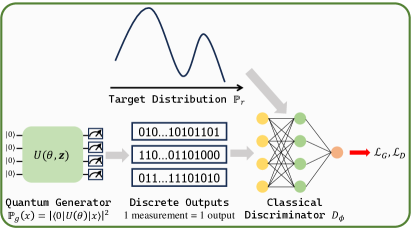
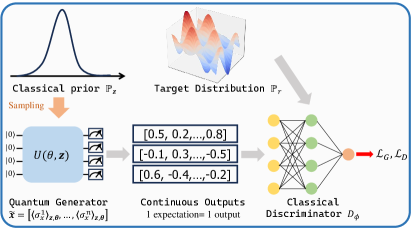
- 使用预训练的卷积自编码器将图像编码到维度为 Dℓ 的潜在空间;在该潜在空间中训练量子生成器 Gθ 和带有 Wasserstein 损失与梯度惩罚的经典判别器 Dφ。
- 采用参数化量子电路(基于风格的生成器),其中潜在噪声 z 被嵌入到旋转角中;使用具有 θℓ = Wℓ z + bℓ 的 L 层(数据重新叠加概念)。
- 在 n 个量子比特上测量期望值 ⟨σx⟩ 和 ⟨σz⟩ 作为潜在特征,并连接成一个 2n 维特征向量供判别器使用。
- 通过将生成的潜在特征传递给(预训练的)自编码器解码器来重建图像;使用 Wasserstein 距离目标来使真实潜在特征与伪造特征相匹配进行训练。
- 比较多种量子电路结构(Circuits 1–3),并在特征与重建图像上用 FID、IS、JSD 进行性能量化。
- 评估训练动态和对拍摄噪声的鲁棒性,并分析贫瘠平台行为,提出多项多项式深度电路的初始化策略。
实验结果
研究问题
- RQ1LaSt-QGAN 是否能够通过在从高维数据映射的潜在空间中工作来生成大尺寸图像?
- RQ2在 MNIST、FashionMNIST 和 SAT4 数据集上,LaSt-QGAN 与具有相似参数量的经典 GAN 的性能对比如何?
- RQ3量子电路深度与架构对生成质量和训练稳定性有何影响?
- RQ4LaSt-QGAN 对拍摄噪声(有限采样)的鲁棒性如何,哪些训练策略可减缓潜在的贫瘠平台效应?
主要发现
- LaSt-QGAN 可以生成大尺寸图像,并在 MNIST、FashionMNIST 和 SAT4 上与具有相似规模的经典 GAN 相比,达到具有竞争力甚至优于的指标(FID、IS、JSD)。
- 在多种电路深度下,LaSt-QGAN 相较于经典 GAN 在 MNIST 和 FashionMNIST 上显示出更快的收敛和更高的稳定性。
- 对于 MNIST 和 FashionMNIST,LaSt-QGAN 在 JSD 值上更低,且 FID/IS 趋势更有利,表明在学习数据分布和多样性方面更出色。
- 在 SAT4 上,LaSt-QGAN 在所有评估指标上优于经典 GAN,同时使用的参数量约为后者的一半左右。
- t-SNE 可视化显示生成的特征形成类别分离的簇,表明生成中保留了潜在结构。
- 本研究为通过对小角度初始化来缓解多项式深度电路的贫瘠平台效应提供了一种方法,从而增强了对连续量子生成模型的可训练性。
阅读本论文
在 Nubint 阅读器中打开原文,边读边就任意段落提问。
在 Nubint 中阅读本论文本解读由 AI 根据论文原文生成,引用前请核对原文。