
[论文解读] Lateral Phishing With Large Language Models: A Large Organization Comparative Study
简要:该研究在大型大学环境中调查由大语言模型生成的横向钓鱼,比较 AI 制作的邮件与人工制作的邮件,并提出基于机器学习的检测器,在评估影响和培训需求时实现高 F1 分数。
The emergence of Large Language Models (LLMs) has heightened the threat of phishing emails by enabling the generation of highly targeted, personalized, and automated attacks. Traditionally, many phishing emails have been characterized by typos, errors, and poor language. These errors can be mitigated by LLMs, potentially lowering the barrier for attackers. Despite this, there is a lack of large-scale studies comparing the effectiveness of LLM-generated lateral phishing emails to those crafted by humans. Current literature does not adequately address the comparative effectiveness of LLM and human-generated lateral phishing emails in a real-world, large-scale organizational setting, especially considering the potential for LLMs to generate more convincing and error-free phishing content. To address this gap, we conducted a pioneering study within a large university, targeting its workforce of approximately 9,000 individuals including faculty, staff, administrators, and student workers. Our results indicate that LLM-generated lateral phishing emails are as effective as those written by communications professionals, emphasizing the critical threat posed by LLMs in leading phishing campaigns. We break down the results of the overall phishing experiment, comparing vulnerability between departments and job roles. Furthermore, to gather qualitative data, we administered a detailed questionnaire, revealing insights into the reasons and motivations behind vulnerable employee's actions. This study contributes to the understanding of cyber security threats in educational institutions and provides a comprehensive comparison of LLM and human-generated phishing emails' effectiveness, considering the potential for LLMs to generate more convincing content. The findings highlight the need for enhanced user education and system defenses to mitigate the growing threat of AI-powered phishing attacks.
研究动机与目标
- 评估在大型教育机构中横向钓鱼攻击的有效性。
- 比较 LLM 制作与人工制作的横向钓鱼邮件的影响。
- 评估在使用内部信息与外部组织信息时有效性的差异。
- 评估钓鱼培训与警示对横向钓鱼的有效性。
- 探索用于识别 LLM 生成的钓鱼邮件的检测器。
提出的方法
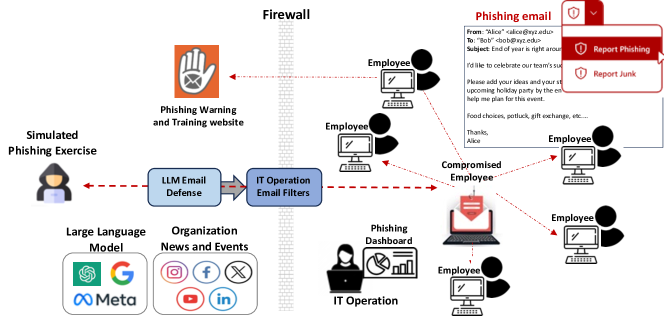
- 利用现有的钓鱼仿真基础设施,在约 9,000 名员工中开展为期 11 个月的研究。
- 创建并测试多种钓鱼模板,包括人工撰写和 LLM 撰写的邮件。
- 使用内部组织数据和外部信息来编写 LLM 邮件,并与人工邮件进行比较。
- 衡量用户互动(打开、点击、输入数据、报告)并计算基于风险的安全姿态分数。
- 开发并评估基于 ML 的检测器,以高 F1 分数(0.9896)识别 LLM 生成的钓鱼邮件。
- 描述威胁模型并将发现与组织培训和政策考量相结合。
实验结果
研究问题
- RQ1RQ1:在大型教育组织中横向钓鱼攻击的有效性如何?
- RQ2RQ2:LLM 制作的横向钓鱼邮件是否与人工生成的横向钓鱼邮件具有相似的影响?
- RQ3RQ3:在使用内部与外部组织信息时,LLM 生成的鱼叉式钓鱼邮件的有效性有何差异?
- RQ4RQ4:在组织层面,钓鱼培训和警示对横向钓鱼的有效性如何?
- RQ5RQ5:是否可以使用 LLM 检测器来识别 LLM 生成的钓鱼邮件?
主要发现
- 约 10% 的收件人在对 LLM 生成的钓鱼邮件作出响应时点击并输入凭据。
- 钓鱼事件在 2023 年安全事件中占比 35.2%,2022 年约 1,947 起,2023 年增至约 2,245 起。
- 在过去 60 天内检测到超过 18,693 次进入钓鱼尝试,其中 934 次攻击绕过了自动过滤器。
- 为期 11 个月的研究覆盖约 9,000 名员工,使用 20+ 个模板;10 月(人工撰写)与 11 月(LLM 撰写)模板实现了 AI 与人工生成的比较。
- 基于 LLM 的检测技术在识别被现有基础设施漏检的邮件方面达到 98.96% 的 F1 分数。
- 研究强调需要将反钓鱼防御与 LLM 检测方法整合,并更新组织政策。
阅读本论文
在 Nubint 阅读器中打开原文,边读边就任意段落提问。
在 Nubint 中阅读本论文本解读由 AI 根据论文原文生成,引用前请核对原文。