
[论文解读] Lattice Realizations of Topological Defects in the critical (1+1)-d Three-State Potts Model
该论文构建并分析关键(1+1)-维三态 Potts 模型的拓扑线缺陷在格子实现中的表述,通过 ED/DMRG、纠缠熵和 g-函数将格子缺陷/线算符与它们在连续 CFT 中的对应联系起来。
Topological/perfectly-transmissive defects play a fundamental role in the analysis of the symmetries of two dimensional conformal field theories (CFTs). In the present work, spin chain regularizations for these defects are proposed and analyzed in the case of the three-state Potts CFT. In particular, lattice versions for all the primitive defects are presented, with the remaining defects obtained from the fusion of the primitive ones. The defects are obtained by introducing modified interactions around two given sites of an otherwise homogeneous spin chain with periodic boundary condition. The various primitive defects are topological on the lattice except for one, which is topological only in the scaling limit. The lattice models are analyzed using a combination of exact diagonalization and density matrix renormalization group techniques. Low-lying energy spectra for different defect Hamiltonians as well as entanglement entropy of blocks located symmetrically around the defects are computed. The latter provides a convenient way to compute the $g$-function which characterizes various defects. Finally, the eigenvalues of the line operators in the "crossed channel'' and fusion of different defect lines are also analyzed. The results are all in agreement with expectations from conformal field theory.
研究动机与目标
- 通过对三态 Potts 模型的晶格正则化,激发并研究 1+1D CFT 中的拓扑/缺陷线及其动机。
- 为原始拓扑线(η, C, N, W)提供格子实现并推导它们的融合规则和作用。
- 计算缺陷谱和基于纠缠的 g-函数,以检验连续 CFT 的预测。
- 证明格子线算符在 primaries 和缺陷希尔伯特空间上 reproduces 连续理论的作用。
提出的方法
- 在 L 近邻晶格上定义临界周期链 Potts 哈密顿量,并用 Potts/Temperley-Lieb 生成元表示。
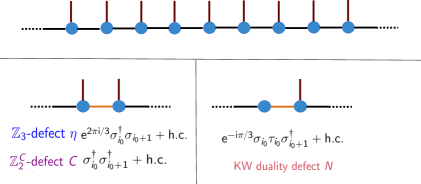
- 通过对相邻两点的局部修改来构造格子缺陷;定义缺陷哈密顿量 H_D。
- 使用对称性作用和可积性传输矩阵方法在晶格上构造线算符;通过谱参数平移实现 N 和 W。
- 利用精确对角化和 DMRG 获取含缺陷系统的低-能谱与纠缠熵。
- 从纠缠熵的标度中提取 g-函数,并将 η、C、N、W 缺陷与 CFT 预测进行比较。
- 将格子 RSOS(D4)实现与 Potts 链联系起来,讨论基之间的等价性/简并性。
- 利用模变换将缺陷谱 Z_D 与跨通道线算符(Ď)的关系联系起来。
实验结果
研究问题
- RQ1晶格对应物在临界三态 Potts 模型中的原始拓扑线 η、C、N、W 是什么?
- RQ2晶格上的缺陷谱、线算符本征值和基于纠缠的 g-函数是否与连续 Potts CFT 的预测一致?
- RQ3RSOS 与 TL 可积构造如何在晶格上实现 N 和 W 线,它们是否复现融合规则?
- RQ4是否可以利用纠缠熵提取缺陷的 g-函数并验证其对每个缺陷的期望值?
- RQ5晶格线算符的跨通道行为和在 primaries 上的作用是否与 CFT 的期望一致?
主要发现
- η、C、N 的晶格实现在格子上具有拓扑性;而 W 缺陷在有限晶格间距下并非拓扑,但在极限连续时流向 W 线。
- 从纠缠熵中提取的缺陷 g-函数值与 CFT 期望一致:g_η = g_C = 1,g_N = sqrt(3),g_W = (1+√5)/2。
- η̂、Ĉ、N̂ 在晶格上是拓扑的;N̂ 实现 Potts 链上的 Kramers–Wannier 对称性,而 Ŵ 并非拓扑但会流向连续线。
- N 和 N′(其中 N′ = CN)可以通过可积晶格方法或对半链进行 Z3 规约来构造,且满足 Z3 Tambara–Yamagami 融合规则。
- N̂ 在 Temperley–Lieb 代数中是中心元,并在缺陷希尔伯特空间上有非平凡作用,如缺陷谱表所示。
- 跨通道谱 Z_D 与线算符在 primaries 上的作用与 Potts CFT 的表格一致,证实格子实现再现了连续理论的期望。
阅读本论文
在 Nubint 阅读器中打开原文,边读边就任意段落提问。
在 Nubint 中阅读本论文本解读由 AI 根据论文原文生成,引用前请核对原文。