
[论文解读] LDM3D: Latent Diffusion Model for 3D
LDM3D 将潜在扩散扩展为从文本提示同时生成 RGB 和深度图,实现 RGBD 输出和通过 DepthFusion 与 TouchDesigner 提供沉浸式 360° 体验。
This research paper proposes a Latent Diffusion Model for 3D (LDM3D) that generates both image and depth map data from a given text prompt, allowing users to generate RGBD images from text prompts. The LDM3D model is fine-tuned on a dataset of tuples containing an RGB image, depth map and caption, and validated through extensive experiments. We also develop an application called DepthFusion, which uses the generated RGB images and depth maps to create immersive and interactive 360-degree-view experiences using TouchDesigner. This technology has the potential to transform a wide range of industries, from entertainment and gaming to architecture and design. Overall, this paper presents a significant contribution to the field of generative AI and computer vision, and showcases the potential of LDM3D and DepthFusion to revolutionize content creation and digital experiences. A short video summarizing the approach can be found at https://t.ly/tdi2.
研究动机与目标
- 从文本提示中生成功能一致的 RGBD 输出(RGB 图像加深度图)的动机。
- 利用从 Stable Diffusion 适配的 KL 正则化潜在扩散框架进行 RGBD 合成。
- 在潜在空间对联合 RGB 和深度输入进行处理的 KL 自动编码器进行微调。
- 演示利用生成的 RGBD 数据的沉浸式 360° 流水线(DepthFusion)。
- 在与已建立基线的对比中评估图像保真度和深度精度以验证质量。
提出的方法
- 使用来自 Stable Diffusion v1.4 的 1.6B 参数 KL 正则化扩散模型,并对其进行修改以生成 RGBD 输出。
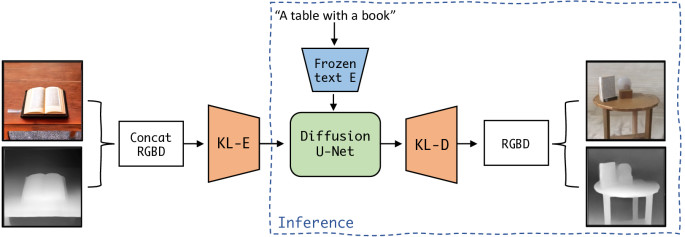
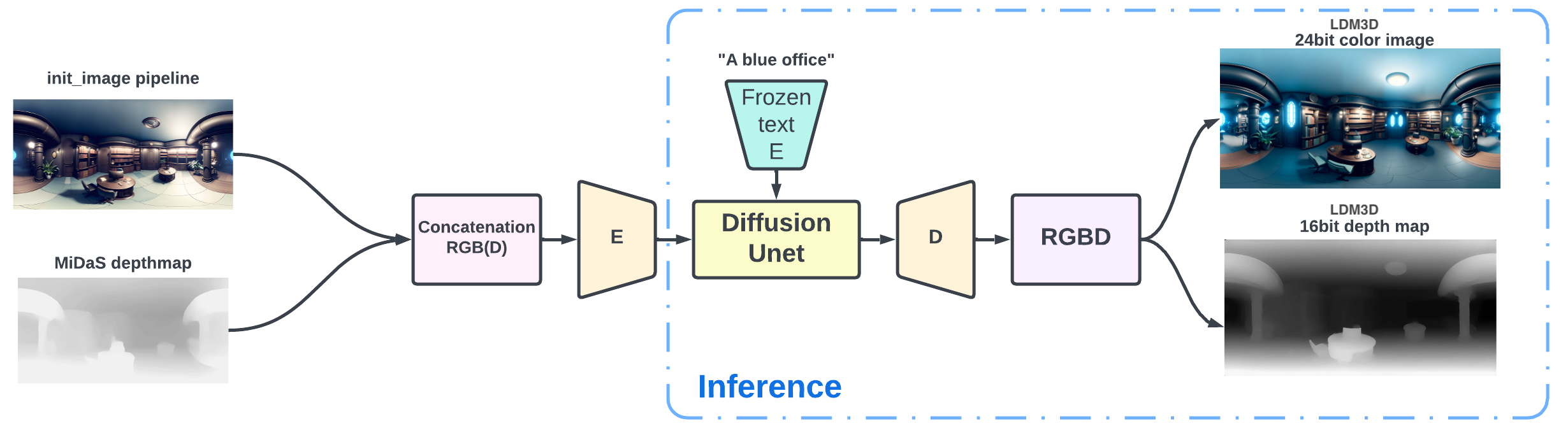
- 通过将 16 位深度图转换为 3 通道的 RGB 类数组并与 RGB 图像拼接来形成六通道输入(512x512x6)进行数据预处理。
- 对 RGBD 元组(图像、深度、字幕)进行 KL 自动编码器微调,降采样因子为 8,采用联合感知/对抗损失。
- 在潜在空间对扩散模型进行微调,使用冻结的自编码器表示(64x64x4)和一个带预测噪声的扩散损失 L_LDM3D,从 Stable Diffusion v1.4 权重开始。
- 用冻结的 CLIP 文本编码器对文本进行条件化,并应用跨注意力将提示映射到 U-Net 层。
- 使用 MS-COCO FID、IS、CLIP 和对 ZoeDepth 对齐的深度指标进行评估;与 SD 基线和 DPT-Large 深度估计进行对比。
实验结果
研究问题
- RQ1一个 RGBD 扩散模型能否从单一文本提示生成高质量的 RGB 图像和准确的深度图?
- RQ2联合 RGBD 训练对深度质量和图像保真度相较于仅 RGB 的扩散模型有何影响?
- RQ3条件强度(引导尺度)、DDIM 步数和训练进度对 RGBD 输出有何影响?
- RQ4生成的 RGBD 输出能否在 TouchDesigner 中有效用于创建沉浸式 360° 体验(DepthFusion)?
- RQ5在标准数据集上,LDM3D 与基线在图像和深度评估指标方面有何对比?
主要发现
- LDM3D 在 MS-COCO(512x512)上使用相同参数量、50 次 DDIM 步数时,与 Stable Diffusion 基线相比在 FID 与 CLIP 评分上具有竞争力。
- 对齐 ZoeDepth 的深度评估显示 LDM3D 达到 AbsRel 0.0911 和 RMSE 0.334 米,接近 DPT-Large 的 AbsRel 0.0779 和 RMSE 0.297。
- 对 RGBD 输入进行自动编码器微调在相对 FID 上仅产生轻微降级(预训练 KL-AE,RGB rFID 0.763 vs 微调后 KL-AE,RGBD rFID 1.966),但实现了有效的 RGBD 生成。
- LDM3D 输出高质量的深度图,与输入提示对齐,CLIP 相似度提升和定性深度可视化所示。
- DepthFusion 流水线显著将生成的 RGBD 输出转化为沉浸式 360° 视图,借助 TouchDesigner 实现交互式体验。
阅读本论文
在 Nubint 阅读器中打开原文,边读边就任意段落提问。
在 Nubint 中阅读本论文本解读由 AI 根据论文原文生成,引用前请核对原文。