
[论文解读] Learned Thresholds Token Merging and Pruning for Vision Transformers
LTMP 将令牌合并与修剪结合学习阈值,能够自适应地减少 Vision Transformer 的令牌数量,在单 epoch 微调下在不同 FLOPs 下降区域保持较强准确性。
Vision transformers have demonstrated remarkable success in a wide range of computer vision tasks over the last years. However, their high computational costs remain a significant barrier to their practical deployment. In particular, the complexity of transformer models is quadratic with respect to the number of input tokens. Therefore techniques that reduce the number of input tokens that need to be processed have been proposed. This paper introduces Learned Thresholds token Merging and Pruning (LTMP), a novel approach that leverages the strengths of both token merging and token pruning. LTMP uses learned threshold masking modules that dynamically determine which tokens to merge and which to prune. We demonstrate our approach with extensive experiments on vision transformers on the ImageNet classification task. Our results demonstrate that LTMP achieves state-of-the-art accuracy across reduction rates while requiring only a single fine-tuning epoch, which is an order of magnitude faster than previous methods. Code is available at https://github.com/Mxbonn/ltmp .
研究动机与目标
- Motivate reducing Vision Transformer computation by adaptive token reduction.
- Propose a framework that couples token merging and pruning with learnable thresholds.
- Enable fast convergence by limiting fine-tuning to thresholds only and using a budget-aware loss.
- Show state-of-the-art accuracy at multiple reduction targets across DeiT variants.
提出的方法
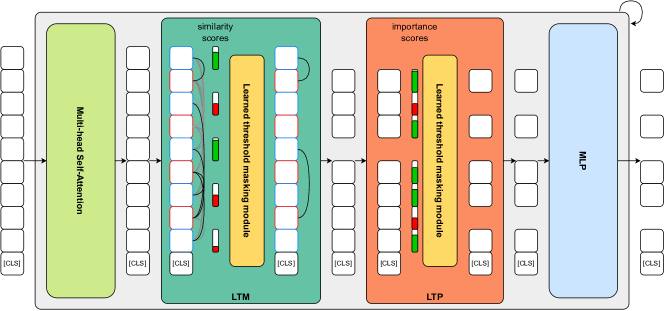
- Add merging (LTM) and pruning (LTP) modules between MSA and MLP in each transformer block.
- Use learned threshold masking to decide which tokens to prune or merge in each layer.
- Modify the attention mechanism to include masked softmax for pruned/merged tokens (Attention_with_mask).
- Apply a budget-aware training loss that targets a desired FLOPs reduction r_target and computes r_FLOPs from layer-wise token masks.
- Train only the two thresholds per block while keeping other parameters fixed for single-epoch convergence.
实验结果
研究问题
- RQ1Can token merging and pruning be effectively combined in Vision Transformers without sacrificing accuracy?
- RQ2Do learned thresholds enable adaptive, layer-wise distribution of token reduction to meet a FLOPs budget?
- RQ3How does LTMP compare to prior token reduction methods in accuracy and required fine-tuning epochs?
主要发现
- LTMP achieves strong accuracy across various token-reduction targets, outperforming prior token pruning methods at comparable FLOPs.
- LTMP converges within a single fine-tuning epoch, introducing only two learnable parameters per transformer block.
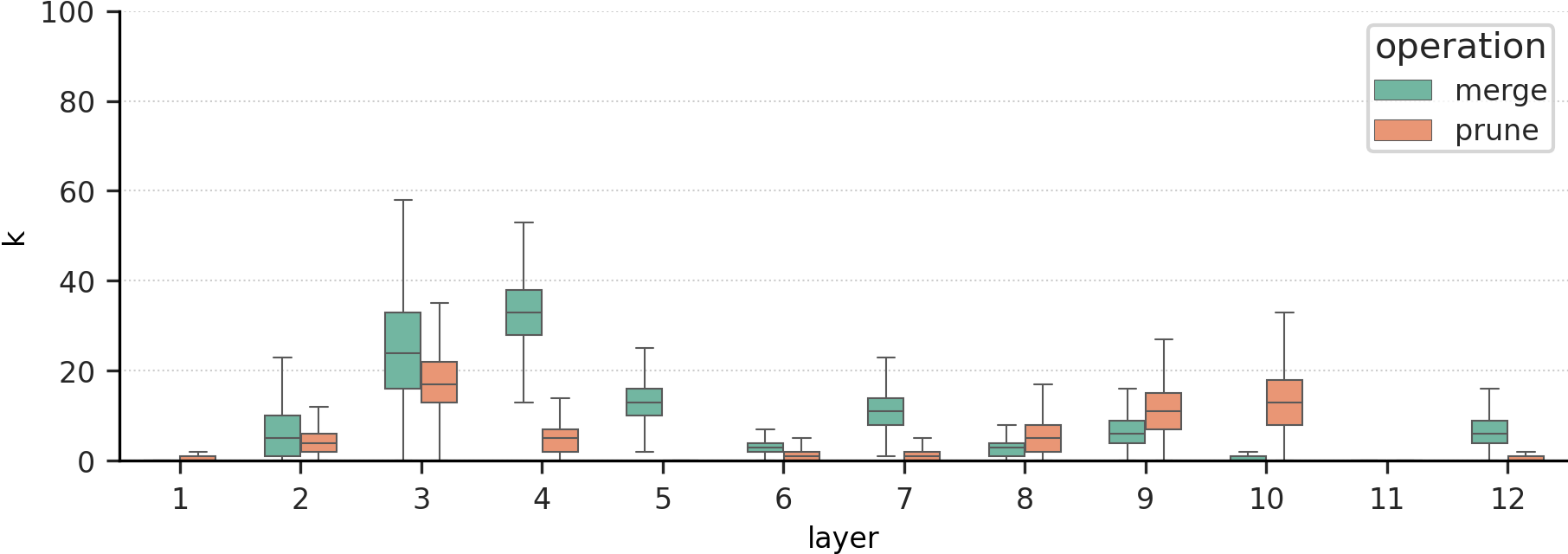
- The budget-aware loss effectively distributes pruning and merging across layers to meet r_target reductions.
- LTMP shows favorable accuracy-FLOPs trade-offs versus ToMe and other learnable pruning methods, with substantially fewer fine-tuning epochs.
- Inference latency improvements on mobile devices correlate closely with FLOPs reductions (about 50% latency reduction for DeiT-S at r_FLOPs≈0.5).
阅读本论文
在 Nubint 阅读器中打开原文,边读边就任意段落提问。
在 Nubint 中阅读本论文本解读由 AI 根据论文原文生成,引用前请核对原文。