
[论文解读] Learning by Reconstruction Produces Uninformative Features For Perception
本文表明,基于重构的表征学习会优先关注高方差、低信息量的特征,这解释了为何模型需要长时间训练和微调。研究证明,掩码噪声有助于学习感知上有用的特征,而加性高斯噪声则不然,并确定了噪声策略在何种情况下会普遍失效。
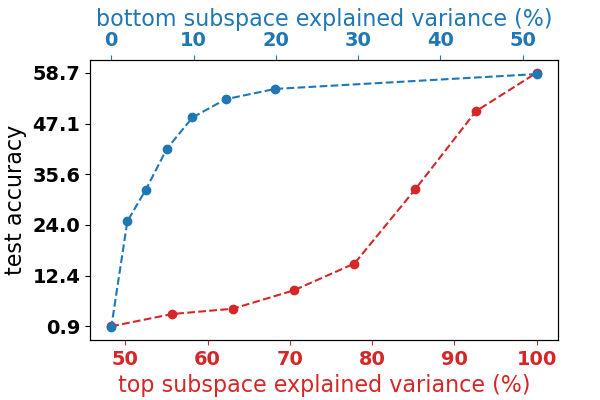
Input space reconstruction is an attractive representation learning paradigm. Despite interpretability of the reconstruction and generation, we identify a misalignment between learning by reconstruction, and learning for perception. We show that the former allocates a model's capacity towards a subspace of the data explaining the observed variance--a subspace with uninformative features for the latter. For example, the supervised TinyImagenet task with images projected onto the top subspace explaining 90\% of the pixel variance can be solved with 45\% test accuracy. Using the bottom subspace instead, accounting for only 20\% of the pixel variance, reaches 55\% test accuracy. The features for perception being learned last explains the need for long training time, e.g., with Masked Autoencoders. Learning by denoising is a popular strategy to alleviate that misalignment. We prove that while some noise strategies such as masking are indeed beneficial, others such as additive Gaussian noise are not. Yet, even in the case of masking, we find that the benefits vary as a function of the mask's shape, ratio, and the considered dataset. While tuning the noise strategy without knowledge of the perception task seems challenging, we provide first clues on how to detect if a noise strategy is never beneficial regardless of the perception task.
研究动机与目标
- 探究为何基于重构的表征学习尽管生成性能强大,却无法为感知任务生成有效特征。
- 识别自编码器中重构能力与感知效用之间错位的根本原因。
- 评估不同噪声策略(尤其是掩码与加性高斯噪声)对学习感知相关特征的影响。
- 提供理论与实证标准,用于判断某种噪声策略是否在根本上对任何下游任务均无效。
- 通过分析潜在空间中的特征学习顺序,解释掩码自编码器等模型为何需要长时间训练。
提出的方法
- 将ImageNet数据投影到主成分子空间(方差前75%与后25%),以评估在ResNet9上的下游分类准确率。
- 通过追踪损失在特征空间中的演化,分析深度自编码器的训练动态,表明低方差特征最后被学习。
- 推导出不同噪声分布下去噪自编码器在最小化重构误差的同时最大化感知效用的理论条件。
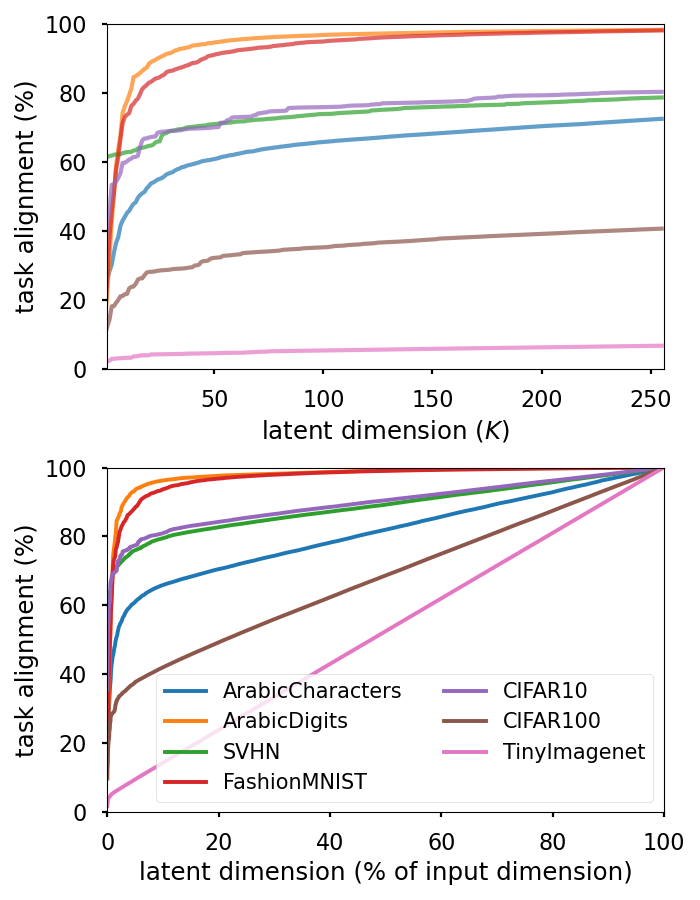
- 使用快速特征分解与基于SVD的对齐度量,高效评估潜在维度上的表征质量。
- 通过梯度下降优化实证验证理论假设,并比较不同噪声类型与超参数下的损失收敛情况。
- 引入一种基于超参数扫描的度量方法,评估在不同潜在维度与噪声类型下,重构数据与原始数据之间的对齐程度。
实验结果
研究问题
- RQ1为何基于重构的模型(如自编码器)尽管重构质量良好,却无法为感知任务生成有用特征?
- RQ2数据子空间的方差与其在图像分类等下游感知任务中的效用之间有何关系?
- RQ3为何使用重构训练的模型需要长时间训练和微调才能在感知任务上取得良好性能?
- RQ4在何种条件下,噪声策略(如掩码与高斯噪声)可被严格证明对学习感知有用特征有益或无效?
- RQ5我们能否在事前检测出某种噪声策略是否在任何下游任务下都永远无法提升感知表征学习?
主要发现
- 在方差前75%的像素方差子空间上训练ResNet9,TinyImageNet上的top-1准确率仅为45%,表明其感知效用极低。
- 相反,在方差后25%的子空间上投影可达到55%的测试准确率,表明对重构无用的特征实际上对感知任务具有信息量。
- 感知最有用的特征在自编码器中最后被学习,因为解释最多方差的主特征空间最先被学习,这解释了为何需要长时间训练。
- 掩码噪声在理论上对学习感知有用特征具有优势,而加性高斯噪声则不然,因其无法有效破坏高方差分量。
- 即使重构误差相同,不同模型在ImageNet-10上的准确率差距可从50%到接近90%,凸显了基于重构学习的病态本质。
- 若某种噪声策略无法以能促使学习低方差、感知相关特征的方式破坏高方差子空间,则其对感知永远无益,这种失效可通过噪声分布的谱影响理论分析检测到。
阅读本论文
在 Nubint 阅读器中打开原文,边读边就任意段落提问。
在 Nubint 中阅读本论文本解读由 AI 根据论文原文生成,引用前请核对原文。