
[论文解读] Learning Causally Disentangled Representations via the Principle of Independent Causal Mechanisms
该论文提出ICM-VAE,一种变分自编码器框架,通过基于流的微分同胚映射和因果解缠先验,强制执行独立因果机制(ICM),从而学习因果解缠表示。该方法在排列和逐元素重参数化意义下实现了因果因子与机制的可识别性,在弱监督设置下表现出高解缠程度、对干预的鲁棒性以及一致的反事实生成能力。
Learning disentangled causal representations is a challenging problem that has gained significant attention recently due to its implications for extracting meaningful information for downstream tasks. In this work, we define a new notion of causal disentanglement from the perspective of independent causal mechanisms. We propose ICM-VAE, a framework for learning causally disentangled representations supervised by causally related observed labels. We model causal mechanisms using nonlinear learnable flow-based diffeomorphic functions to map noise variables to latent causal variables. Further, to promote the disentanglement of causal factors, we propose a causal disentanglement prior learned from auxiliary labels and the latent causal structure. We theoretically show the identifiability of causal factors and mechanisms up to permutation and elementwise reparameterization. We empirically demonstrate that our framework induces highly disentangled causal factors, improves interventional robustness, and is compatible with counterfactual generation.
研究动机与目标
- 为解决现有解缠表示学习方法假设因子独立的局限性,该假设在具有因果依赖的真实世界数据中往往不现实。
- 基于独立因果机制(ICM)原则,形式化一种新的因果解缠概念。
- 开发一种利用基于流的微分同胚函数和因果解缠先验来学习因果因子化潜在表示的框架。
- 在温和条件下,建立因果因子与机制的理论可识别性,识别结果至多为排列和逐元素重参数化。
- 在弱监督设置下,实证验证改进的解缠程度、干预鲁棒性以及反事实生成能力。
提出的方法
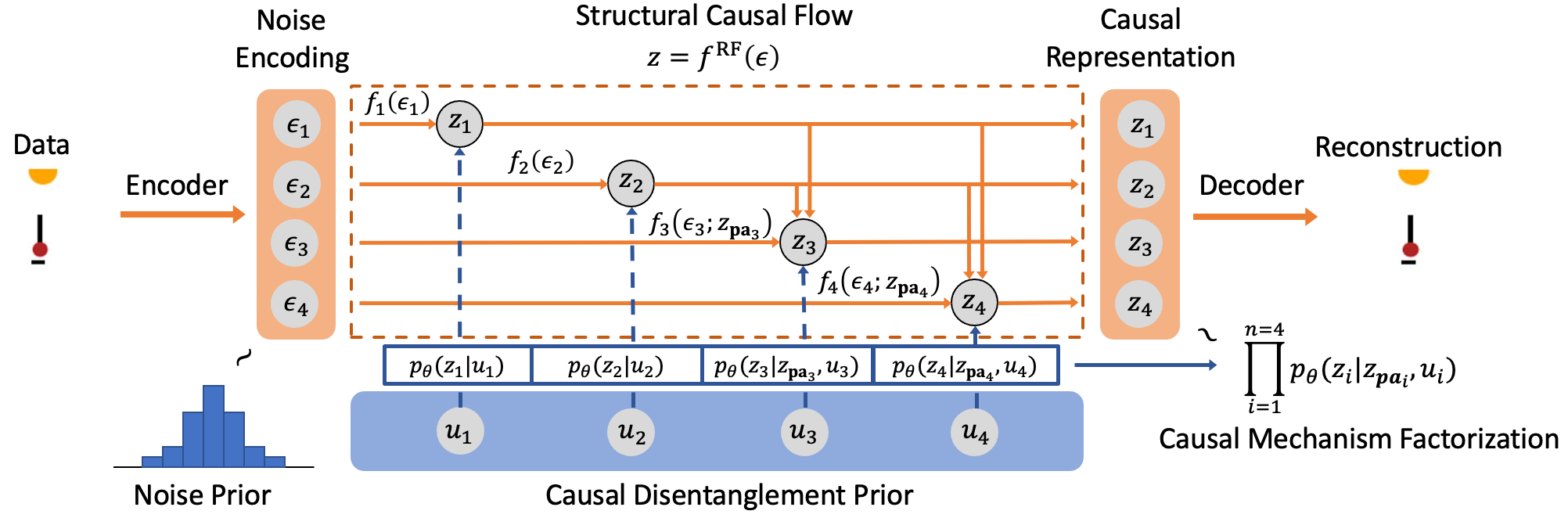
- 提出ICM-VAE,一种变分自编码器,利用可学习的基于流的微分同胚函数,将噪声变量映射为潜在因果变量,以建模因果机制。
- 引入因果解缠先验,利用已知因果结构,以在潜在空间中促进因果因子化分布。
- 采用基于辅助标签的条件先验以强制实现可识别性,将iVAE框架扩展至因果设置。
- 使用可逆流以确保噪声变量与潜在变量之间的双射映射,从而实现精确推理与反事实生成。
- 应用独立因果机制(ICM)原则,确保一个机制的变化不影响其他机制,从而促进结构解缠。
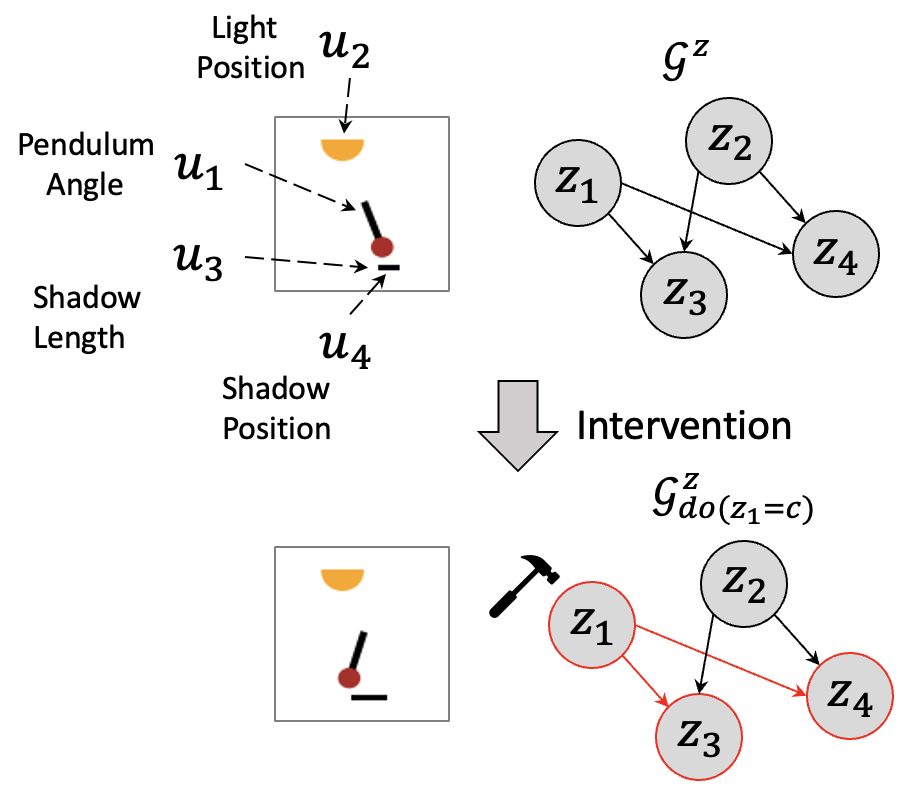
- 采用两阶段推理过程生成反事实:归因(从观测中推断潜在噪声)、干预(对潜在因子进行干预)和预测(从修改后的潜在变量重建数据)。
实验结果
研究问题
- RQ1能否在弱监督设置下,基于独立因果机制(ICM)原则,形式化并实现因果解缠?
- RQ2如何设计因果解缠先验,以在潜在空间中促进因子化且可识别的因果表示?
- RQ3在温和假设下,所提框架在多大程度上能实现因果因子与机制的可识别性?
- RQ4与先前方法相比,该模型是否提升了对干预的鲁棒性,并实现了更一致的反事实生成?
- RQ5当因子存在因果关联而非独立时,该框架能否保持高解缠性能?
主要发现
- 所提出的ICM-VAE框架在多个随机种子下实现了接近完美的因果因子解缠,中位DCI得分为0.98。
- 该模型表现出强大的干预鲁棒性,在对生成因子进行干预时,潜在表示保持高度一致性。
- 反事实生成具有一致性且语义合理,模型在对因果变量(如摆角)进行干预后,成功生成了合理的反事实图像。
- 理论分析表明,在温和条件下,因果因子与机制的可识别性可达排列和逐元素重参数化程度。
- 与基线方法(如β-VAE和iVAE)相比,该方法在解缠程度和鲁棒性方面表现更优,尤其在数据中存在因果依赖时优势更明显。
- 该框架兼容连续和离散潜在变量,但当前结果仅限于连续真实变量。
阅读本论文
在 Nubint 阅读器中打开原文,边读边就任意段落提问。
在 Nubint 中阅读本论文本解读由 AI 根据论文原文生成,引用前请核对原文。