
[论文解读] Learning from Multiple Independent Advisors in Multi-agent Reinforcement Learning
本文提出了一种两级Q-learning框架,使多智能体强化学习(MARL)智能体能够同时从多个独立的、次优的顾问处学习,通过评估其建议并据此指导动作选择。该方法在三个MARL测试环境中实现了更高的样本效率和对纳什均衡的收敛,优于基线方法,同时有效整合了多样化的顾问专长并过滤掉了低质量建议。
Multi-agent reinforcement learning typically suffers from the problem of sample inefficiency, where learning suitable policies involves the use of many data samples. Learning from external demonstrators is a possible solution that mitigates this problem. However, most prior approaches in this area assume the presence of a single demonstrator. Leveraging multiple knowledge sources (i.e., advisors) with expertise in distinct aspects of the environment could substantially speed up learning in complex environments. This paper considers the problem of simultaneously learning from multiple independent advisors in multi-agent reinforcement learning. The approach leverages a two-level Q-learning architecture, and extends this framework from single-agent to multi-agent settings. We provide principled algorithms that incorporate a set of advisors by both evaluating the advisors at each state and subsequently using the advisors to guide action selection. We also provide theoretical convergence and sample complexity guarantees. Experimentally, we validate our approach in three different test-beds and show that our algorithms give better performances than baselines, can effectively integrate the combined expertise of different advisors, and learn to ignore bad advice.
研究动机与目标
- 为解决多智能体强化学习(MARL)中的样本效率低下问题,这是实际部署的主要障碍。
- 克服先前研究依赖单一专家或近似专家示范者的局限性。
- 在复杂的MARL环境中,实现对多个独立、可能相互冲突的顾问的高效整合,其专长各不相同。
- 为收敛至纳什均衡和有限时间样本复杂度提供理论保证。
- 通过实证验证该方法能够从综合顾问知识中学习,同时忽略次优建议的能力。
提出的方法
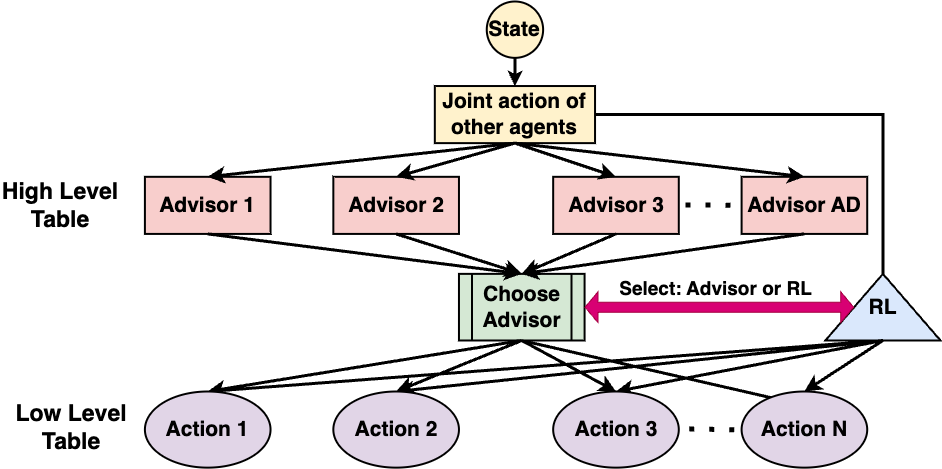
- 该方法采用两级Q-learning架构:高层Q网络用于评估顾问建议,低层Q网络基于此评估结果选择动作。
- 在每个状态对顾问进行评估,使用价值估计机制,其建议通过加权动作选择过程被整合。
- 该框架将先前的单智能体TLQL扩展至多智能体设置,采用独立Q-learning与策略剪枝率(PPR)相结合,防止执行过程中过度依赖顾问。
- 针对集中训练、分散执行(CTDE)设置,开发了一种类演员-评论家变体,实现可扩展的训练。
- 理论分析证明在标准MARL假设下可收敛至纳什均衡,并为两种学习率调度方案提供了有限时间样本复杂度边界。
- 该方法采用双回放缓冲区系统和硬目标网络更新以稳定训练,超参数在多个基线中进行了调优。
实验结果
研究问题
- RQ1能否在多智能体强化学习中有效利用多个独立的次优顾问,以提升样本效率?
- RQ2在多智能体环境中,如何解决来自多个顾问的冲突建议,以实现稳健的动作选择?
- RQ3所提出的两级Q-learning架构在多智能体设置中是否能收敛至纳什均衡?
- RQ4所提出的多顾问MARL算法的有限时间样本复杂度是多少?
- RQ5该方法能否学会忽略低质量建议,同时有效整合来自多样化顾问的高质量指导?
主要发现
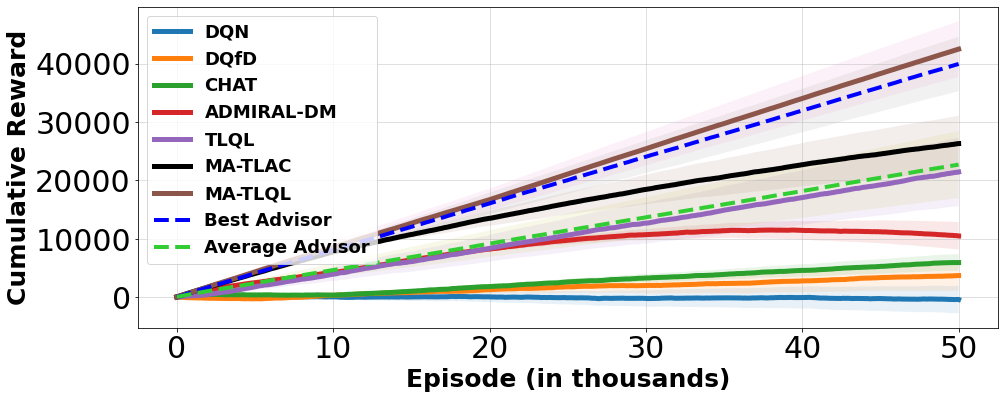
- 所提方法在三个不同的多智能体测试环境(Pommerman、Pursuit和Rovis)中,优于强基线方法,包括DQfD、CHAT、TLQL和ADMIRAL-DM。
- 该方法成功整合了多个顾问的综合专长,获得的累积奖励高于任何单一顾问基线。
- 算法能够抑制低质量建议,表现为当顾问不可用时执行性能提升,表明实现了有效的顾问过滤。
- 策略剪枝率(PPR)的使用显著提升了泛化能力,与非PPR变体相比,执行性能最高提升达40%。
- 理论分析确认了对纳什均衡的收敛性,并提供了有限时间样本复杂度边界,验证了算法的稳定性。
- 每项实验在单个A100 GPU上训练约需12–15小时,表明在标准硬件上的可行性。
阅读本论文
在 Nubint 阅读器中打开原文,边读边就任意段落提问。
在 Nubint 中阅读本论文本解读由 AI 根据论文原文生成,引用前请核对原文。