
[论文解读] Learning Generalized Zero-Shot Learners for Open-Domain Image Geolocalization
StreetCLIP 使用基于合成标题域特定的预训练来提高开放域图像地理定位的泛化零样本学习,达成无需微调的SOTA零样本结果。
Image geolocalization is the challenging task of predicting the geographic coordinates of origin for a given photo. It is an unsolved problem relying on the ability to combine visual clues with general knowledge about the world to make accurate predictions across geographies. We present $\href{https://huggingface.co/geolocal/StreetCLIP}{ ext{StreetCLIP}}$, a robust, publicly available foundation model not only achieving state-of-the-art performance on multiple open-domain image geolocalization benchmarks but also doing so in a zero-shot setting, outperforming supervised models trained on more than 4 million images. Our method introduces a meta-learning approach for generalized zero-shot learning by pretraining CLIP from synthetic captions, grounding CLIP in a domain of choice. We show that our method effectively transfers CLIP's generalized zero-shot capabilities to the domain of image geolocalization, improving in-domain generalized zero-shot performance without finetuning StreetCLIP on a fixed set of classes.
研究动机与目标
- 激发开放域图像地理定位及其跨地理信息的一般化挑战。
- Introduce a domain-specific pretraining method that grounds CLIP with synthetic captions for geolocalization.
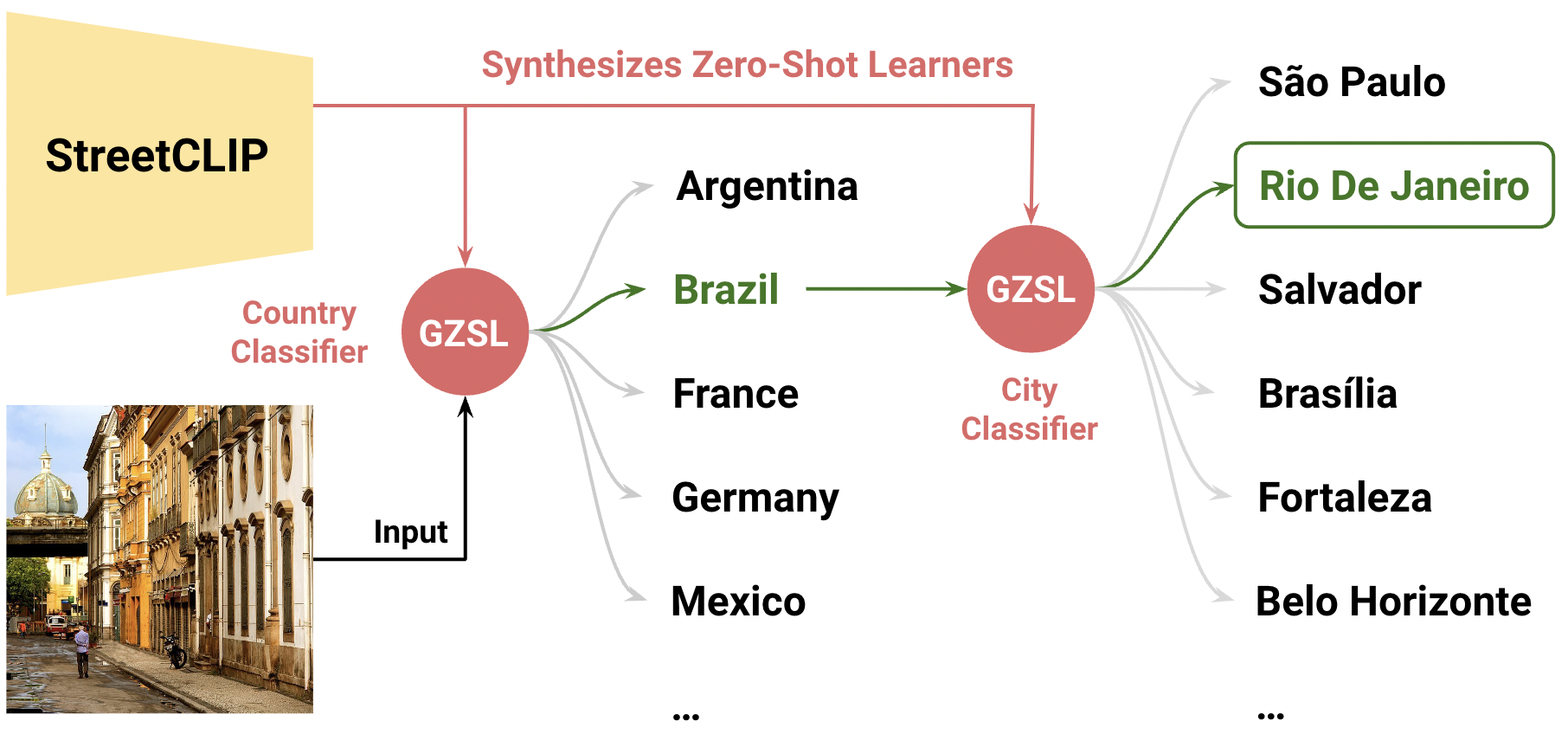
- Develop StreetCLIP and a hierarchical linear probing strategy to enable zero-shot, planet-scale inference.
- Demonstrate that synthetic-caption pretraining improves generalized zero-shot performance over zero-shot CLIP.
- Provide a publicly available StreetCLIP model and dataset to enable broader research.
提出的方法
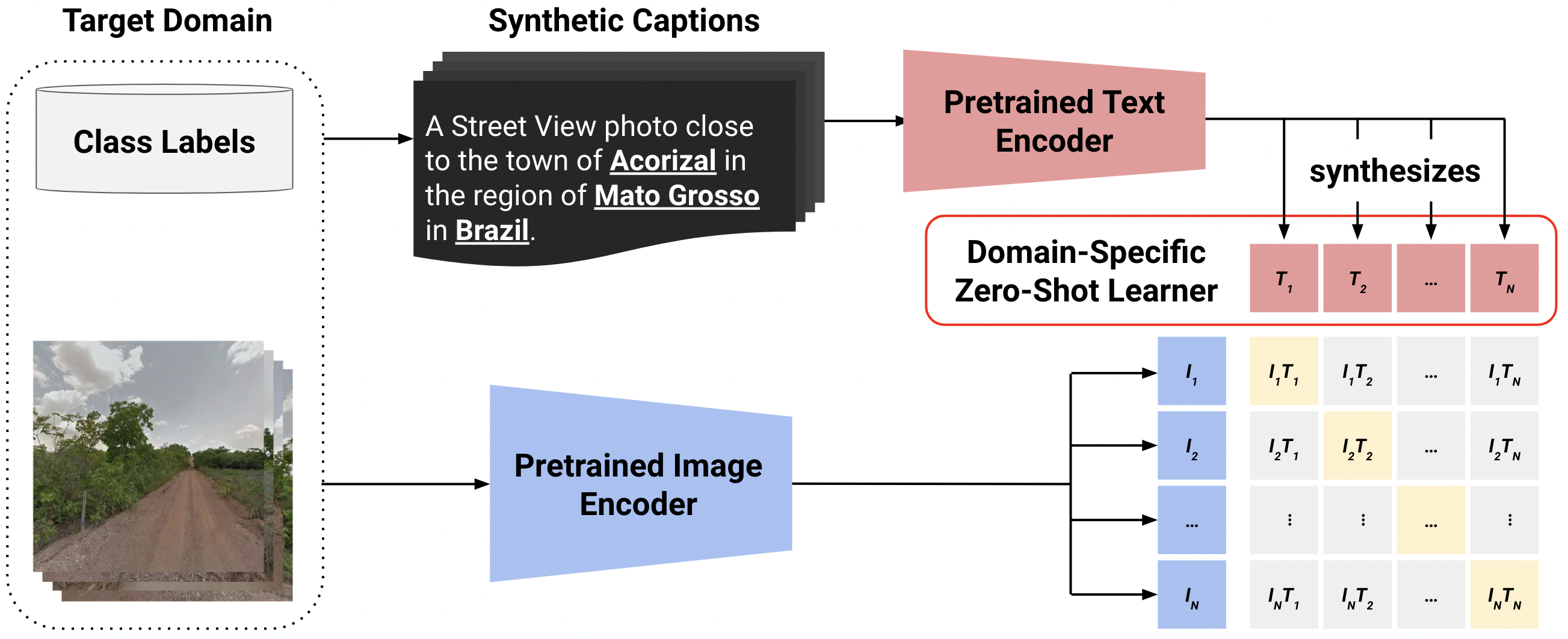
- 使用来自地理定位模板的合成标题对 CLIP 进行预训练,在每个训练批次中创建一个域特定的通用零样本学习者。
- 将 CLIP 的损失公式化为 generalized-zero-shot 损失 (GZSL) 与视觉-表示对齐的组合,以实现 GZSL 的元学习。
- 通过在 1.1M Street View 图像数据集上进一步预训练,并具有城市/区域/国家层级标签,来创建 StreetCLIP。
- 推理时应用分层线性探测,先预测国家再在每个国家的前30个城市中细化到城市。
- 使用标准的 CLIP 主干网络与域特定提示,将模型扎根于地理知识。
实验结果
研究问题
- RQ1如何在不进行任务特定微调的情况下,改进开放域图像地理定位的泛化零样本学习?
- RQ2域特定的合成标题是否能将 CLIP 的零样本能力迁移到地理定位任务?
- RQ3分层探测在提速的同时,是否能保持或提高开放域地理定位的准确性?
- RQ4在 ODIG 基准上,合成标题域特定预训练相对于原生 CLIP 的性能提升有哪些?
主要发现
- StreetCLIP 在零样本推断下实现 IM2GPS 和 IM2GPS3K 开放域地理定位基准的最新性能。
- 合成标题域特定预训练在各距离阈值上带来 1.3 到 3.4 百分点的提升,相较于零样本 CLIP。
- StreetCLIP 在某些阈值上超过了在超过 4 百万张图像上训练的监督模型。
- 分层探测在提高效率和准确性方面,尤其在更大距离阈值时表现出色。
- StreetCLIP 在保持零样本能力的同时利用域特定 grounding,表明可广泛应用于其他领域。
阅读本论文
在 Nubint 阅读器中打开原文,边读边就任意段落提问。
在 Nubint 中阅读本论文本解读由 AI 根据论文原文生成,引用前请核对原文。