
[论文解读] Learning Graph-Enhanced Commander-Executor for Multi-Agent Navigation
该论文提出 MAGE-X,一种用于多智能体导航的图增强分层强化学习框架,通过目标指挥官(Goal Commander)分配最优目标,并利用图神经网络(GNN)驱动的动作执行器通过动态子图构建和目标感知表征来提升协作。MAGE-X 在 MPE 环境中实现 50 名智能体 100% 的成功率,在 3D 无人飞行器导航任务中相比最先进多智能体强化学习基线方法,成功率至少提升 12%,数据效率提升 2 倍。
This paper investigates the multi-agent navigation problem, which requires multiple agents to reach the target goals in a limited time. Multi-agent reinforcement learning (MARL) has shown promising results for solving this issue. However, it is inefficient for MARL to directly explore the (nearly) optimal policy in the large search space, which is exacerbated as the agent number increases (e.g., 10+ agents) or the environment is more complex (e.g., 3D simulator). Goal-conditioned hierarchical reinforcement learning (HRL) provides a promising direction to tackle this challenge by introducing a hierarchical structure to decompose the search space, where the low-level policy predicts primitive actions in the guidance of the goals derived from the high-level policy. In this paper, we propose Multi-Agent Graph-Enhanced Commander-Executor (MAGE-X), a graph-based goal-conditioned hierarchical method for multi-agent navigation tasks. MAGE-X comprises a high-level Goal Commander and a low-level Action Executor. The Goal Commander predicts the probability distribution of goals and leverages them to assign each agent the most appropriate final target. The Action Executor utilizes graph neural networks (GNN) to construct a subgraph for each agent that only contains crucial partners to improve cooperation. Additionally, the Goal Encoder in the Action Executor captures the relationship between the agent and the designated goal to encourage the agent to reach the final target. The results show that MAGE-X outperforms the state-of-the-art MARL baselines with a 100% success rate with only 3 million training steps in multi-agent particle environments (MPE) with 50 agents, and at least a 12% higher success rate and 2x higher data efficiency in a more complicated quadrotor 3D navigation task.
研究动机与目标
- 解决大规模或复杂导航任务中多智能体强化学习(MARL)存在的数据效率低和协作能力差的问题。
- 克服在高维、多智能体搜索空间中直接进行 MARL 策略学习的局限性。
- 通过分层、目标条件化的学习方法,提升多智能体导航中的目标分配与智能体间协调能力。
- 通过图神经网络(GNN)增强协作,动态建模智能体间关系并优先关注关键队友。
- 在简单与复杂环境中,实现比最先进 MARL 方法更高的成功率与数据效率。
提出的方法
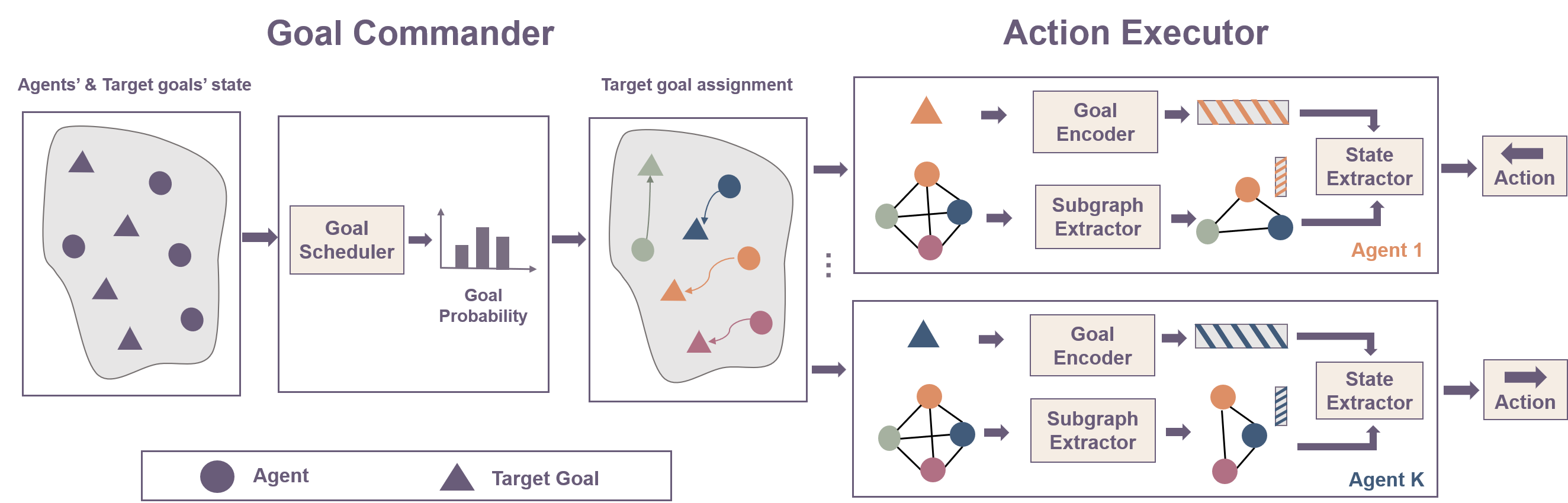
- MAGE-X 采用两级分层结构:高层的目标指挥官(Goal Commander)为每个智能体预测目标目标的概率分布。
- 目标指挥官为智能体分配最终目标,将多智能体导航问题转化为多个具有目标导向目标的单智能体任务。
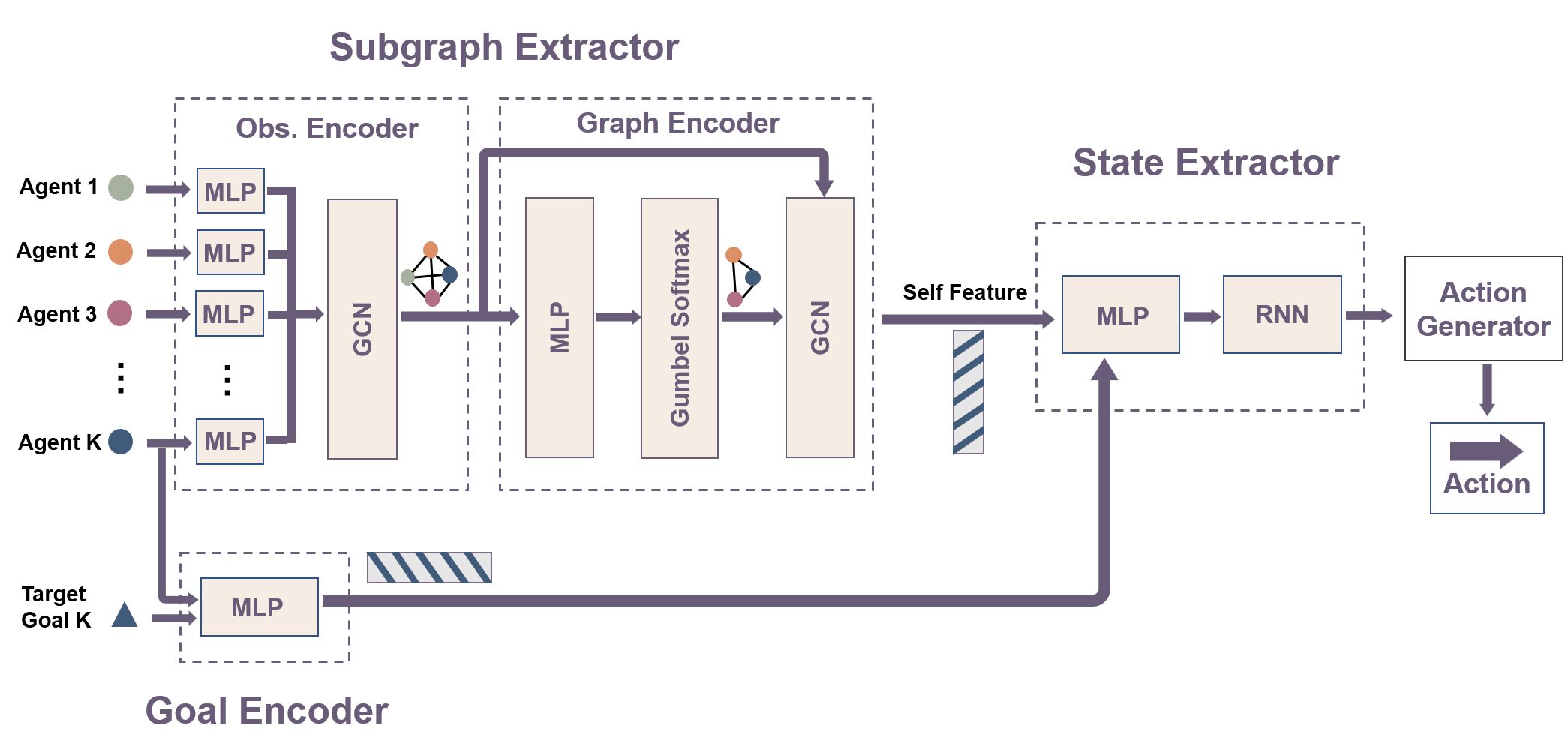
- 低层的动作执行器(Action Executor)使用 GNN 为每个智能体构建子图,仅聚焦于关键合作伙伴以提升协调性并减少噪声。
- 动作执行器中的目标编码器(Goal Encoder)捕捉智能体与其分配目标之间的关系,增强目标导向行为。
- 状态提取器(State Extractor)将智能体在其子图上的 GNN 嵌入特征与目标特定表征融合,生成目标感知的团队表征。
- 该框架采用 MAPPO 进行训练,结合特征归一化与奖励归一化,使用正交权重初始化,并对超参数进行调优以确保稳定性和样本效率。
实验结果
研究问题
- RQ1目标条件化的分层框架是否能提升大规模多智能体导航中的数据效率与成功率?
- RQ2在多智能体导航中,引入基于 GNN 的动态子图构建如何增强智能体间的协作?
- RQ3与基于子目标的方法相比,采用高层策略直接分配最终目标是否能带来更优性能?
- RQ4在动作执行器中集成目标感知表征如何提升目标抵达性能?
- RQ5在复杂 3D 环境中,MAGE-X 与基于规划的方法及最先进 MARL 方法相比表现如何?
主要发现
- 在包含 50 名智能体的多智能体粒子环境(MPE)中,MAGE-X 仅使用 300 万次训练步数即实现 100% 成功率,优于所有基线方法。
- 在更复杂的 3D 无人飞行器导航任务中,MAGE-X 的成功率比次优基线方法至少高出 12%。
- 在 3D 导航任务中,MAGE-X 的数据效率是当前最先进 MARL 方法的 2 倍,表明其具有更优的样本效率。
- 与基于规划的 MA A* 基线相比,MAGE-X 在 N=50 时仍保持 100% 成功率,而 MA A* 的成功率下降至 77%,表明 MAGE-X 具有更强的可扩展性。
- 消融实验表明,目标指挥官与基于 GNN 的子图构建均对性能至关重要,每个组件均对成功率与效率有显著贡献。
- 在动作执行器中使用目标感知表征可带来更一致且准确的目标抵达行为,尤其在高密度多智能体场景中表现更优。
阅读本论文
在 Nubint 阅读器中打开原文,边读边就任意段落提问。
在 Nubint 中阅读本论文本解读由 AI 根据论文原文生成,引用前请核对原文。