
[论文解读] Learning Likelihood Ratios with Neural Network Classifiers
本论文提出了用于神经网络分类器的优化损失函数与参数化方法,以提升统计推断中的似然比估计。通过系统评估具有可调指数 $p$ 和 $r$ 的MSE与SQR损失,识别出 $p^*=1.25$ 与 $r^*=0.1$ 为更优选择,使复杂数据集(包括高能物理模拟)上的平均绝对误差降低高达50%。
The likelihood ratio is a crucial quantity for statistical inference in science that enables hypothesis testing, construction of confidence intervals, reweighting of distributions, and more. Many modern scientific applications, however, make use of data- or simulation-driven models for which computing the likelihood ratio can be very difficult or even impossible. By applying the so-called ``likelihood ratio trick,'' approximations of the likelihood ratio may be computed using clever parametrizations of neural network-based classifiers. A number of different neural network setups can be defined to satisfy this procedure, each with varying performance in approximating the likelihood ratio when using finite training data. We present a series of empirical studies detailing the performance of several common loss functionals and parametrizations of the classifier output in approximating the likelihood ratio of two univariate and multivariate Gaussian distributions as well as simulated high-energy particle physics datasets.
研究动机与目标
- 提升在解析似然函数难以计算的科学应用中似然比估计的准确性。
- 研究不同损失泛函与神经网络分类器参数化方式对似然比近似性能的影响。
- 识别使似然比估计中平均绝对误差最小化的MSE与SQR损失函数的最优超参数 $p$ 与 $r$。
- 为现实世界科学机器学习工作流中的损失函数选择提供实用且经实证验证的建议。
- 证明次优损失选择可能导致显著性能下降,尤其在复杂或高维数据场景下。
提出的方法
- 通过实验评估四种损失泛函:二元交叉熵、MSE、SQR与最大似然分类器(MLC)损失。
- 引入使用可调指数 $p$ 与 $r$ 的MSE与SQR损失的参数化形式,以推广标准公式。
- 在单变量与多变量高斯分布以及模拟的高能物理数据集上训练神经网络分类器。
- 使用似然比技巧:在类别先验平衡的前提下,通过 $\mathcal{L}(x) = \frac{f(x)}{1-f(x)}$ 将分类器输出 $f(x)$ 映射为似然比。
- 通过在多个训练运行中对超参数 $p$ 与 $r$ 进行扫描,以最小化测试数据上的平均绝对误差(MAE)来优化它们。
- 通过MAE、数值稳定性与收敛行为比较不同损失类型与参数化方式的性能。
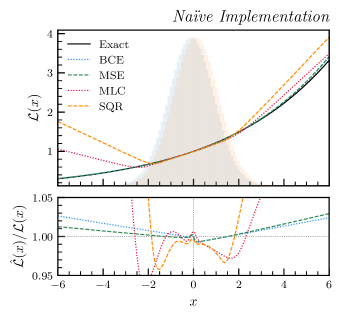
实验结果
研究问题
- RQ1在有限训练数据下,不同损失泛函(如二元交叉熵、MSE、SQR、MLC)在近似似然比方面表现如何?
- RQ2对分类器输出使用可调指数 $p$ 与 $r$ 的参数化方式对似然比估计准确性有何影响?
- RQ3在包括高维与物理启发数据集在内的多种数据分布中,哪种损失泛函与参数化组合能实现最低的平均绝对误差(MAE)?
- RQ4优化后的 $p^*$ 与 $r^*$ 值是否可泛化至不同数据集,还是高度依赖于数据结构?
- RQ5损失泛函的选择如何影响损失曲面的几何结构,这对训练稳定性和收敛性有何影响?
主要发现
- 在复杂数据集(包括多维高斯分布与模拟的高能物理数据)上,采用指数参数化的最大似然分类器(MLC)损失始终优于其他损失泛函。
- 对MSE与SQR损失中的指数 $p$ 与 $r$ 进行优化,使Checker与Circle数据集上的平均绝对误差相比默认值降低30%至50%。
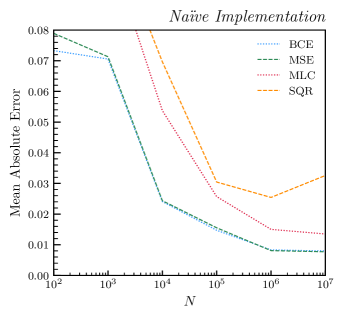
- 在大规模数据集($N > 10^5$)上,优化后的 $p^*=1.25$ 与 $r^*=0.1$ 相比默认设置,误差降低至少50%。
- 推荐的优化损失形式为 $L_{\text{MSE}}^*[f] = -\int \text{d}x \left( (1-f)^{1.25} p(x|\theta_0) + f^{1.25} p(x|\theta_1) \right)$ 与 $L_{\text{SQR}}^*[f] = -\int \text{d}x \left( f^{-0.05} p(x|\theta_0) + f^{0.05} p(x|\theta_1) \right)$,其能实现更低的MAE与更好的数值稳定性。
- 在Hyperbola与高能物理数据集上,$p$ 与 $r$ 的取值范围在 $[-2,3]$ 内未发现显著改进,尽管该区间外可能存在更优值。
- 次优损失选择可能导致MAE相比最优配置增加高达82%,凸显了仔细选择超参数的重要性。
阅读本论文
在 Nubint 阅读器中打开原文,边读边就任意段落提问。
在 Nubint 中阅读本论文本解读由 AI 根据论文原文生成,引用前请核对原文。