
[论文解读] Learning Perceptive Bipedal Locomotion over Irregular Terrain
本文提出了一种基于强化学习的双足行走控制器,通过使用基于注意力的信念编码器,将噪声较大的外部感知传感器数据(如摄像头或激光雷达)与本体感觉信息融合,形成对不规则地形的鲁棒内部表征。该方法在速度、效率和鲁棒性方面均优于仅依赖本体感觉的基线模型,在16 cm高台阶的测试中成功率接近100%,而基线模型在12 cm时即已失败。
In this paper we propose a novel bipedal locomotion controller that uses noisy exteroception to traverse a wide variety of terrains. Building on the cutting-edge advancements in attention based belief encoding for quadrupedal locomotion, our work extends these methods to the bipedal domain, resulting in a robust and reliable internal belief of the terrain ahead despite noisy sensor inputs. Additionally, we present a reward function that allows the controller to successfully traverse irregular terrain. We compare our method with a proprioceptive baseline and show that our method is able to traverse a wide variety of terrains and greatly outperforms the state-of-the-art in terms of robustness, speed and efficiency.
研究动机与目标
- 解决在传统状态机控制器无法泛化的不规则、未见过的地形上实现鲁棒双足行走的挑战。
- 克服仅依赖本体感觉的控制器所存在的局限性,后者依赖于反应式、预防性的行为,缺乏预测性规划能力。
- 通过学习的信念表征,将噪声较大的外部感知输入与本体感觉信息融合,实现在复杂地形上的高效且稳定的行走。
- 设计一种奖励函数,支持学习多样化步态和地形穿越行为,而无需依赖预设轨迹的模仿。
- 证明控制器能够根据传感器数据的可靠性,学会选择性地信任或忽略噪声较大的外部感知信息,从而在类真实世界条件下提升鲁棒性。
提出的方法
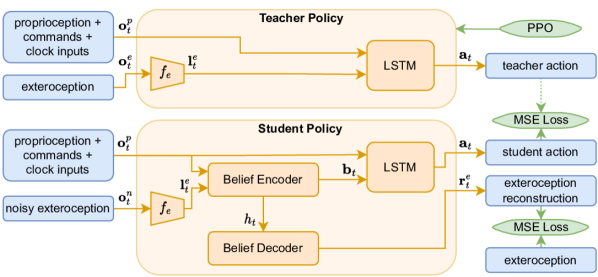
- 采用特权学习:训练一个教师策略,使其可访问无噪声的地形观测信息,随后将教师策略的行为蒸馏到仅使用噪声较大的外部感知和本体感觉信息的学生策略中。
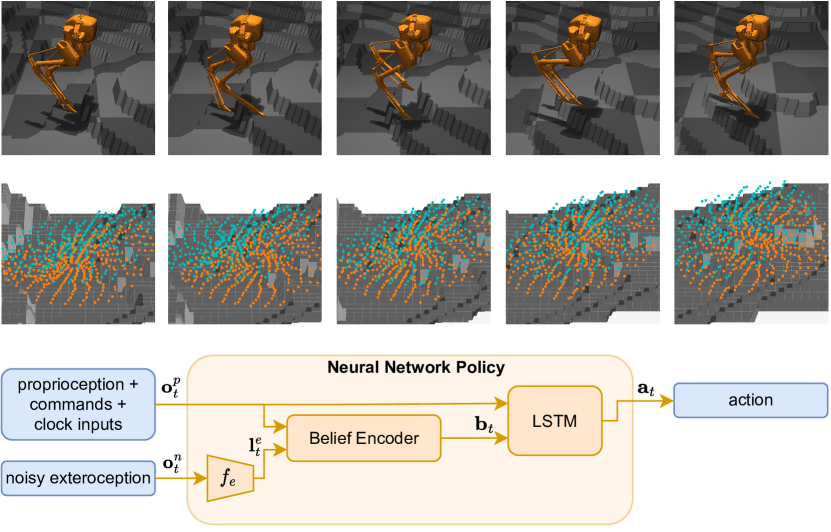
- 实现一个带有自注意力机制的循环信念编码器,将噪声较大的外部感知高度图与本体感觉状态数据融合,形成可靠的内部地形信念表征。
- 采用近端策略优化(PPO)训练学生策略,以最大化一个奖励函数,该函数鼓励向前推进、保持稳定性和成功穿越地形。
- 设计基于课程学习的训练计划,逐步增加地形复杂度,从平坦地面开始,逐步过渡到楼梯和随机地形等不规则地形。
- 使用信念解码器从信念编码器的输出中重建去噪后的、精确的地形表征,从而在传感器噪声存在的情况下仍能实现鲁棒决策。
- 将信念表征集成到策略网络中,使步态规划能够基于对前方地形的预测,实现主动而非被动的导航。
实验结果
研究问题
- RQ1双足行走策略是否能仅依靠噪声较大的外部感知输入,可靠地穿越不规则且此前未见过的地形?
- RQ2与仅依赖本体感觉的控制相比,集成基于注意力的循环信念编码器在应对传感器噪声方面如何提升鲁棒性?
- RQ3单一神经网络策略在使用周期性奖励函数时,能在多大程度上学习多样化步态并适应不同类型的地形?
- RQ4在复杂地形上,外部感知策略与本体感觉基线在速度、成功率和能效方面的表现如何比较?
- RQ5策略是否能学会有选择性地信任或忽略不可靠的外部感知输入(例如反射、透明表面),同时保持准确的地形感知?
主要发现
- 在16 cm高台阶的楼梯地形中,外部感知策略实现了100%的成功率,而本体感觉基线在12 cm时即已失败。
- 在方形地形上,外部感知策略保持了更高的平均前进速度,并在x方向上表现出更好的指令跟踪精度,尤其在复杂地形中优势明显。
- 信念编码器成功去除了外部感知高度图中大范围、交替出现的偏移,消除了异常值,同时保留了准确的地形结构。
- 该策略在包括随机地形和楼梯在内的多种复杂地形上均表现出稳定且高效的行走,对反应式修正的依赖极低。
- 在复杂地形上,外部感知策略在速度和鲁棒性方面均显著优于本体感觉基线,成功率差距明显。
- 系统学会了动态权衡外部感知和本体感觉输入,有效忽略了诸如反射或透明表面等虚假传感器读数。
阅读本论文
在 Nubint 阅读器中打开原文,边读边就任意段落提问。
在 Nubint 中阅读本论文本解读由 AI 根据论文原文生成,引用前请核对原文。