
[论文解读] Learning Roles with Emergent Social Value Orientations
该论文提出RESVO,一种新颖的多智能体强化学习框架,通过对称地赋予智能体利他主义以共享奖励,将角色学习转化为涌现的社会价值取向(SVO)形成过程。该框架采用基于SVO的角色嵌入空间,并结合秩正则化器与互信息最大化器,在多种任务中实现了时间跨度社会困境下的稳定分工与卓越性能。
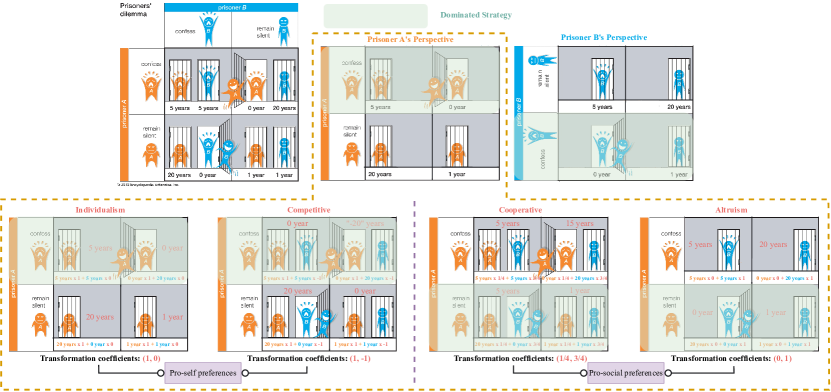
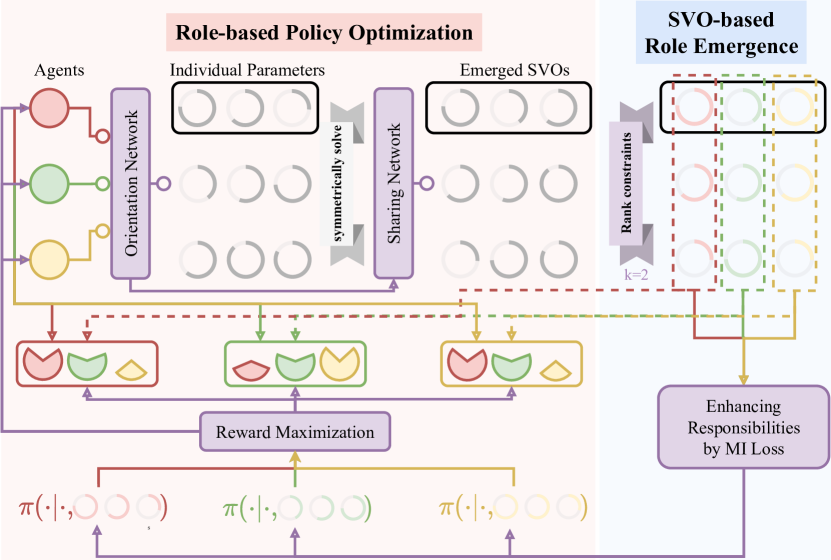
Social dilemmas can be considered situations where individual rationality leads to collective irrationality. The multi-agent reinforcement learning community has leveraged ideas from social science, such as social value orientations (SVO), to solve social dilemmas in complex cooperative tasks. In this paper, by first introducing the typical "division of labor or roles" mechanism in human society, we provide a promising solution for intertemporal social dilemmas (ISD) with SVOs. A novel learning framework, called Learning Roles with Emergent SVOs (RESVO), is proposed to transform the learning of roles into the social value orientation emergence, which is symmetrically solved by endowing agents with altruism to share rewards with other agents. An SVO-based role embedding space is then constructed by individual conditioning policies on roles with a novel rank regularizer and mutual information maximizer. Experiments show that RESVO achieves a stable division of labor and cooperation in ISDs with different complexity.
研究动机与目标
- 通过借鉴人类分工机制,解决多智能体强化学习中的时间跨度社会困境(ISDs),以实现可持续合作。
- 将角色涌现建模为非预设分配的结果,而是社会价值取向(SVO)在训练过程中动态形成的产物。
- 设计一种对称的、以利他主义为驱动的学习框架,使智能体能够以不同权重共享奖励,促进稳定合作。
- 通过秩正则化器与互信息最大化器构建基于SVO的角色嵌入空间,确保有意义且明确的角色分化。
- 实证验证基于SVO涌现的静态分工优于动态奖励传递方法,在具有固定角色分配的任务中表现更优。
提出的方法
- 引入对称利他机制,使智能体通过可学习权重与他人共享奖励,实现奖励的均衡分配,促进集体福祉。
- 将角色学习表述为不同社会价值取向(SVO)的涌现,其中每个智能体的SVO反映其对其他智能体的合作或竞争倾向。
- 利用秩正则化器控制不同角色的数量,通过互信息最大化器保留SVO的多样性与独特性,构建基于SVO的角色嵌入空间。
- 采用集中式训练、分布式执行(CTDE)范式进行训练,使个体策略基于SVO嵌入进行条件化,以实现角色特异性行为。
- 采用对比学习目标,对齐相似的SVO并解耦不同的SVO,确保具有相似角色的智能体在SVO空间中聚类。
- 对SVO嵌入矩阵施加秩约束,以控制涌现角色的数量,消融实验表明在中等秩值(如k=2或k=4)时性能最优。
实验结果
研究问题
- RQ1SVO的涌现能否作为多智能体系统在时间跨度社会困境中实现稳定且可扩展的角色形成机制?
- RQ2对SVO嵌入施加的秩约束如何影响涌现角色的数量与独特性,以及整体系统性能?
- RQ3在收敛速度与社会福利方面,基于SVO的角色嵌入实现的静态分工是否优于动态奖励传递机制?
- RQ4SVO-based角色嵌入模块能否作为即插即用组件集成到现有基于SVO的多智能体强化学习方法中,以提升性能?
- RQ5在复杂协作任务中,SVO多样性、角色独特性与集体效率之间存在何种关系?
主要发现
- RESVO在三种不同任务中均实现了时间跨度社会困境(ISDs)下的稳定分工:重复囚徒困境、3人逃脱房、10人清理任务。
- 在最优秩约束下(如k=2或k=4),RESVO的收敛社会福利优于基线方法,尤其在具有固定角色分配的任务中表现更优。
- 当秩约束过低(如k=2)时,智能体会收敛到相似的SVO,导致角色无法区分或集体搭便车,性能下降。
- 当秩约束过高(如k=9)时,SVO变得过于随机,导致智能体采取不稳定策略并执行无用工作,性能下降。
- 基于SVO的角色嵌入机制在角色分化方面优于基线方法,可视化结果表明相似角色在SVO空间中形成清晰聚类。
- 在需要稳定静态角色分配的任务中,RESVO优于基于惩罚的LIO、基于SVO的LToS与D3C,证明了静态分工在该场景下的优势。
阅读本论文
在 Nubint 阅读器中打开原文,边读边就任意段落提问。
在 Nubint 中阅读本论文本解读由 AI 根据论文原文生成,引用前请核对原文。