
[论文解读] Learning stiff chemical kinetics using extended deep neural operators
本文提出了一种扩展的DeepONet框架——结合自编码器与新型的统一划分(Partition-of-Unity, PoU-)DeepONet——以学习刚性化学动力学问题的解传播算子。通过在初始条件的降维潜在表示上进行训练,该模型实现了<0.01%的相对L2误差,并支持快速推理(约10⁻²秒),在计算效率方面显著优于传统求解器,同时在复杂合成气与基准动力学体系中保持了高精度。
We utilize neural operators to learn the solution propagator for the challenging chemical kinetics equation. Specifically, we apply the deep operator network (DeepONet) along with its extensions, such as the autoencoder-based DeepONet and the newly proposed Partition-of-Unity (PoU-) DeepONet to study a range of examples, including the ROBERS problem with three species, the POLLU problem with 25 species, pure kinetics of the syngas skeletal model for $CO/H_2$ burning, which contains 11 species and 21 reactions and finally, a temporally developing planar $CO/H_2$ jet flame (turbulent flame) using the same syngas mechanism. We have demonstrated the advantages of the proposed approach through these numerical examples. Specifically, to train the DeepONet for the syngas model, we solve the skeletal kinetic model for different initial conditions. In the first case, we parametrize the initial conditions based on equivalence ratios and initial temperature values. In the second case, we perform a direct numerical simulation of a two-dimensional temporally developing $CO/H_2$ jet flame. Then, we initialize the kinetic model by the thermochemical states visited by a subset of grid points at different time snapshots. Stiff problems are computationally expensive to solve with traditional stiff solvers. Thus, this work aims to develop a neural operator-based surrogate model to solve stiff chemical kinetics. The operator, once trained offline, can accurately integrate the thermochemical state for arbitrarily large time advancements, leading to significant computational gains compared to stiff integration schemes.
研究动机与目标
- 为反应CFD模拟中的刚性化学动力学计算瓶颈提供解决方案。
- 开发一种数据驱动的代理模型,能够在外推至远超化学时间尺度的长时间推进中保持有效性。
- 提升对CO/H₂合成气火焰等复杂多组分燃烧系统建模的效率与精度。
- 减少对计算成本高昂的积分方案或降低模型复杂度技术的依赖,从而避免物理保真度的损失。
- 通过训练好的神经算子实现实时或近实时的瞬态燃烧过程模拟。
提出的方法
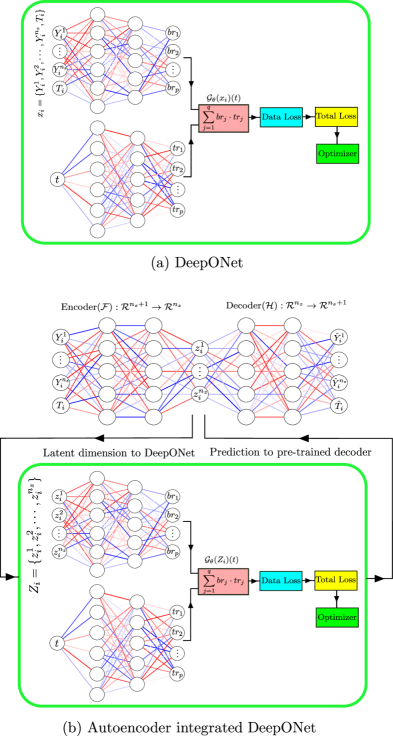
- 采用DeepONet架构学习从初始条件到时间演化热化学状态的解传播映射。
- 集成自编码器,将高维初始条件数据压缩至低维潜在空间,降低训练成本并提升泛化能力。
- 采用统一划分(PoU-)DeepONet以增强在多样化输入分布下的局部逼近精度。
- 在由当量比与温度参数化的合成初始条件,以及2D湍流射流火焰的直接数值模拟快照上进行模型训练。
- 对训练数据的对数值值进行归一化处理,以稳定学习过程并提升收敛性。
- 利用解码器从潜在预测中重建全状态解,确保在原始状态空间中的保真度。
实验结果
研究问题
- RQ1DeepONet及其扩展能否准确学习并泛化刚性化学动力学系统的解传播算子?
- RQ2与标准DeepONet相比,集成自编码器的DeepONet框架在训练成本与推理精度方面表现如何?
- RQ3训练后的算子在分布外初始条件或长时间推进下的外推能力达到何种程度?
- RQ4该框架在复杂真实燃烧系统(如湍流CO/H₂射流火焰)中的应用是否仍能保持高精度?
- RQ5与传统刚性ODE求解器相比,该方法在推理时间与训练效率方面获得了多大的计算增益?
主要发现
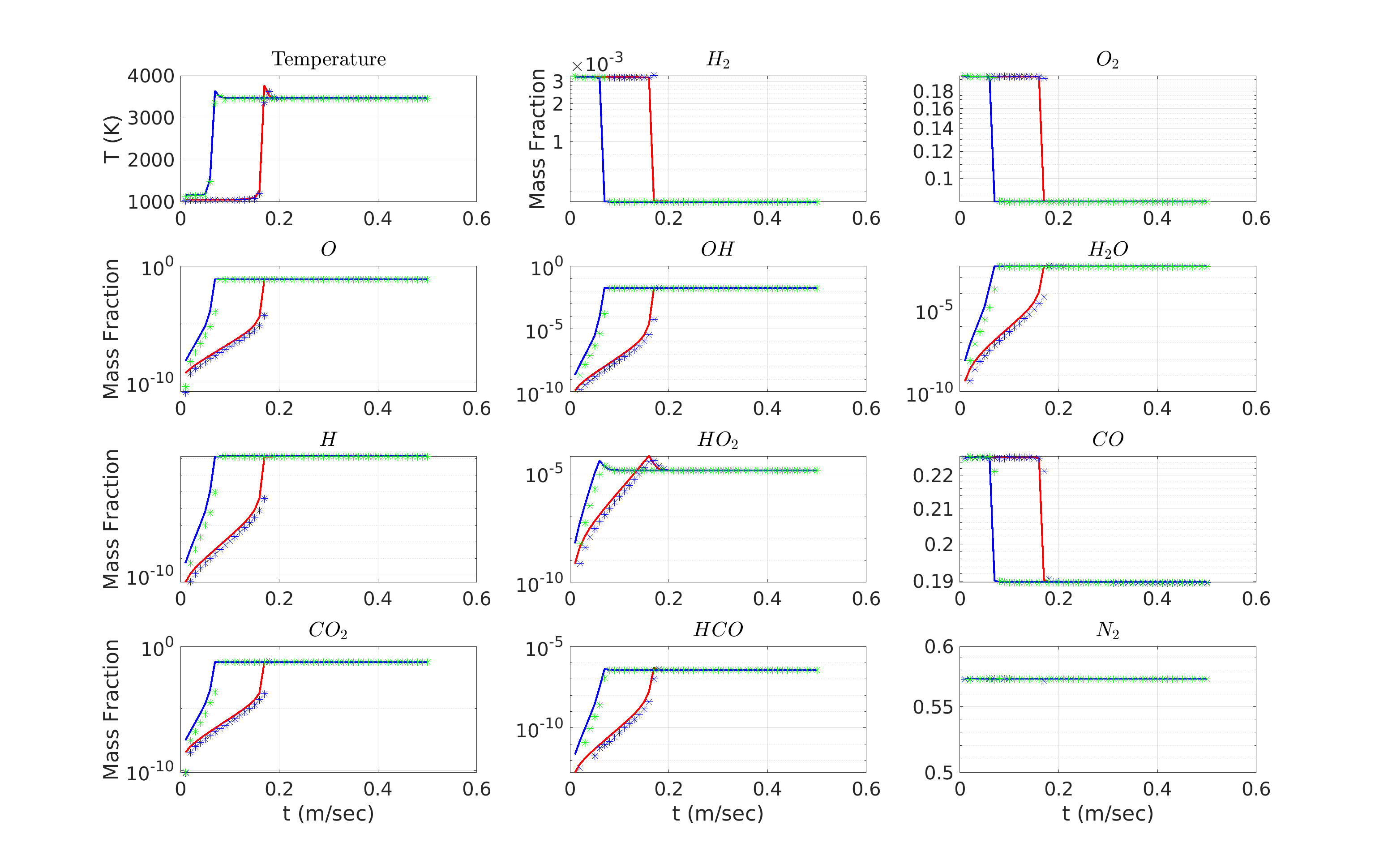
- 自编码器集成的DeepONet在潜在空间上实现了0.01%的平均相对L2误差,在合成气模型的重建全状态解上也达到0.01%的相对L2误差。
- 在示例3中,使用AE+DeepONet相较于标准DeepONet,训练时间减少了约5.7倍;在示例4中,减少了约3.8倍。
- 在未见测试样本上的推理时间约为10⁻²秒,实现了近乎即时的解预测。
- PoU-DeepONet与AE+DeepONet框架在基准问题(ROBERS, POLLU)与真实燃烧情景中均表现出稳健性能。
- 该模型成功在外推时间尺度上实现远超训练窗口的外推,展现出强大的泛化能力。
- 该方法在计算效率方面显著优于传统刚性求解器,同时保持了物理保真度。
阅读本论文
在 Nubint 阅读器中打开原文,边读边就任意段落提问。
在 Nubint 中阅读本论文本解读由 AI 根据论文原文生成,引用前请核对原文。