
[论文解读] Les Houches Lectures on Community Ecology: From Niche Theory to Statistical Mechanics
一份将生态群落学中的生态位理论与统计物理学相连接的综述,详述消费资源模型和广义Lotka-Volterra模型,并探讨使用腔方法和随机矩阵理论进行的高维分析。
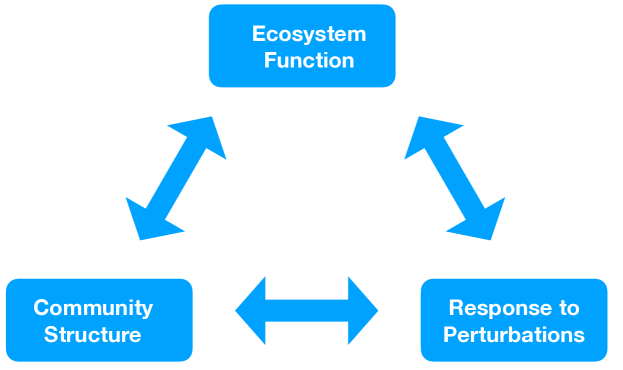
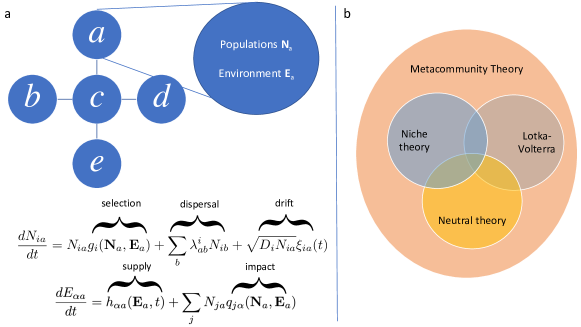
Ecosystems are among the most interesting and well-studied examples of self-organized complex systems. Community ecology, the study of how species interact with each other and the environment, has a rich tradition. Over the last few years, there has been a growing theoretical and experimental interest in these problems from the physics and quantitative biology communities. Here, we give an overview of community ecology, highlighting the deep connections between ecology and statistical physics. We start by introducing the two classes of mathematical models that have served as the workhorses of community ecology: Consumer Resource Models (CRM) and the generalized Lotka-Volterra models (GLV). We place a special emphasis on graphical methods and general principles. We then review recent works showing a deep and surprising connection between ecological dynamics and constrained optimization. We then shift our focus by analyzing these same models in "high-dimensions" (i.e. in the limit where the number of species and resources in the ecosystem becomes large) and discuss how such complex ecosystems can be analyzed using methods from the statistical physics of disordered systems such as the cavity method and Random Matrix Theory.
研究动机与目标
- 介绍群落生态学的核心原理以及生态位理论在塑造群落中的作用。
- 提出并对比两种主要建模框架:消费资源模型(CRMs)和广义Lotka-Volterra(GLV)模型。
- 解释生态动力学如何与约束优化及高维统计物理方法相连接。
- 讨论用于共存性、稳定性和资源-消费者相互作用几何的图形方法。
- 强调高维分析和无序系统技术如何揭示生态系统行为。
提出的方法
- 将CRMs和GLVs描述并分析为群落生态学的基础模型。
- 使用诸如零净生长等值线(ZNGIs)和共存锥等图形表示来推导共存性和稳定性准则。
- 使用弹性类比,从固定点周围的线性响应展开推导GLV方程。
- 讨论广义MacArthur资源模型及具有相应供给向量和影响向量的本质资源/可替代资源。
- 引入通过随机矩阵理论和腔方法的高维分析概念。
实验结果
研究问题
- RQ1CRMs和GLVs如何在群落组装中编码生态相互作用与环境调控?
- RQ2在CRMs和GLV框架下,在哪些几何和动力学条件下多种物种能够稳定共存?
- RQ3随着高维极限(大量物种与资源),在生态位理论下稳定性与多样性如何改变?
- RQ4生态位理论与生态动力学中的优化原理之间的关系是什么?
- RQ5统计物理学的技术(如腔方法、随机矩阵理论)如何应用于分析大型生态网络?
主要发现
- CRMs与GLVs提供互补视角:CRMs强调环境介导的相互作用,而GLVs捕捉物种-物种相互作用。
- CRMs中的共存性可以通过ZNGIs、供给点以及由负影响向量形成的锥几何来理解,竞争排除原理将稳定共存限定为资源数量。
- 外部供给的资源改变锥几何,缩小定点共存区域,并在高维下影响竞争排除界限的饱和度。
- 本质资源(不可替代)可能导致双曲ZNGIs,并且根据生物量计量关系可能出现不稳定定点,从而产生超越简单共存的复杂动力学。
- 从生态动力学导出的GLV揭示,有效的种间相互作用取决于环境调控,并且在从资源显式模型推导时可能包含高阶效应。
- 在高维情境中,来自随机矩阵理论和腔方法的工具为分析复杂生态系统的稳定性和多样性提供框架。
阅读本论文
在 Nubint 阅读器中打开原文,边读边就任意段落提问。
在 Nubint 中阅读本论文本解读由 AI 根据论文原文生成,引用前请核对原文。