
[论文解读] Let 2D Diffusion Model Know 3D-Consistency for Robust Text-to-3D Generation
3DFuse 将 3D 感知引入预训练的 2D 扩散模型,通过对粗略 3D 先验的深度图进行条件化,并使用语义编码与 LoRA 来提升基于 SDS 的文本到 3D 生成中的 3D 一致性。
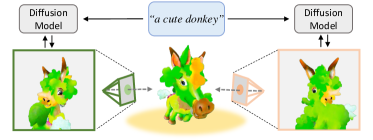
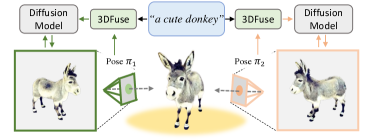
Text-to-3D generation has shown rapid progress in recent days with the advent of score distillation, a methodology of using pretrained text-to-2D diffusion models to optimize neural radiance field (NeRF) in the zero-shot setting. However, the lack of 3D awareness in the 2D diffusion models destabilizes score distillation-based methods from reconstructing a plausible 3D scene. To address this issue, we propose 3DFuse, a novel framework that incorporates 3D awareness into pretrained 2D diffusion models, enhancing the robustness and 3D consistency of score distillation-based methods. We realize this by first constructing a coarse 3D structure of a given text prompt and then utilizing projected, view-specific depth map as a condition for the diffusion model. Additionally, we introduce a training strategy that enables the 2D diffusion model learns to handle the errors and sparsity within the coarse 3D structure for robust generation, as well as a method for ensuring semantic consistency throughout all viewpoints of the scene. Our framework surpasses the limitations of prior arts, and has significant implications for 3D consistent generation of 2D diffusion models.
研究动机与目标
- 激励并解决基于 SDS 的文本到 3D 生成中的 3D 不一致性(“Janus 问题”)。
- 引入对 3D 有感知的条件化机制到预训练的 2D 扩散模型。
- 实现跨视点的健壮、几何上一致的 3D 场景生成。
- 通过语义编码和 LoRA 提升 3D 生成中的语义一致性和可控性。
提出的方法
- 语义代码采样通过优化文本嵌入以适配生成图像来减少提示歧义,产生语义代码 s=(hat{x}, hat{e})。
- 利用现成的 3D 模型从语义代码图像构建粗略的3D 点云,并为每个视图投影其深度图 p。
- 引入一个稀疏深度注入模块,以控制网(ControlNet)风格的残差方式将投影的深度图输入到扩散 U-net,从而提供 3D 感知的条件。
- 仅训练深度注入器(以及可选的 LoRA 层),在保持扩散模型冻结的情况下实现高效微调。
- 对扩散 U-net 应用 LoRA,通过调优低秩自适应层来提高跨视点的语义一致性。
- 展示在多个基于 SDS 的基线(DreamFusion、SJC、ProlificDreamer)和 MCC 基于的 3D 先验上的适应。
实验结果
研究问题
- RQ1将预训练的 2D 扩散模型对来自粗略 3D 先验的视图特定深度图进行条件化,是否能提升基于 SDS 的文本到 3D 生成中的 3D 一致性?
- RQ2语义编码是否能降低提示歧义,从而在不同视点下生成语义上一致的 3D 场景?
- RQ33D 感知条件化在不同基线下如何影响保真度和几何稳健性?
- RQ4在 3D 生成中使用 LoRA 提高语义一致性的影响是?
- RQ5所提出的方法是否可扩展到各种 2D 扩散骨干网络和 3D 先验?
主要发现
- 3DFuse 在 DreamFusion、SJC 和 ProlificDreamer 基线下显著提升了 3D 一致性和保真度。
- 基于 COLMAP 的度量显示 3DFuse 相较基线 SJC 方法在 3D 不一致性方差上更低(0.0499 vs 0.0870)。
- 用户研究(102 名参与者)偏好 3DFuse 增强的结果,因为在 3D 连贯性、提示遵循度和整体质量方面表现更好。
- 语义编码降低了视点引起的语义和几何不一致性。
- 基于 LoRA 的微调在不对扩散模型进行大幅修改的情况下进一步提高了语义一致性。
- 定性结果扩展到 MCC 基于的 3D 先验,证实了对先验的鲁棒性。
阅读本论文
在 Nubint 阅读器中打开原文,边读边就任意段落提问。
在 Nubint 中阅读本论文本解读由 AI 根据论文原文生成,引用前请核对原文。