
[论文解读] Leveraging ChatGPT As Text Annotation Tool For Sentiment Analysis
本文将 ChatGPT 作为文本注释工具用于情感分析进行评估,并在两个数据集(足球推文和亚马逊评论)上报告了相对于基于词典的方法的显著准确性提升。
Sentiment analysis is a well-known natural language processing task that involves identifying the emotional tone or polarity of a given piece of text. With the growth of social media and other online platforms, sentiment analysis has become increasingly crucial for businesses and organizations seeking to monitor and comprehend customer feedback as well as opinions. Supervised learning algorithms have been popularly employed for this task, but they require human-annotated text to create the classifier. To overcome this challenge, lexicon-based tools have been used. A drawback of lexicon-based algorithms is their reliance on pre-defined sentiment lexicons, which may not capture the full range of sentiments in natural language. ChatGPT is a new product of OpenAI and has emerged as the most popular AI product. It can answer questions on various topics and tasks. This study explores the use of ChatGPT as a tool for data labeling for different sentiment analysis tasks. It is evaluated on two distinct sentiment analysis datasets with varying purposes. The results demonstrate that ChatGPT outperforms other lexicon-based unsupervised methods with significant improvements in overall accuracy. Specifically, compared to the best-performing lexical-based algorithms, ChatGPT achieves a remarkable increase in accuracy of 20% for the tweets dataset and approximately 25% for the Amazon reviews dataset. These findings highlight the exceptional performance of ChatGPT in sentiment analysis tasks, surpassing existing lexicon-based approaches by a significant margin. The evidence suggests it can be used for annotation on different sentiment analysis events and taskss.
研究动机与目标
- 说明在无需大规模人工标注的情况下实现高效、高质量情感标注的必要性。
- 评估 ChatGPT 是否能在跨领域的情感任务中用作零-shot 文本标注工具。
- 使用标准指标将 ChatGPT 与基于词典的基线(VADER、TextBlob)进行比较。
- 展示 ChatGPT 在情感标注中处理表情符号、讽刺和长篇评论的潜力。
提出的方法
- 使用固定提示语的 GPT-3.5-turbo(ChatGPT)对从 API 响应中提取的情感分数进行标注。
- 在两个数据集上进行评估:足球推文(6,201 行;1,214 个表情符号;2,551 条正向,2,710 条负向,943 条中性)和 2,000 条亚马逊评论(正向 1,002,负向 998)。”
- 将基线设为词典方法工具 VADER 和 TextBlob 进行比较。
- 从 ChatGPT 输出中提取数值情感分数以分配标签。
- 报告每个标签和数据集的精确度、召回率、F1 值和准确率。
- 讨论情感标注中的表情符号处理和讽刺识别等定性方面。
实验结果
研究问题
- RQ1Can ChatGPT serve as an effective zero-shot text annotator for sentiment analysis across different domains?
- RQ2How does ChatGPT’s sentiment labeling compare to lexicon-based approaches on social media and long-form reviews?
- RQ3Does ChatGPT handle emojis, sarcasm, and irony better than traditional lexicon-based methods?
- RQ4What are the practical considerations (speed, cost, bias) when using ChatGPT for annotation tasks?
主要发现
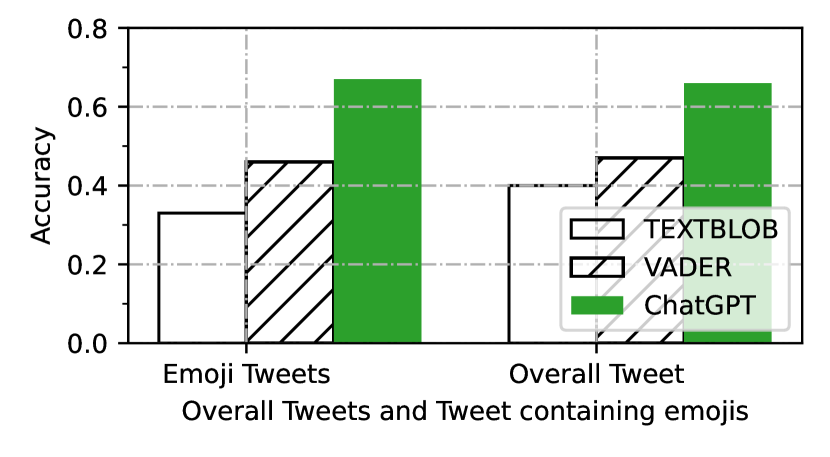
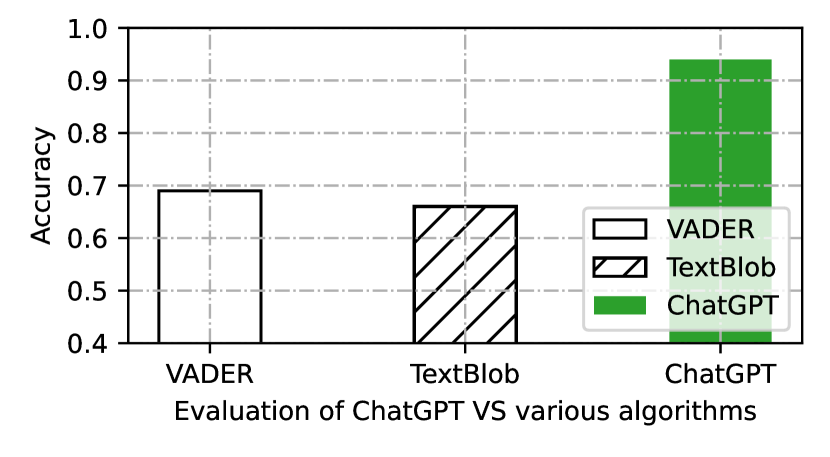
- ChatGPT 在两个数据集上均达到比 VADER 和 TextBlob 更高的准确性(例如:Soccer Tweets: 总体 67% vs 47% VADER 和 40% TextBlob;Amazon Reviews: 94% vs 69% VADER 和 66% TextBlob)。
- ChatGPT 在情感分类中有效处理表情符号,提升包含表情符号的推文的表现。
- 在所报告的表格中,ChatGPT 在正向、中性和负向类别上显示出更高的每标签精确度、召回率和 F1。
- ChatGPT 的零-shot 情感分析显示出强劲的表现,在长篇评论和短文本社交媒体文本上相对于词汇方法也有显著提升。
- 该研究指出的局限性包括提示依赖、回答中的潜在偏见,以及相较于某些工具更慢的处理速度/成本。
阅读本论文
在 Nubint 阅读器中打开原文,边读边就任意段落提问。
在 Nubint 中阅读本论文本解读由 AI 根据论文原文生成,引用前请核对原文。