
[论文解读] Leveraging Large Language Models in Conversational Recommender Systems
本文提出 RecLLM,一种端到端的由大语言模型驱动的对话式推荐系统架构,统一对话管理、检索、带解释的排序与用户画像,并通过可控的基于 LLM 的用户模拟器生成合成数据,同时在 YouTube 内容上利用 LaMDA 进行演示。
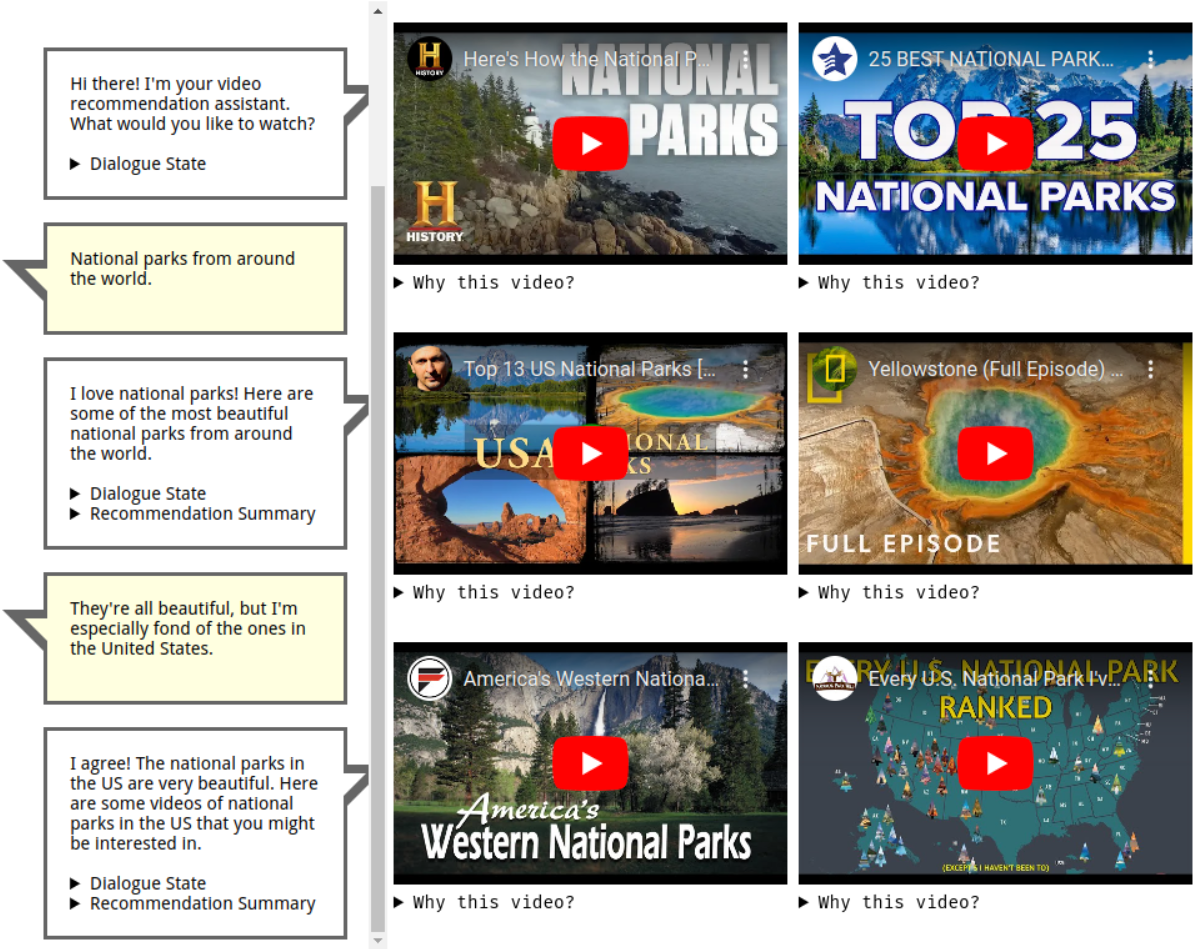
A Conversational Recommender System (CRS) offers increased transparency and control to users by enabling them to engage with the system through a real-time multi-turn dialogue. Recently, Large Language Models (LLMs) have exhibited an unprecedented ability to converse naturally and incorporate world knowledge and common-sense reasoning into language understanding, unlocking the potential of this paradigm. However, effectively leveraging LLMs within a CRS introduces new technical challenges, including properly understanding and controlling a complex conversation and retrieving from external sources of information. These issues are exacerbated by a large, evolving item corpus and a lack of conversational data for training. In this paper, we provide a roadmap for building an end-to-end large-scale CRS using LLMs. In particular, we propose new implementations for user preference understanding, flexible dialogue management and explainable recommendations as part of an integrated architecture powered by LLMs. For improved personalization, we describe how an LLM can consume interpretable natural language user profiles and use them to modulate session-level context. To overcome conversational data limitations in the absence of an existing production CRS, we propose techniques for building a controllable LLM-based user simulator to generate synthetic conversations. As a proof of concept we introduce RecLLM, a large-scale CRS for YouTube videos built on LaMDA, and demonstrate its fluency and diverse functionality through some illustrative example conversations.
研究动机与目标
- 激励使用大语言模型以实现透明、交互式、多轮对话式推荐。
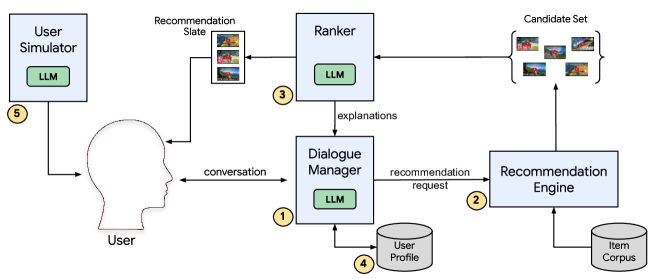
- 提出一个端到端架构,在该架构中单个 LLM 处理对话管理、检索、排序和解释。
- 通过与 LLM 兼容的多种检索策略,在大规模项目集中实现可扩展的检索。
- 纳入可解释的自然语言用户画像,以个性化会话上下文。
- 提供可控的基于 LLM 的用户模拟器,用于生成合成对话以调优系统模块。
提出的方法
- 统一的基于 LLM 的对话管理,将系统操作和响应作为一个语言建模任务输出。
- 面向大规模语料的通用检索框架,通过 Generalized Dual Encoder、Direct LLM Search、Concept Based Search 和 Search API Lookup 等方法实现可控的候选生成。
- 一个联合的 LLM 排名模块,利用项目信摘要和上下文摘要对项进行打分并生成自然语言解释。
- 将持久且可解释的自然语言用户画像作为输入提供给 LLM,以调制会话上下文。
- 开发一个可控的基于 LLM 的用户模拟器,以生成合成对话用于可扩展的调优和评估。
实验结果
研究问题
- RQ1如何使用 LLM 将对话管理、检索和排序在 CRS 中统一?
- RQ2哪些检索策略能够实现对基于 LLM 的 CRS 的大规模候选生成的可控性?
- RQ3LLM 能否为其在 CRS 中的推荐生成易于理解的解释?
- RQ4可解释的自然语言用户画像如何提升 CRS 的个性化?
- RQ5由可控的基于 LLM 的模拟器生成的合成对话是否能有效调优和评估 CRS 的组件?
主要发现
- 展示一个功能性端到端的 RecLLM 架构,在统一的 LLM 框架内处理上下文跟踪、API 调用和响应生成。
- 提出多种适用于大规模项目集的检索方法,在效率与准确性之间取得平衡。
- 显示基于 LLM 的排序器能够产出基于项目信摘要和上下文摘要的分数和自然语言解释。
- 引入可解释的自然语言用户画像,可以并入对话管理以个性化会话。
- 提出一个可控的基于 LLM 的用户模拟器,能够生成用于系统调优和评估的合成对话。
阅读本论文
在 Nubint 阅读器中打开原文,边读边就任意段落提问。
在 Nubint 中阅读本论文本解读由 AI 根据论文原文生成,引用前请核对原文。