
[论文解读] LiDAR-NeRF: Novel LiDAR View Synthesis via Neural Radiance Fields
LiDAR-NeRF 提出一个可微分的端到端框架,通过学习一个编码 LiDAR 距离、强度和射线衰减概率的神经辐射场来渲染新颖的 LiDAR 视图,并通过结构正则化和新的面向对象的数据集 NeRF-MVL 实现。
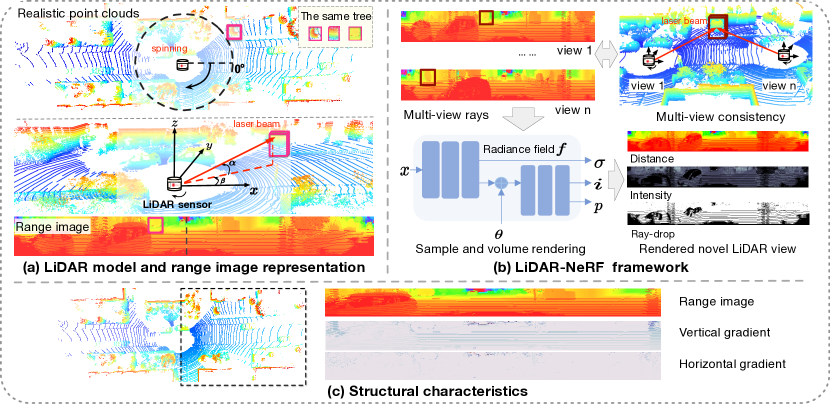
We introduce a new task, novel view synthesis for LiDAR sensors. While traditional model-based LiDAR simulators with style-transfer neural networks can be applied to render novel views, they fall short of producing accurate and realistic LiDAR patterns because the renderers rely on explicit 3D reconstruction and exploit game engines, that ignore important attributes of LiDAR points. We address this challenge by formulating, to the best of our knowledge, the first differentiable end-to-end LiDAR rendering framework, LiDAR-NeRF, leveraging a neural radiance field (NeRF) to facilitate the joint learning of geometry and the attributes of 3D points. However, simply employing NeRF cannot achieve satisfactory results, as it only focuses on learning individual pixels while ignoring local information, especially at low texture areas, resulting in poor geometry. To this end, we have taken steps to address this issue by introducing a structural regularization method to preserve local structural details. To evaluate the effectiveness of our approach, we establish an object-centric multi-view LiDAR dataset, dubbed NeRF-MVL. It contains observations of objects from 9 categories seen from 360-degree viewpoints captured with multiple LiDAR sensors. Our extensive experiments on the scene-level KITTI-360 dataset, and on our object-level NeRF-MVL show that our LiDAR-NeRF surpasses the model-based algorithms significantly.
研究动机与目标
- 为新颖 LiDAR 视图合成提供动机并界定任务,解决现有 LiDAR 模拟器难以产生真实 LiDAR 模式的空白。
- 通过一个受 NeRF 启发的框架,在不进行显式 3D 重建的前提下,联合学习几何和每个伪像素的 LiDAR 属性(距离、强度、射线-drop)。
- 引入结构正则化策略,在低纹理区域保持局部几何细节。
- 创建并发布 NeRF-MVL 面向对象的 LiDAR 数据集,以便在多个对象和视角上评估 LiDAR 视图合成。
提出的方法
- 将 LiDAR 点云转换为每个视图的距离伪图像,使每个伪像素对应一个 LiDAR 光束。
- 使用一个两 MLP 的 NeRF 风格辐射场来预测每个伪像素的属性:深度相关密度和一个含强度与射线-drop 的两通道特征图;计算沿射线的每视图综合深度、强度和射线-drop。
- 加入一个结构正则化项,主要在低纹理区域惩罚局部结构差异,以改善几何。
- 用多任务损失进行训练,结合深度距离、强度、射线-drop 和结构正则化项。

实验结果
研究问题
- RQ1是否能够端到端学习出一个可微分的 LiDAR 渲染器,从新颖视点合成真实的 LiDAR 视图?
- RQ2在神经辐射场框架中如何对 LiDAR 特定属性(强度和射线-drop)建模?
- RQ3结构正则化策略是否提升 LiDAR-NeRF 的几何保真度,特别是在低纹理区域?
- RQ4相较于基于模型的渲染,LiDAR-NeRF 在场景级和对象级的新颖 LiDAR 视图合成上表现如何?
主要发现
- LiDAR-NeRF 在 KITTI-360 与 NeRF-MVL 的场景级和对象级任务上优于基线 LiDAR 渲染器(LiDARsim、PCGen)。
- 对于 KITTI-360,在 iNGP 基础架构与结构正则化存在的情况下,LiDAR-NeRF 在所测试的变体(C-D、F-score、RMSE、δ1/δ2/δ3、SSIM、MAE)中达到最佳指标。
- 在 NeRF-MVL 的对象级数据中,LiDAR-NeRF 使用 iNGP 相对于基线取得更优的 C-D、RMSE、δ1/δ2/δ3、SSIM、MAE。
- 消融研究显示,结构正则化和 iNGP 架构的选择显著提升几何和 LiDAR 模式的真实感。
阅读本论文
在 Nubint 阅读器中打开原文,边读边就任意段落提问。
在 Nubint 中阅读本论文本解读由 AI 根据论文原文生成,引用前请核对原文。