
[论文解读] Light-Matter Hybridization and Entanglement from the First-Principles
本文在量子电动力学哈特ree-福克(QEDHF)框架内提出了一种变分压缩变换,以捕捉强耦合光-物质系统中的非谐振量子涨落。通过优化压缩参数,该方法能准确描述光子场涨落并量化光-物质纠缠,显著提升了在强耦合区域中对传统平均场近似之外的预测能力。
The hybridization between light and matter is fundamental for achieving cavity-induced control over quantum materials, necessitating accurate ab initio methods for their analysis. Among these, the quantum electrodynamics Hartree-Fock framework stands out as an essential mean field approximation for electron-electron and electron-photon interactions, forming the basis for advanced post-Hartree-Fock methods like quantum electrodynamics coupled cluster and auxiliary field quantum Monte Carlo. However, trivial quantum electrodynamics Hartere-Fock (QEDHF) methods assume a product state ansätze and thus cannot describe the light-matter Entanglement. Furthermore, our previous work on variational ansätze approaches lacked the capability to capture anharmonic or nonlinear fluctuations, limiting their applicability to strongly coupled systems. To overcome these limitations, we propose an extended QEDHF formalism by introducing a variational Squeeze transformation capable of describing anharmonic quantum fluctuations in photon fields. By optimizing the squeezing parameters, our framework provides a more nuanced and accurate characterization of photon field quantum fluctuations, significantly enhancing the predictive power of QEDHF in strong coupling regimes. Moreover, this formalism enhances the description of light-matter Entanglement, providing a first-principles framework for understanding light-matter hybridization and paving the way for deeper insights into cavity-modified quantum phenomena.
研究动机与目标
- 为克服标准QEDHF在描述强耦合光-物质系统中非谐振和非线性量子涨落方面的局限性。
- 通过引入变分压缩变换,将变分位移QEDHF框架扩展至更优地处理光子场关联。
- 在强耦合区域中,从第一性原理出发,实现对光-物质纠缠的定量表征。
- 为量子电动力学中的后-HF方法(如QED-CC和QMC)提供更精确的平均场参考。
- 弥合平均场近似与量子材料中强关联光子效应之间的差距。
提出的方法
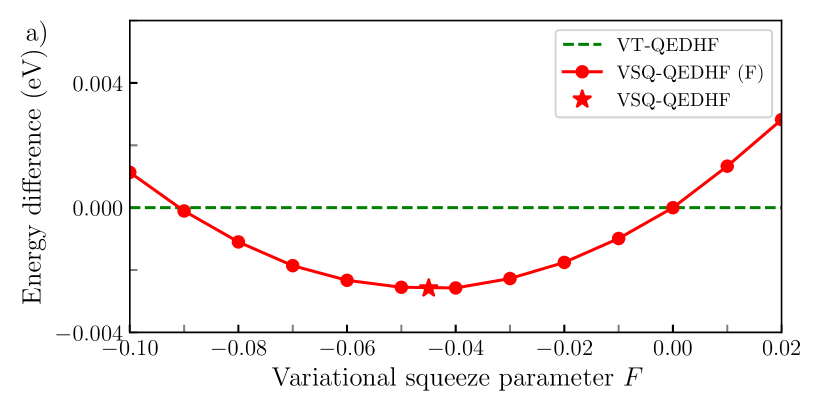
- 将变分压缩(VSQ)变换引入QEDHF形式化体系,将压缩参数作为变分变量以最小化能量。
- 对光子场哈密顿量应用压缩变换,修改光子能量和耦合项,以反映非谐振涨落。
- 在压缩相干态(SCS)表示下推导有效哈密顿量,该表示对双线性项和二次项光子项进行重整化。
- 利用相干压缩态(CSS)表示计算有效哈密顿量和密度矩阵,从而实现纠缠的量化。
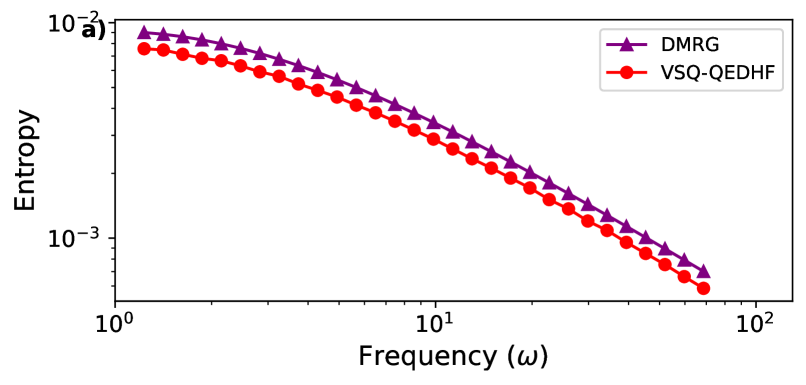
- 通过对电子自由度进行部分迹运算,计算光子约化密度矩阵,进而计算冯诺依曼熵作为纠缠的度量。
- 通过与DMRG基准结果对比验证该方法,结果表明在纠缠和能量预测方面均具有更高的准确性。
实验结果
研究问题
- RQ1在QEDHF中引入的变分压缩变换能否准确描述强耦合光-物质系统中的非谐振量子涨落?
- RQ2与标准QEDHF相比,引入压缩变换在描述光-物质纠缠方面有何改进?
- RQ3VSQ-QEDHF框架在多强耦合区域中在多大程度上提升了平均场理论的预测能力?
- RQ4该框架能否定量再现与DMRG计算基准一致的纠缠度量?
- RQ5光子非谐性对腔修饰量子材料中基态能量和电子结构有何影响?
主要发现
- 变分压缩变换成功捕捉了光子场中的非谐振涨落,使对强耦合系统的描述超越了谐振近似。
- 该方法可通过冯诺依曼熵实现光-物质纠缠的定量计算,且结果经DMRG基准验证。
- 压缩参数通过变分法优化,获得更低的变分能量,并在强耦合区域中显著提升计算精度。
- 在相干压缩态(CSS)表示下的有效哈密顿量对双线性耦合项和光子哈密顿量项均实现重整化,反映出非平凡的光子关联。
- 在多光子基组极限下,压缩操作显著影响基态能量,证实其非微扰作用。
- 该框架为后哈特ree-福克方法(如QED-CC和QMC)在量子电动力学中提供了稳健的第一性原理参考。
阅读本论文
在 Nubint 阅读器中打开原文,边读边就任意段落提问。
在 Nubint 中阅读本论文本解读由 AI 根据论文原文生成,引用前请核对原文。