
[论文解读] LIVABLE: Exploring Long-Tailed Classification of Software Vulnerability Types
LIVABLE 是一种基于图神经网络(GNN)的新方法,用于长尾分布的软件漏洞类型分类,通过差异化传播机制和自适应重加权损失,解决了过平滑和类别不平衡问题。在 Fan 等人的数据集上,其准确率比当前最先进方法高出 24.18%,尾部类别预测性能提升 7.7%。
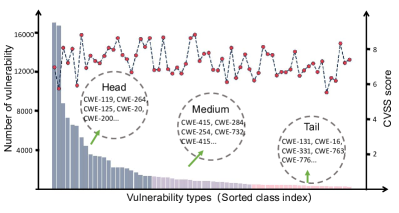
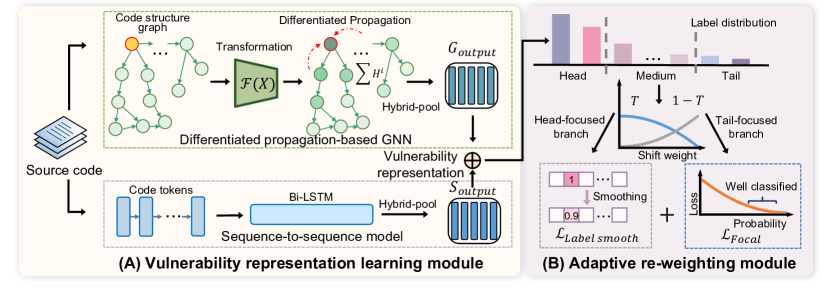
Prior studies generally focus on software vulnerability detection and have demonstrated the effectiveness of Graph Neural Network (GNN)-based approaches for the task. Considering the various types of software vulnerabilities and the associated different degrees of severity, it is also beneficial to determine the type of each vulnerable code for developers. In this paper, we observe that the distribution of vulnerability type is long-tailed in practice, where a small portion of classes have massive samples (i.e., head classes) but the others contain only a few samples (i.e., tail classes). Directly adopting previous vulnerability detection approaches tends to result in poor detection performance, mainly due to two reasons. First, it is difficult to effectively learn the vulnerability representation due to the over-smoothing issue of GNNs. Second, vulnerability types in tails are hard to be predicted due to the extremely few associated samples.To alleviate these issues, we propose a Long-taIled software VulnerABiLity typE classification approach, called LIVABLE. LIVABLE mainly consists of two modules, including (1) vulnerability representation learning module, which improves the propagation steps in GNN to distinguish node representations by a differentiated propagation method. A sequence-to-sequence model is also involved to enhance the vulnerability representations. (2) adaptive re-weighting module, which adjusts the learning weights for different types according to the training epochs and numbers of associated samples by a novel training loss.
研究动机与目标
- 解决软件漏洞类型中长尾分布的问题,即少数类别(尾部)样本极少但严重性高。
- 克服 GNN 中因深层架构导致的过平滑问题,该问题会降低节点表示学习性能。
- 提升罕见(尾部)漏洞类型分类性能,这些类别常被标准模型忽略。
- 构建一个统一框架,在长尾数据设置下同时提升漏洞类型分类和检测性能。
- 通过准确识别高严重性、低频次的漏洞类型,实现更有效的漏洞分类与修复。
提出的方法
- 提出一种差异化 GNN 传播机制,根据节点中心性和局部结构动态调整消息传递,以减少过平滑。
- 集成序列到序列模型,通过捕捉代码标记中的序列模式,丰富漏洞表示。
- 设计一种自适应重加权模块,根据类别频率和训练轮次动态调整损失权重,优先关注尾部类别。
- 提出一种新型训练损失函数,结合类别频率和模型置信度,减少对头部类别的偏差。
- 将增强的 GNN 表示与自适应重加权策略相结合,联合优化表示学习与长尾分类任务。
- 在真实世界数据集(包括 Fan 等人的基准数据集)上评估框架,使用准确率和 F1 分数等标准指标,分别评估头部和尾部类别的性能。
实验结果
研究问题
- RQ1漏洞类型长尾分布对现有基于 GNN 的漏洞检测模型性能有何影响?
- RQ2差异化 GNN 传播策略是否能有效缓解过平滑问题,并提升漏洞图中的节点表示学习?
- RQ3基于类别频率和训练进度的自适应重加权,在多大程度上能改善对罕见(尾部)漏洞类型的分类?
- RQ4所提出的 LIVABLE 框架是否在漏洞类型分类和端到端漏洞检测任务中均优于当前最先进方法?
- RQ5该模型在高严重性、低频次漏洞类型(如 CWE-507 和 CWE-912)上的表现如何?
主要发现
- 在 Fan 等人的数据集上,LIVABLE 在漏洞类型分类任务中,整体准确率比当前最先进方法高出 24.18%。
- 模型在尾部类别预测准确率上提升 7.7%,显著增强了对高严重性、低频次漏洞的识别能力。
- 漏洞表示学习模块在三个基准数据集上,平均使基线模型准确率提升 4.03%。
- 消融实验表明,差异化 GNN 传播机制和自适应重加权组件对性能提升均至关重要。
- 尾部类别的平均 CVSS 得分为 7.01,表明其严重性较高,而 LIVABLE 有效识别了这些关键漏洞。
- 该框架在多种编程语言上表现有效,且在跨数据集评估中展现出良好的泛化能力,能有效识别未见的漏洞类型。
阅读本论文
在 Nubint 阅读器中打开原文,边读边就任意段落提问。
在 Nubint 中阅读本论文本解读由 AI 根据论文原文生成,引用前请核对原文。