
[论文解读] LLaMAX: Scaling Linguistic Horizons of LLM by Enhancing Translation Capabilities Beyond 100 Languages
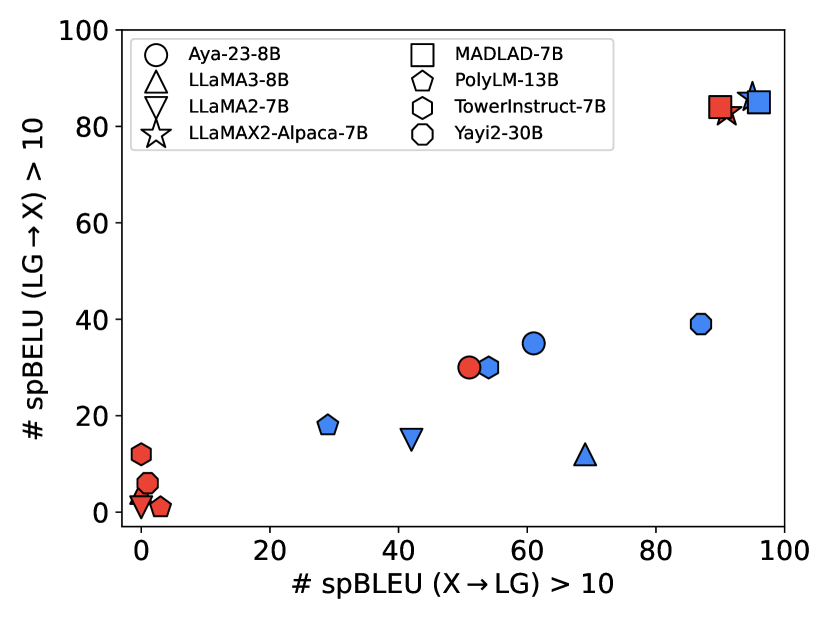
LLaMAX 通过在 35,000 个 A100 GPU 小时的持续预训练中整合 102 种语言的词汇扩展和数据增强,增强了基于 LLaMA 模型的多语言翻译能力。其在 Flores-101 上的性能优于开源 LLM,提升超过 10 spBLEU,且在低资源语言翻译中表现尤为出色,同时保持了良好的泛化能力,性能可与专用模型 M2M-100-12B 相媲美。
Large Language Models (LLMs) demonstrate remarkable translation capabilities in high-resource language tasks, yet their performance in low-resource languages is hindered by insufficient multilingual data during pre-training. To address this, we conduct extensive multilingual continual pre-training on the LLaMA series models, enabling translation support across more than 100 languages. Through a comprehensive analysis of training strategies, such as vocabulary expansion and data augmentation, we develop LLaMAX. Remarkably, without sacrificing its generalization ability, LLaMAX achieves significantly higher translation performance compared to existing open-source LLMs (by more than 10 spBLEU points) and performs on-par with specialized translation model (M2M-100-12B) on the Flores-101 benchmark. Extensive experiments indicate that LLaMAX can serve as a robust multilingual foundation model. The code \footnote{\url{https://github.com/CONE-MT/LLaMAX/.}} and the models \footnote{\url{https://huggingface.co/LLaMAX/.}} are publicly available.
研究动机与目标
- 通过增强 LLM 的多语言能力,弥合低资源语言翻译中的性能差距。
- 通过可扩展的预训练和数据增强,克服低资源语言的数据稀缺问题。
- 在显著提升 102 种语言翻译质量的同时,保持强大的泛化能力。
- 利用开源 LLM 实现与专用翻译模型相当的竞争力表现。
- 构建适用于多样化翻译方向的稳健多语言基础模型。
提出的方法
- 使用 35,000 个 A100 GPU 小时,在 LLaMA 模型上进行大规模持续预训练,数据包括单语和并行多语言数据。
- 通过添加语言特定的 token 实现词汇扩展,分析其对分词、嵌入质量及模型分布的影响。
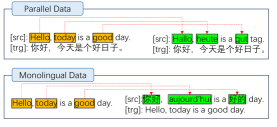
- 利用多语言词典(MUSE 和 PanLex)进行数据增强,通过一跳和二跳翻译扩充并行和单语数据。
- 采用混合数据构建策略:提取特定语言的单语和并行子集,并在并行数据不足时补充英语单语数据。
- 在监督微调中同时使用拆分并行(split-parallel)和连接并行(connected-parallel)格式,评估其对翻译性能的影响。
- 应用结构化提示模板,确保在不同模型间实现公平且可复现的评估。
实验结果
研究问题
- RQ1添加语言特定 token 后,词汇扩展如何影响模型性能和分布?
- RQ2哪种数据增强策略(如一跳 vs. 二跳翻译)最有利于提升低资源语言翻译性能?
- RQ3在多样化单语和并行数据上进行持续预训练,是否能显著提升 102 种语言的翻译性能,同时不损害泛化能力?
- RQ4LLaMAX 在多语言翻译基准测试中与专用翻译模型(如 M2M-100-12B)相比表现如何?
- RQ5并行数据格式(拆分并行 vs. 连接并行)对翻译性能和跨语言泛化能力有何影响?
主要发现
- LLaMAX 在 Flores-101 基准测试中,翻译性能比现有开源 LLM 提升超过 10 spBLEU 点。
- LLaMAX 在 Flores-101 上与专用模型 M2M-100-12B 表现相当,尤其在低资源语言翻译中表现突出。
- 使用多语言词典进行一跳翻译的数据增强显著提升性能,而二跳翻译未见增益,甚至可能造成性能下降。
- 与拆分并行格式相比,连接并行格式在并行数据中显著提升翻译性能,尤其在高资源方向表现更优。
- LLaMAX 在从日语生成目标语言翻译时,优于专门针对日语的模型 Swallow,有效减少语言混淆。
- 与 GPT-4 的对比显示,LLaMAX 在低资源翻译方向上表现匹配或超越 GPT-4,尽管成本更高且评估范围有限。
阅读本论文
在 Nubint 阅读器中打开原文,边读边就任意段落提问。
在 Nubint 中阅读本论文本解读由 AI 根据论文原文生成,引用前请核对原文。