
[论文解读] LLM-Blender: Ensembling Large Language Models with Pairwise Ranking and Generative Fusion
LLM-Blender 通过将成对排序模块(PairRanker)与生成融合模块(GenFuser)配对来对开源 LLM 进行集成,并引入 MixInstruct 作为该任务的基准。它在性能上优于单一模型和基线集成方法。
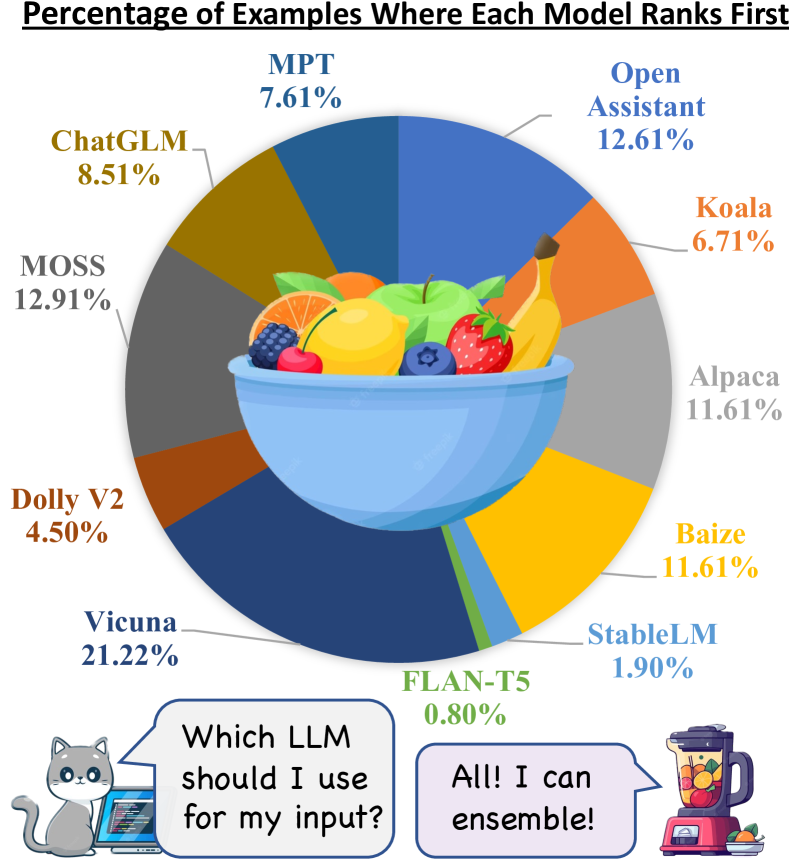
We present LLM-Blender, an ensembling framework designed to attain consistently superior performance by leveraging the diverse strengths of multiple open-source large language models (LLMs). Our framework consists of two modules: PairRanker and GenFuser, addressing the observation that optimal LLMs for different examples can significantly vary. PairRanker employs a specialized pairwise comparison method to distinguish subtle differences between candidate outputs. It jointly encodes the input text and a pair of candidates, using cross-attention encoders to determine the superior one. Our results demonstrate that PairRanker exhibits the highest correlation with ChatGPT-based ranking. Then, GenFuser aims to merge the top-ranked candidates, generating an improved output by capitalizing on their strengths and mitigating their weaknesses. To facilitate large-scale evaluation, we introduce a benchmark dataset, MixInstruct, which is a mixture of multiple instruction datasets featuring oracle pairwise comparisons. Our LLM-Blender significantly outperform individual LLMs and baseline methods across various metrics, establishing a substantial performance gap.
研究动机与目标
- 促使对多样化的开源 LLM 进行动态集成,以超越任何单一模型。
- 开发一个成对排序模块,捕捉候选输出之间的细微差异。
- 创建一个生成式融合模块,将Top候选整合成更优的最终输出。
- 提供 MixInstruct 作为评估 LLM 集成的带有 oracle 成对比较的基准。
- 证明集成在指令遵循任务中带来鲁棒性和对齐性的提升。
提出的方法
- PairRanker 结合输入与一对候选输出,通过跨注意力学习成对优越性。
- 在所有候选对之间构建成对比较矩阵并从中推导排名。
- 使用 MaxLogits(默认)聚合以在 O(N) 时间内高效选择顶端候选。
- GenFuser 使用输入和前-K 名排序候选,通过一个 seq2seq 模型生成最终输出(实验中使用 Flan-T5-XL)。
- MixInstruct 提供带有 oracle 风格的成对比较的训练数据,用于监督 PairRanker 并评估集成性能。
实验结果
研究问题
- RQ1相比传统的逐点评分,成对候选比较是否能更好地在众多 LLM 候选中识别最高质量的输出?
- RQ2前-K 名排序候选的融合是否能产生超越任何单一候选或简单重排序的输出?
- RQ3与单一 LLM 和现有基线相比,LLM- Blender 框架在指令遵循任务中的表现如何?
- RQ4MixInstruct 是否是一个有效的基准,用于在多样化的指令任务上评估 LLM 集成方法?
- RQ5在此设置下,自动化度量(BERTScore、BLEURT、BARTScore)与基于 GPT 的排序(GPT-Rank)之间的相关性是多少?
主要发现
- 在排序方法中,PairRanker 与 GPT-Rank 的相关性最高,超越 SummaReranker 和 SimCLS。
- LLM- Blender 采用前3个 PairRanker 选择 + GenFuser,在 GPT-Rank 和 NLG 指标上优于最佳单一 LLM。
- 在 MixInstruct 上,LLM- Blender 与 PR(K=3) + GF 达到 GPT-Rank 3.01、BERTScore 79.09、BARTScore -3.02、BLEURT -0.17、Top-3 比例 68.59,以及更高比例的输出超过 OA 和 Vicuna。
- 单独的 PairRanker 就已优于最佳单一模型,达到 GPT-Rank 3.20 和 Top-3 65.12%,表明对每个样本的模型选择效果显著。
- BARTScore 与 GPT-Rank 在评估指标中显示出强相关性,支持其用于 PairRanker 训练的监督。
阅读本论文
在 Nubint 阅读器中打开原文,边读边就任意段落提问。
在 Nubint 中阅读本论文本解读由 AI 根据论文原文生成,引用前请核对原文。