
[论文解读] LLM Discussion: Enhancing the Creativity of Large Language Models via Discussion Framework and Role-Play
本工作提出 LLM Discussion,一种由多個 LLM 进行角色扮演的三阶段讨论框架以提升创造力,在 AUT、Instances、Similarities 及 Scientific Creativity 的评估中,使用 LLM 与人类评估者进行评估,表现优于基线。
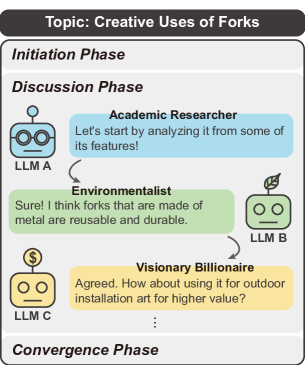
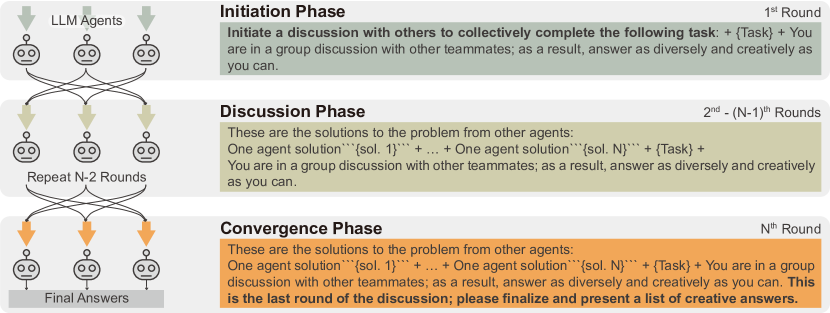
Large language models (LLMs) have shown exceptional proficiency in natural language processing but often fall short of generating creative and original responses to open-ended questions. To enhance LLM creativity, our key insight is to emulate the human process of inducing collective creativity through engaging discussions with participants from diverse backgrounds and perspectives. To this end, we propose LLM Discussion, a three-phase discussion framework that facilitates vigorous and diverging idea exchanges and ensures convergence to creative answers. Moreover, we adopt a role-playing technique by assigning distinct roles to LLMs to combat the homogeneity of LLMs. We evaluate the efficacy of the proposed framework with the Alternative Uses Test, Similarities Test, Instances Test, and Scientific Creativity Test through both LLM evaluation and human study. The results show that our proposed framework outperforms single-LLM approaches and existing multi-LLM frameworks across various creativity metrics. The code is available at https://github.com/lawraa/LLM-Discussion.
研究动机与目标
- 通过协作的多代理讨论来提升 LLM 创造力的思路。
- 解决 LLM 在多轮互动中的局限性和同质化思维。
- 设计一个三阶段的启动、讨论与收敛框架,以促进发散性与收敛性思维。
- 将角色扮演与多样化的 LLM 角色(以及 Six Thinking Hats)结合,以增加视角多样性。
- 使用 Wallach-Kogan Creativity Tests 和一个 Scientific Creativity Test 进行评估,评估包含 LLM 与人类评估。
提出的方法
- 包含启动、讨论和收敛提示的三阶段讨论框架,以引导发散性和收敛性思维。
- 角色生成以创建多样化的 LLM 角色与视角,利用 Six Thinking Hats 提供多元观点。
- 角色扮演整合:为 LLM 指定固定角色,并在每轮提醒其角色。
- 创造力基准:Alternative Uses Task (AUT)、Instances、Similarities,以及 Scientific Creativity Test。
- 基于 TTCT 的评估指标:Originality 与 Elaboration(主要),再加上 Fluency 与 Flexibility。
- 基线包括 Single Agent prompting、Brainstorm-then-Select (BTS) 与 LLM Debate。
实验结果
研究问题
- RQ1相较于现有基线,多 LLM 讨论与角色扮演是否能提升创造力指标?
- RQ2诸如提示设计、讨论轮数与参与 LLM 数量等因素如何影响创造力结果?
- RQ3基于 LLM 的创造力评估与人类判断之间的相关性有多大?
- RQ4所提出的框架能否在多轮中维持发散性思维并收敛到高质量的创造性结论?
主要发现
- LLM Discussion 在 Originality 与 Elaboration 上超过 AUT、Instances、Similarities 以及 Scientific Creativity tests 的基线表现。
- 角色扮演与三阶段讨论框架促进协作动力学,减少 LLM 之间的同质化思维。
- 五轮讨论、四个 LLM 获得最佳整体性能。
- 人类评估与 LLM 评估在 Originality 与 Elaboration 上一致,对若干指标与平均人类判断具有强相关性。
- Kendall’s tau 指出 LLM 评估与平均人类评估在 Originality、Fluency 与 Flexibility 之间存在强相关性,Elaboration 则存在中等相关性。
阅读本论文
在 Nubint 阅读器中打开原文,边读边就任意段落提问。
在 Nubint 中阅读本论文本解读由 AI 根据论文原文生成,引用前请核对原文。