
[论文解读] LLM-Enhanced User-Item Interactions: Leveraging Edge Information for Optimized Recommendations
本论文提出一个基于图注意力的GPT-2为基础的推荐系统,通过通过专门的提示和预训练/微调将一阶和二阶图边信息注入注意力,在多个Amazon数据集上获得更好的推荐。
Graph recommendation methods, representing a connected interaction perspective, reformulate user-item interactions as graphs to leverage graph structure and topology to recommend and have proved practical effectiveness at scale. Large language models, representing a textual generative perspective, excel at modeling user languages, understanding behavioral contexts, capturing user-item semantic relationships, analyzing textual sentiments, and generating coherent and contextually relevant texts as recommendations. However, there is a gap between the connected graph perspective and the text generation perspective as the task formulations are different. A research question arises: how can we effectively integrate the two perspectives for more personalized recsys? To fill this gap, we propose to incorporate graph-edge information into LLMs via prompt and attention innovations. We reformulate recommendations as a probabilistic generative problem using prompts. We develop a framework to incorporate graph edge information from the prompt and attention mechanisms for graph-structured LLM recommendations. We develop a new prompt design that brings in both first-order and second-order graph relationships; we devise an improved LLM attention mechanism to embed direct the spatial and connectivity information of edges. Our evaluation of real-world datasets demonstrates the framework's ability to understand connectivity information in graph data and to improve the relevance and quality of recommendation results.
研究动机与目标
- 推动将大语言模型(LLMs)与面向图结构的数据结合用于推荐,利用边信息来捕捉复杂的用户-物品关系。
- 开发一个图注意力LLM骨干,将一阶和二阶图连通性纳入注意力机制。
- 设计面向众包上下文的预训练提示和个性化预测提示用于微调,以优化推荐质量。
提出的方法
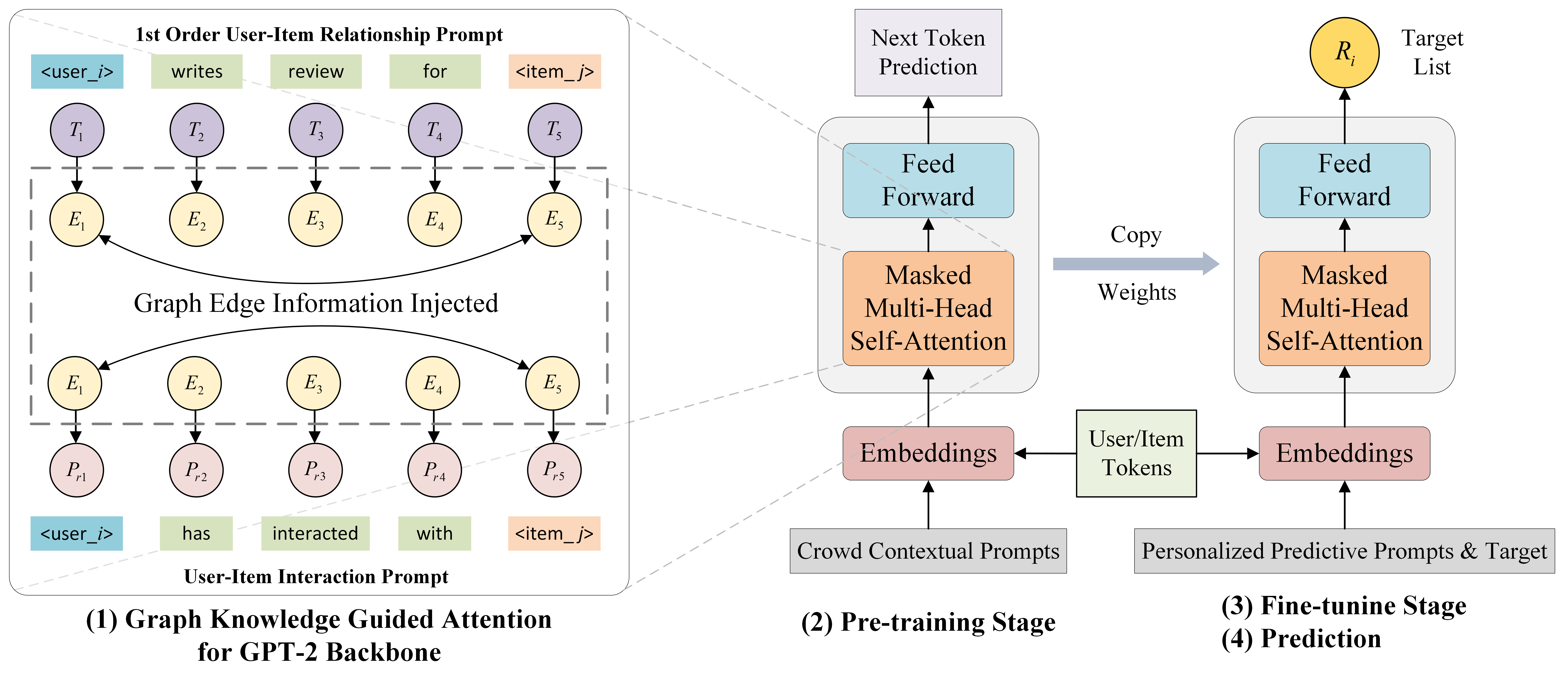
- 以GPT-2作为基础LLM,并通过在注意力计算中加入一个边编码项R,将图边知识嵌入注意力机制。
- 将直接(一阶)和间接(二阶)图连通性表示为 R = R^conn + R^path,其中 R^conn 作为邻接样项,R^path 来自归一化的最短路径分数。
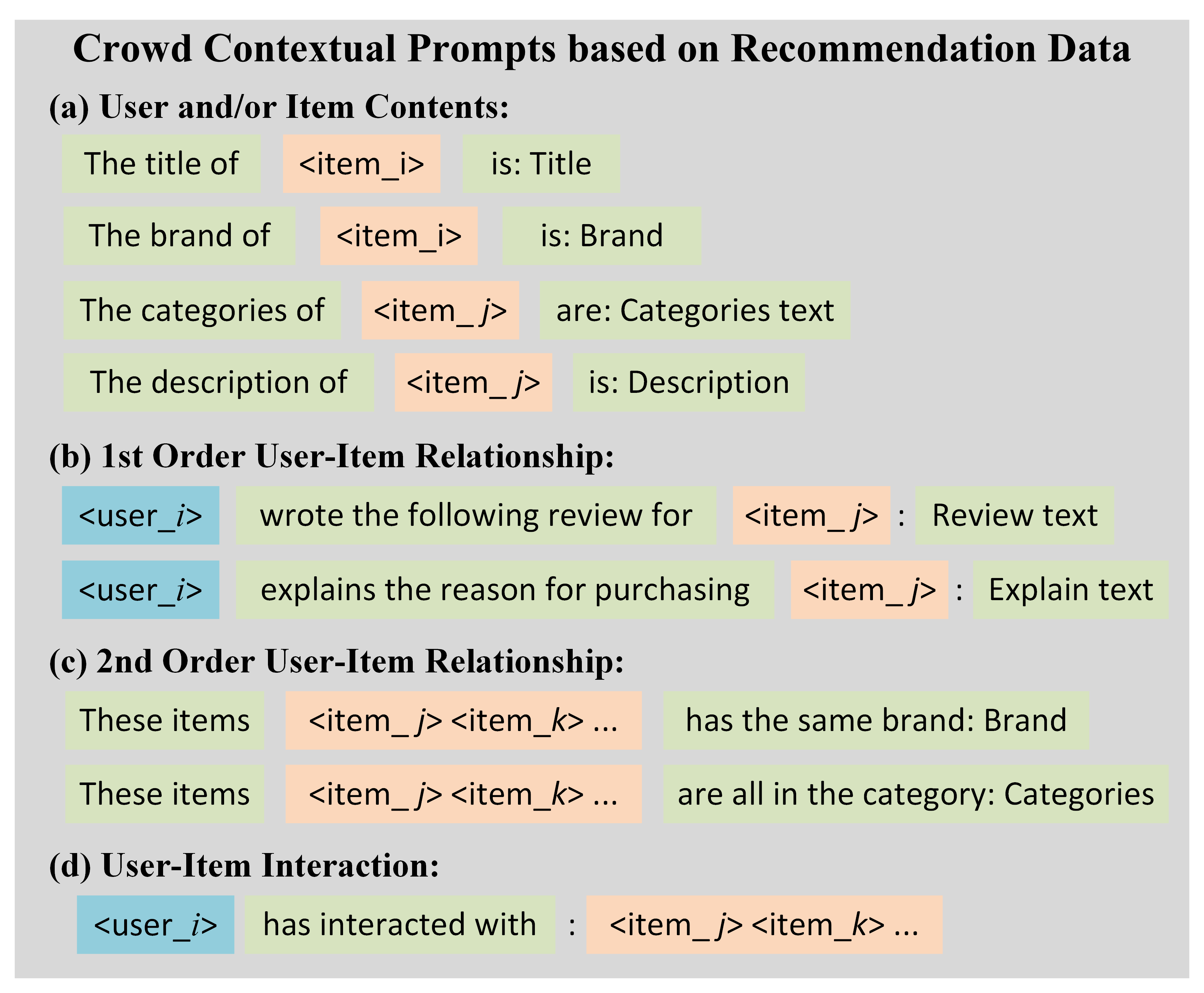
- 在包含用户/项目标记、物品属性和用户-物品交互事件的众包上下文提示上对图注意力LLM进行预训练,以最大化代币生成可能性。
- 使用个性化预测提示进行微调,将用户历史转换为过去时提示并带有将来时触发器,以优化推荐准确性。
- 在生产中通过使用提示为用户-物品对生成推荐分数,结合离线批处理和在线缓存以控制延迟。
- 以 Recall@20、Recall@40 和 NDCG@100 在七个 Amazon 数据集上进行评估;消融研究测试预训练、微调、GKIA(将图知识注入注意力)和 GHIP(图/历史提示)。
实验结果
研究问题
- RQ1图注意力LLM框架是否能够在真实世界数据集上提升相对于基线的推荐准确性?
- RQ2一阶与二阶图连通性对推荐性能的贡献是什么?
- RQ3预训练、微调以及图增强注意力组件如何影响结果?
- RQ4是否将物品背景信息和二阶关系纳入考虑能够提升推荐?
- RQ5不同提示结构和将注意力注入方法在面向图的LLM推荐中的效果如何?
主要发现
- 所提出的图注意力LLM在七个Amazon数据集上比基线在Recall@20、Recall@40和NDCG@100上表现更好。
- 消融表明预训练和微调对性能有显著影响,验证了学习流程。
- 通过 GKIA 注意力机制将图边信息引入并使用二阶关系可提升结果。
- 包含二阶物品关系和物品背景信息的提示可实现最佳性能,优于缺少这些组件的模型。
- 不同的注意力注入方法体现了将边缘知识嵌入到LLM注意力动态中的重要性。
阅读本论文
在 Nubint 阅读器中打开原文,边读边就任意段落提问。
在 Nubint 中阅读本论文本解读由 AI 根据论文原文生成,引用前请核对原文。