
[论文解读] LLM-GAN: Construct Generative Adversarial Network Through Large Language Models For Explainable Fake News Detection
LLM-GAN 提出了一种新颖的框架,利用大型语言模型(LLMs)作为生成器和检测器,在生成对抗网络中实现可解释的虚假新闻检测。通过采用相互对抗的提示(inter-adversary prompting)来模拟真实的虚假新闻,并利用自我反思提示(self-reflection prompting)迭代修正检测错误,LLM-GAN 在检测准确率和解释质量方面均达到当前最先进水平,在真实世界数据集上的表现优于现有方法。
Explainable fake news detection predicts the authenticity of news items with annotated explanations. Today, Large Language Models (LLMs) are known for their powerful natural language understanding and explanation generation abilities. However, presenting LLMs for explainable fake news detection remains two main challenges. Firstly, fake news appears reasonable and could easily mislead LLMs, leaving them unable to understand the complex news-faking process. Secondly, utilizing LLMs for this task would generate both correct and incorrect explanations, which necessitates abundant labor in the loop. In this paper, we propose LLM-GAN, a novel framework that utilizes prompting mechanisms to enable an LLM to become Generator and Detector and for realistic fake news generation and detection. Our results demonstrate LLM-GAN's effectiveness in both prediction performance and explanation quality. We further showcase the integration of LLM-GAN to a cloud-native AI platform to provide better fake news detection service in the cloud.
研究动机与目标
- 为解决利用大型语言模型(LLMs)进行可解释虚假新闻检测的挑战,此类模型常因确认偏误而误判具有欺骗性但逻辑连贯的虚假新闻。
- 通过自我反思提示实现错误自动修正,降低人工标注可靠解释的高昂成本。
- 通过对抗方式生成虚假内容来模拟复杂且随机的新闻造假过程,从而提升基于 LLM 的检测能力。
- 将 LLM-GAN 框架集成至云原生 AI 平台,实现可扩展的、面向真实场景的部署,并提供人类可读的解释。
提出的方法
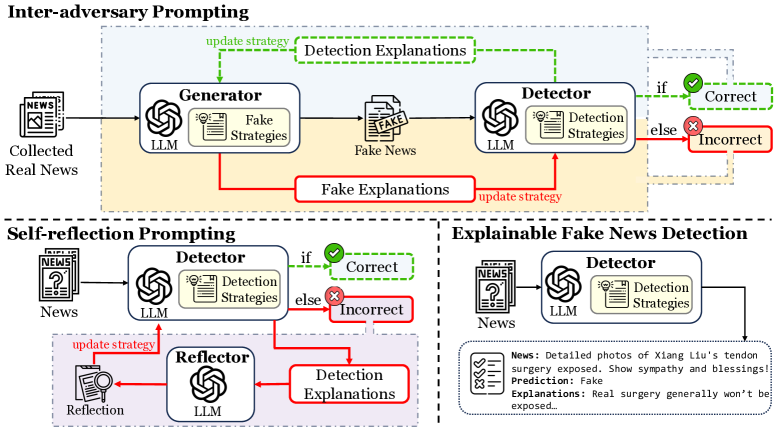
- 相互对抗提示:使用 LLM 作为生成器,基于真实新闻输入生成极具欺骗性的虚假新闻,迫使 LLM 检测器从对抗性样本中学习。
- 自我反思提示:使检测器能够通过语言化、基于证据的反思分析自身过往的预测与错误,实现无需人工干预的自主改进。
- 该框架在双循环对抗训练机制中集成两个 LLM——一个作为生成器(生成虚假新闻),一个作为检测器(判断真实性并生成解释)。
- 系统采用 few-shot 和思维链(Chain-of-Thought, CoT)提示技术,以增强检测器的推理与泛化能力,消融研究验证了其有效性。
- 消融研究证实,若移除自我反思提示,性能显著下降,证明其在错误修正与鲁棒性方面具有关键作用。
- 模型部署于云原生 AI 平台(阿里云),支持可扩展的按需推理,并通过 WebUI 为记者和专家提供访问支持。
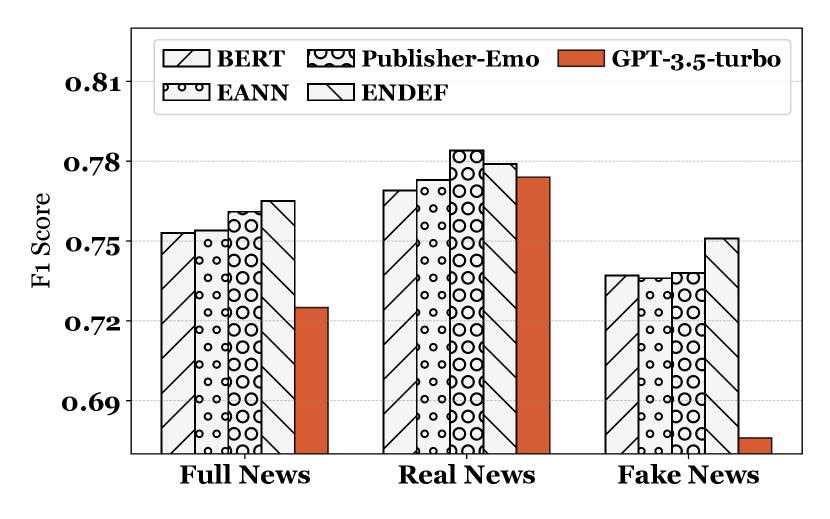
实验结果
研究问题
- RQ1LLM 能否被有效提示以在类似 GAN 的框架中同时充当生成器和检测器,用于虚假新闻检测?
- RQ2相互对抗提示——即使用 LLM 生成具有欺骗性的虚假新闻——在多大程度上提升了检测器识别细微虚假新闻模式的能力?
- RQ3自我反思提示在多大程度上可使 LLM 检测器实现无需人工标注的自主错误修正?
- RQ4可解释的推理集成是否能提升真实世界虚假新闻检测系统中的用户信任度与可用性?
- RQ5LLM-GAN 在准确率、公平性与解释质量方面,相较于现有深度学习与基于 LLM 的虚假检测方法表现如何?
主要发现
- LLM-GAN 在 GossipCop 数据集上达到 0.804 的宏 F1 分数,在 Weibo21 上达到 0.806,采用 few-shot CoT 提示,显著优于基线方法。
- 自我反思提示组件在被移除时显著导致性能下降,Weibo21 上宏 F1 从 0.804 降至 0.760,证明其在错误修正中的关键作用。
- 相互对抗提示显著提升了 F1-fake 分数,表明接触对抗性虚假新闻可增强对欺骗性内容的检测能力。
- LLM-GAN 在所有评估指标上均优于 GPT-3.5-turbo,包括相关性(5.7 vs. 4.1)、准确率(6.1 vs. 4.7)和上下文理解(6.0 vs. 5.8)。
- 消融研究证实,few-shot 提示结合 CoT 能取得最佳性能,尤其在 GossipCop 上表现突出;尽管 CoT 有时会降低性能,表明其对提示设计较为敏感。
- 集成至云原生 AI 平台后,系统支持动态扩展与实时推理,用户可同时获得预测结果与人类可读的解释,显著提升信任度与可用性。
阅读本论文
在 Nubint 阅读器中打开原文,边读边就任意段落提问。
在 Nubint 中阅读本论文本解读由 AI 根据论文原文生成,引用前请核对原文。