
[论文解读] Local Implicit Normalizing Flow for Arbitrary-Scale Image Super-Resolution
本文提出局部隐式归一化流(LINF),一种新颖的框架,将坐标条件归一化流与局部隐式神经表示相结合,实现任意尺度图像超分,生成逼真、高保真度的结果。通过建模在低分辨率输入、缩放因子和傅里叶特征条件下的局部纹理块分布,LINF 在任意缩放因子下均能生成细节丰富、感知真实的图像,且在感知质量和推理速度方面优于先前方法。
Flow-based methods have demonstrated promising results in addressing the ill-posed nature of super-resolution (SR) by learning the distribution of high-resolution (HR) images with the normalizing flow. However, these methods can only perform a predefined fixed-scale SR, limiting their potential in real-world applications. Meanwhile, arbitrary-scale SR has gained more attention and achieved great progress. Nonetheless, previous arbitrary-scale SR methods ignore the ill-posed problem and train the model with per-pixel L1 loss, leading to blurry SR outputs. In this work, we propose "Local Implicit Normalizing Flow" (LINF) as a unified solution to the above problems. LINF models the distribution of texture details under different scaling factors with normalizing flow. Thus, LINF can generate photo-realistic HR images with rich texture details in arbitrary scale factors. We evaluate LINF with extensive experiments and show that LINF achieves the state-of-the-art perceptual quality compared with prior arbitrary-scale SR methods.
研究动机与目标
- 通过将超分问题建模为分布问题而非确定性回归任务,解决其病态性质。
- 克服固定尺度超分模型无法在不修改架构的前提下泛化至任意缩放因子的局限。
- 通过采用基于流的生成方法替代逐像素 L1 损失,提升感知质量,以捕捉纹理细节分布。
- 通过基于补丁的、坐标条件的归一化流架构与傅里叶特征集成,实现在任意尺度超分中的高效推理。
- 通过控制归一化流中的采样温度,平衡保真度(PSNR)与感知质量(LPIPS),实现 PSNR 与 LPIPS 指标之间的权衡优化。
提出的方法
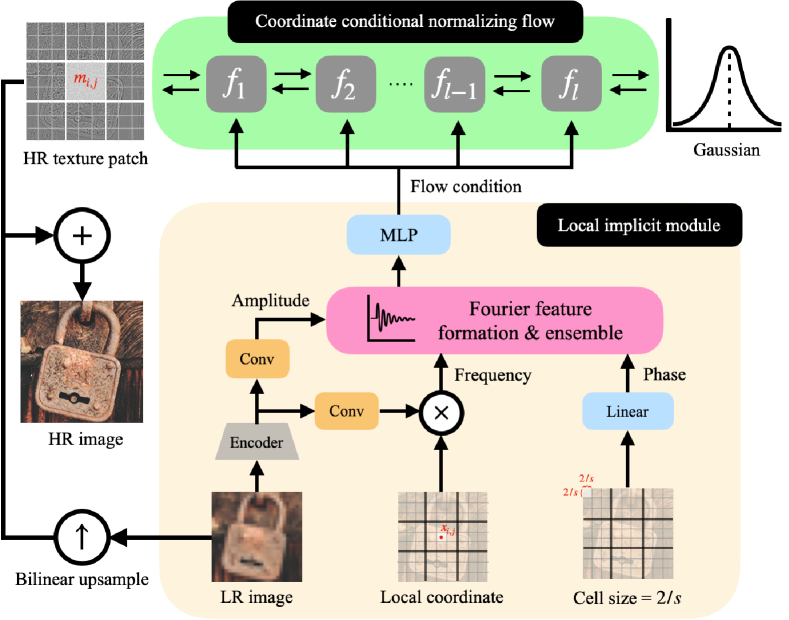
- LINF 将超分建模为使用坐标条件归一化流模型学习局部纹理块分布。
- 该流模型以低分辨率图像、每个局部补丁的中心坐标以及期望的缩放因子为条件。
- 局部隐式神经表示在每个补丁位置估计傅里叶特征,为流模型提供条件信号。
- 采用傅里叶特征集成以提升推理速度与性能,替代效率较低的局部集成机制。
- 模型采用基于补丁的方法(n×n 区域)以保持局部纹理一致性,并减少生成过程中的前向传播次数。
- 通过控制采样温度,平衡保真度(PSNR)与感知质量(LPIPS),实现权衡优化。

实验结果
研究问题
- RQ1归一化流能否在保持高感知质量的同时,有效适配任意尺度超分?
- RQ2与逐像素回归相比,建模局部纹理块分布如何提升图像细节恢复能力?
- RQ3局部隐式表示能否为归一化流提供足够的条件监督,以在任意尺度下生成多样且逼真的纹理?
- RQ4补丁大小对基于流的超分中纹理一致性和推理效率有何影响?
- RQ5归一化流中温度控制的采样如何影响任意尺度超分中 PSNR 与 LPIPS 之间的权衡?
主要发现
- LINF 在 DIV2K 验证集上达到最先进感知质量,τ=0.6 时 LPIPS 为 0.158,显著优于先前方法。
- 与局部集成基线相比,模型将推理时间减少约 33%,在 TITAN X 上每张图像推理时间为 1.44 秒。
- 傅里叶特征集成机制使推理速度比自回归模型快 27.2 倍,比基于流的基线快 2.6 倍。
- 基于补丁的模型(n>1)相比基于像素的模型(n=1)产生更具感知一致性的结果,避免了随机采样中的局部不一致性问题。
- 在 τ=0 时,基于像素的模型 PSNR 较高(28.85),但感知质量较低(LPIPS 0.273);而基于补丁的模型在 τ=0.6 时 LPIPS 更优(0.158),视觉质量更佳。
- 在傅里叶特征集成中移除振幅缩放会导致性能轻微下降(LPIPS 0.271 vs. 0.270),验证了加权振幅缩放的重要性。
阅读本论文
在 Nubint 阅读器中打开原文,边读边就任意段落提问。
在 Nubint 中阅读本论文本解读由 AI 根据论文原文生成,引用前请核对原文。