
[论文解读] Log Probabilities Are a Reliable Estimate of Semantic Plausibility in Base and Instruction-Tuned Language Models
本文研究基础模型与指令微调大语言模型(LLMs)中的语义合理性估计,表明对数似然(LL)得分比零样本提示更可靠地反映句子合理性的指标。尽管指令微调提升了与用户的对齐性,但通常会降低基于LL的合理性表现,而LL得分仍与人类判断高度一致,尤其是在上下文敏感的情境中。
Semantic plausibility (e.g. knowing that "the actor won the award" is more likely than "the actor won the battle") serves as an effective proxy for general world knowledge. Language models (LMs) capture vast amounts of world knowledge by learning distributional patterns in text, accessible via log probabilities (LogProbs) they assign to plausible vs. implausible outputs. The new generation of instruction-tuned LMs can now also provide explicit estimates of plausibility via prompting. Here, we evaluate the effectiveness of LogProbs and basic prompting to measure semantic plausibility, both in single-sentence minimal pairs (Experiment 1) and short context-dependent scenarios (Experiment 2). We find that (i) in both base and instruction-tuned LMs, LogProbs offers a more reliable measure of semantic plausibility than direct zero-shot prompting, which yields inconsistent and often poor results; (ii) instruction-tuning generally does not alter the sensitivity of LogProbs to semantic plausibility (although sometimes decreases it); (iii) across models, context mostly modulates LogProbs in expected ways, as measured by three novel metrics of context-sensitive plausibility and their match to explicit human plausibility judgments. We conclude that, even in the era of prompt-based evaluations, LogProbs constitute a useful metric of semantic plausibility, both in base and instruction-tuned LMs.
研究动机与目标
- 评估对数似然(LL)得分与零样本提示在大语言模型中估计语义合理性的优劣。
- 比较基础模型与指令微调模型在通过LL得分与提示方法估计合理性的能力差异。
- 通过显式提示与隐式LL估计,评估上下文对大语言模型合理性判断的影响。
- 确定LL得分是否能可靠地模拟人类对上下文合理性的敏感性。
提出的方法
- 本研究在英文数据集上开展句子合理性任务,比较多种架构的基础模型与指令微调模型。
- LL得分直接从模型概率计算得出,无需提示,作为合理性的隐式度量。
- 零样本提示用作查询模型关于句子合理性的显式方法。
- 通过向模型暴露完整的句子-上下文对,评估上下文合理性,测量目标词上的LL与提示性能。
- 人类合理性判断用作比较模型输出的黄金标准。
- 统计分析评估模型输出与人类判断之间的相关性,包括上下文敏感的模式。
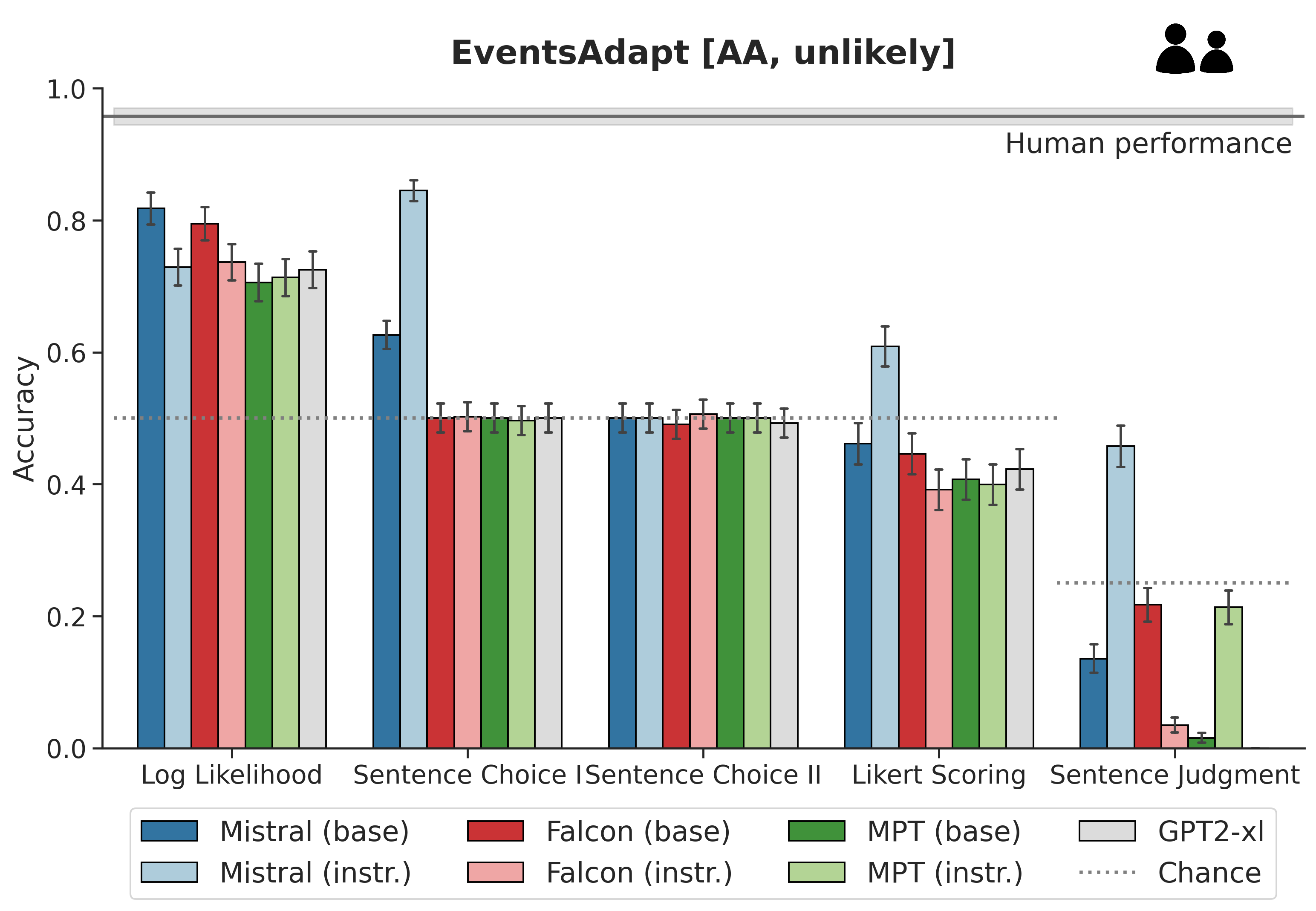
实验结果
研究问题
- RQ1在基础模型与指令微调大语言模型中,对数似然得分是否比零样本提示更可靠地估计语义合理性?
- RQ2指令微调如何影响大语言模型的对数似然得分与人类合理性判断之间的对齐性?
- RQ3LL得分能否有效建模上下文敏感的合理性,例如话语中的许可效应?
- RQ4大语言模型的句子级LL得分在多大程度上反映了人类对上下文语义异常的敏感性?
- RQ5与直接的LL估计相比,提示方法是否系统性地低估了模型的内部知识?
主要发现
- 对数似然(LL)得分在各种模型架构与数据集上均为句子合理性的最可靠指标,优于零样本提示。
- 指令微调模型在合理性任务上的基于LL的表现劣于其基础模型,表明隐式知识表征的退化。
- LL得分在三种上下文敏感合理性的度量上表现优异,并在上下文化情境中与人类判断高度一致。
- 尽管在上下文敏感任务中对齐性较强,句子级LL得分通常无法有效区分语义异常句子与语境许可句子,原因在于事后的似然重平衡。
- 提示结果虽在某些情况下与人类模式定性匹配,但其可靠性低于LL得分,尤其是在模型无法访问内部概率时。
- LL估计仍是评估大语言模型隐式世界知识的稳健、零样本方法,即使提示无法捕捉模型知识的完整范围。
阅读本论文
在 Nubint 阅读器中打开原文,边读边就任意段落提问。
在 Nubint 中阅读本论文本解读由 AI 根据论文原文生成,引用前请核对原文。