
[论文解读] Long-term predictions of turbulence by implicit U-Net enhanced Fourier neural operator
该论文提出 IU-FNO,一种隐式U-Net增强的傅里叶神经算子,以实现对LES中3D湍流的稳定、准确与快速长时预测,在多项统计指标上优于原生 FNO、IFNO、U-FNO 以及 DSM。
Long-term predictions of nonlinear dynamics of three-dimensional (3D) turbulence are very challenging for machine learning approaches. In this paper, we propose an implicit U-Net enhanced Fourier neural operator (IU-FNO) for stable and efficient predictions on the long-term large-scale dynamics of turbulence. The IU-FNO model employs implicit recurrent Fourier layers for deeper network extension and incorporates the U-net network for the accurate prediction on small-scale flow structures. The model is systematically tested in large-eddy simulations of three types of 3D turbulence, including forced homogeneous isotropic turbulence (HIT), temporally evolving turbulent mixing layer, and decaying homogeneous isotropic turbulence. The numerical simulations demonstrate that the IU-FNO model is more accurate than other FNO-based models including vanilla FNO, implicit FNO (IFNO) and U-Net enhanced FNO (U-FNO), and dynamic Smagorinsky model (DSM) in predicting a variety of statistics including the velocity spectrum, probability density functions (PDFs) of vorticity and velocity increments, and instantaneous spatial structures of flow field. Moreover, IU-FNO improves long-term stable predictions, which has not been achieved by the previous versions of FNO. Besides, the proposed model is much faster than traditional LES with DSM model, and can be well generalized to the situations of higher Taylor-Reynolds numbers and unseen flow regime of decaying turbulence.
研究动机与目标
- 在3D流动中的长期非线性湍流预测挑战及现有机器学习方法的局限性方面提供动机。
- 开发一种代理模型(IU-FNO),将隐式傅里叶层与U-Net结合,以捕获大尺度与小尺度结构。
- 证明在多种湍流状态下,长时预测的精度和稳定性优于其他方法。
- 显示 IU-FNO 的速度快于基于 DSM 的 LES,并且能够推广到更高雷诺数和未见流态。
提出的方法
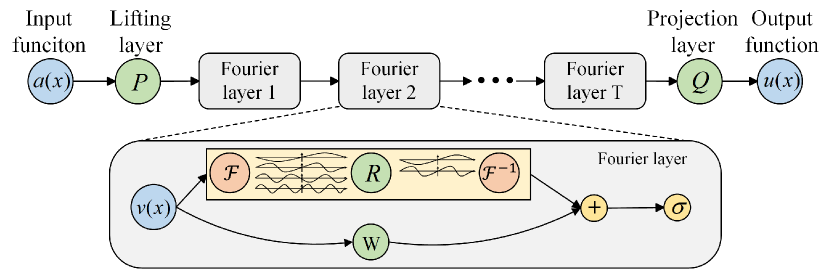
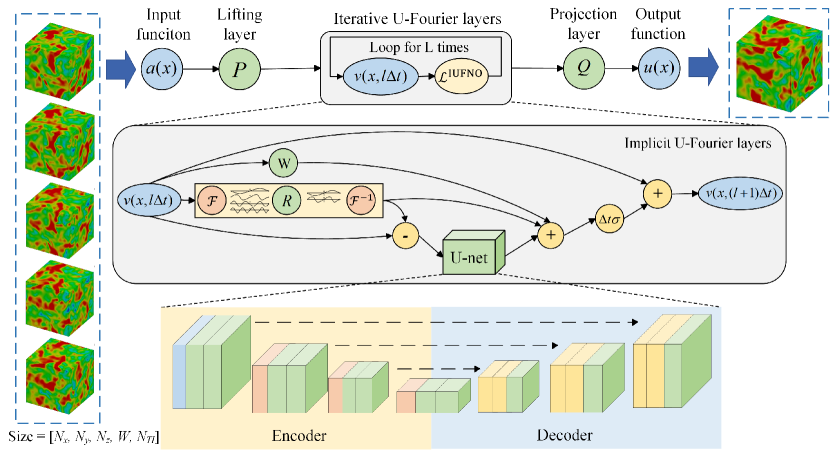
- 通过将一个隐式傅里叶层与U-Net结合来预测相邻时间步之间的速度增量来引入IU-FNO。
- 使用共享隐藏层,使深度网络在固定参数数量下实现,从而实现长时积分。
- 通过对全场与大尺度FFT重构之间的差值应用U-Net来计算小尺度修正。
- 在强迫 HIT 的 fDNS 派生数据上进行训练,并在多个湍流流态上对比 DSM 及其他 FNO 变体进行后验评估。
- 使用速度谱、涡度与速度增量的PDF、结构函数以及瞬时流结构等指标来比较性能。
实验结果
研究问题
- RQ1IU-FNO 是否能够在 LES 的3D湍流长期预测中超越原生 FNO、IFNO、U-FNO 的能力,实现稳定性?
- RQ2隐式共享层结构是否在维持或提升深度FNO模型精度的同时降低参数量?
- RQ3在不同湍流状态(强迫 HIT、混合层、衰减 HIT)下,IU-FNO 在光谱、统计与结构等指标方面的表现如何?
- RQ4在更高的 Reλ 或未见 regime 下,IU-FNO 是否比传统 DSM 基于LES及其他 ML代理模型更快且具有更好的泛化能力?
主要发现
- IU-FNO 在强迫 HIT 中可在 t/τ ≤ 50 的短期和长期预测中获得准确的速度谱,在 t/τ ≥ 100 仍然保持稳定。
- 将U-Net引入学习小尺度结构,提升训练与测试损失相比基线FNO与U-FNO,IU-FNO 在 L=40 时达到最小测试损失(0.155)。
- 隐式共享层模型(IFNO 与 IU-FNO)在深度增加时减少参数量且维持性能,与标准 FNO/U-FNO 不同。
- IU-FNO 在时间上的二阶与四阶结构函数保持准确性,而在某些状态下 DSM 会发散。
- 在时间推进中,IU-FNO 的速度增量PDF 接近 fDNS,且在后期时间优于 IFNO 与 U-FNO。
- 总体而言,IU-FNO 在无压强的湍流统计与瞬时流结构方面超越 DSM、DMM、VGM 及先前的 FNO 变体,并相对于传统 LES 提供了显著的计算加速。
阅读本论文
在 Nubint 阅读器中打开原文,边读边就任意段落提问。
在 Nubint 中阅读本论文本解读由 AI 根据论文原文生成,引用前请核对原文。