
[论文解读] Long-Term Rhythmic Video Soundtracker
LORIS 是一种新颖的潜在条件扩散模型,通过整合视觉、运动和时间上下文(利用霍克斯过程和双向LSTM编码器),从节奏性视频中生成长期、节奏同步的音乐波形。该模型在新建立的基准上实现了最先进性能,该基准包含86.43小时的多样化视频-音乐数据,涵盖舞蹈和体育场景。
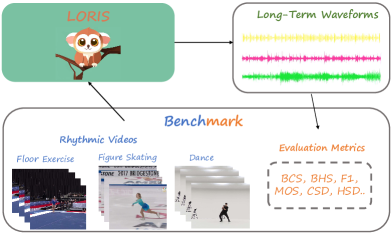
We consider the problem of generating musical soundtracks in sync with rhythmic visual cues. Most existing works rely on pre-defined music representations, leading to the incompetence of generative flexibility and complexity. Other methods directly generating video-conditioned waveforms suffer from limited scenarios, short lengths, and unstable generation quality. To this end, we present Long-Term Rhythmic Video Soundtracker (LORIS), a novel framework to synthesize long-term conditional waveforms. Specifically, our framework consists of a latent conditional diffusion probabilistic model to perform waveform synthesis. Furthermore, a series of context-aware conditioning encoders are proposed to take temporal information into consideration for a long-term generation. Notably, we extend our model's applicability from dances to multiple sports scenarios such as floor exercise and figure skating. To perform comprehensive evaluations, we establish a benchmark for rhythmic video soundtracks including the pre-processed dataset, improved evaluation metrics, and robust generative baselines. Extensive experiments show that our model generates long-term soundtracks with state-of-the-art musical quality and rhythmic correspondence. Codes are available at \url{https://github.com/OpenGVLab/LORIS}.
研究动机与目标
- 解决缺乏长期、高保真、视频条件化音乐生成且具备丰富音频表现力的问题。
- 克服先前方法依赖符号化音乐表示(如MIDI)或短时、低质量波形生成的局限性。
- 实现从舞蹈之外的复杂节奏性体育项目(如地板操和花样滑冰)的泛化能力。
- 建立一个全面的基准,包含大规模配对的视频-音乐数据、改进的评估指标以及强大的生成基线,以支持未来研究。
提出的方法
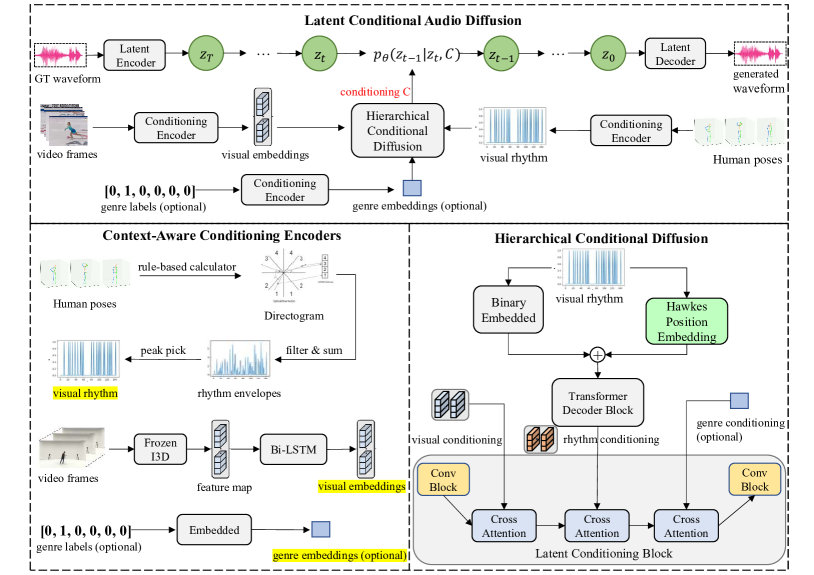
- 提出一种潜在条件扩散模型(LDM),将音频波形压缩至潜在空间,实现高效且高保真的生成。
- 通过交叉注意力机制整合多种条件输入——RGB视频特征、2D姿态运动序列以及提取的视觉节奏特征。
- 利用对RGB嵌入的双向LSTM和对视觉节奏事件的霍克斯过程建模时间上下文,以捕捉长程依赖关系。
- 对视觉节奏嵌入应用位置编码,以保留时间顺序,提升与音频峰值的对齐效果。
- 通过交叉注意力机制将视觉节奏包络注入潜在音频特征,而非简单的逐元素乘法。
- 在潜在空间上使用离散T步噪声调度,通过去噪目标端到端训练模型。
实验结果
研究问题
- RQ1潜在扩散模型能否有效生成基于节奏性视觉视频的长期、高质量波形?
- RQ2上下文感知的时间建模组件(如霍克斯过程、双向LSTM)在提升节奏对齐和生成稳定性方面有何作用?
- RQ3该模型在舞蹈之外的多样化节奏性活动中(如地板操和花样滑冰)的泛化能力如何?
- RQ4改进的评估指标是否能比现有短时长度指标更有效地捕捉长期音乐质量和节奏对应关系?
- RQ5视觉、运动和节奏特征对模型在音视频对齐性能中的相对贡献如何?
主要发现
- LORIS 在 LORIS FE25 子集上取得 62.7 的最高 F1 分数,显著优于消融模型和基线模型,在音乐质量和节奏对应方面均表现更优。
- 消融实验表明,移除双向LSTM层会使覆盖率降低 5.6 个百分点,证明了对视觉特征进行时间建模的必要性。
- 霍克斯过程与节奏嵌入的位置编码显著提升节奏对齐效果,相比简单乘法(rhymul)提升 4.1 F1 分数。
- 采用视觉节奏条件化的 LORIS 表现优于仅使用RGB或运动特征的模型,证实了节奏感知条件化的重要性。
- 定性结果表明,即使真实节奏存在错配,视觉节奏峰值与音频峰值之间仍能实现精确对齐,表明模型具备稳健的音视频对应学习能力。
- 由于扩散模型的随机采样特性,模型生成多样化且非重复的输出,同时在长序列中保持一致的节奏结构。
阅读本论文
在 Nubint 阅读器中打开原文,边读边就任意段落提问。
在 Nubint 中阅读本论文本解读由 AI 根据论文原文生成,引用前请核对原文。