
[论文解读] Lorentz-Equivariant Geometric Algebra Transformers for High-Energy Physics
介绍 L-GATr,一种面向高能物理的洛伦兹等变几何代数 Transformer,并通过用 Riemannian flow matching 训练的连续正则化流展示回归、分类和洛伦兹等变生成建模。
Extracting scientific understanding from particle-physics experiments requires solving diverse learning problems with high precision and good data efficiency. We propose the Lorentz Geometric Algebra Transformer (L-GATr), a new multi-purpose architecture for high-energy physics. L-GATr represents high-energy data in a geometric algebra over four-dimensional space-time and is equivariant under Lorentz transformations, the symmetry group of relativistic kinematics. At the same time, the architecture is a Transformer, which makes it versatile and scalable to large systems. L-GATr is first demonstrated on regression and classification tasks from particle physics. We then construct the first Lorentz-equivariant generative model: a continuous normalizing flow based on an L-GATr network, trained with Riemannian flow matching. Across our experiments, L-GATr is on par with or outperforms strong domain-specific baselines.
研究动机与目标
- 利用洛伦兹对称性设计一个数据高效、多功能的高能物理任务架构。
- 将粒子数据表示为四维几何代数,以实现自然的洛伦兹变换。
- 开发洛伦兹等变层和可扩展到大粒子系统的 Transformer 架构。
- 在一个统一框架内演示多样化任务(回归、分类和生成建模)。
- 证明所提出的模型在各任务中优于或达到强基线的水平。
提出的方法
- 将输入表示为几何代数 G_{1,3} 的标记,粒子类型标量和四动量位于第一等级。
- 在 G_{1,3} 通道之间构造洛伦兹等变线性映射,带有受限参数形式。
- 实现洛伦兹等变非线性层,包括缩放点积注意力、洛伦兹等变 LayerNorm,以及标量门控的 GELU 非线性。
- 将这些层整合到具有多头注意力和 MLP 块的 Transformer 架构中。
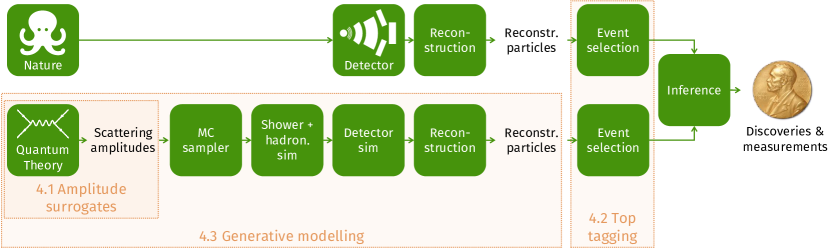
- 开发一个洛伦兹等变的连续正则化流用于生成建模,通过 Riemannian flow matching 训练以处理相空间边界。
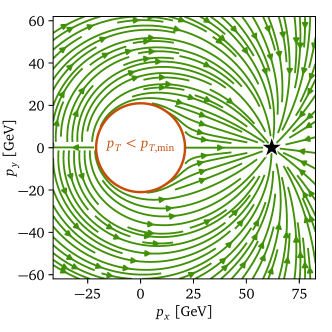
- 用物理上有意义的坐标对动量空间约束进行参数化,并在动量流形上使用测地线引导流动路径。
实验结果
研究问题
- RQ1相比非等变基线,洛伦兹等变几何代数表示是否能提高粒子物理任务的准确性和数据效率?
- RQ2强制洛伦兹对称性如何影响高能物理问题中的回归、分类和生成建模性能?
- RQ3洛伦兹等变的连续正则化流是否能为重构粒子数据生成高保真且考虑相空间边界的生成样本?
- RQ4在密集高多粒子数据上使用洛伦兹等变 Transformer 时,计算和可扩展性有哪些权衡?
主要发现
- L-GATr 在回归、分类(top tagging)以及生成建模任务上实现了与强基线相竞争或更优的性能。
- The Lorentz-equivariant generative model using Riemannian flow matching effectively respects phase-space boundaries and improves sample quality and likelihoods across jet multiplicities.
- L-GATr maintains data efficiency, performing well with varying dataset sizes due to its strong inductive biases and Transformer scalability.
- The approach scales comparably to standard Transformers in terms of attention-based computations and is more efficient than many Lorentz-equivariant message-passing architectures for dense graphs.
- Geodesic-based probability paths in RFM help preserve physical constraints and enhance learning of high-dimensional particle distributions.
- The combination of Lorentz-equivariant representations with Transformer-style attention provides a versatile, general-purpose tool for multiple stages of the LHC analysis pipeline.
阅读本论文
在 Nubint 阅读器中打开原文,边读边就任意段落提问。
在 Nubint 中阅读本论文本解读由 AI 根据论文原文生成,引用前请核对原文。